Former top civil servant tells MPs he was not consulted a...
Andrew Sparr·2026-04-28·via The Guardian
From
Barton says he was not consulted about Mandelson appointment - but suggests he should have been
Q: Where you ever asked your view about appointing Peter Mandelson?
Barton says he was first told about this on 15 December 2024.
He was not told this was being planned. He was not told a decision was coming.
Q: Should you have been?
Barton says the head of the Foreign Office would expect to be told.
But, given it was a political appointment, he can see why he was not involved.
He says he is “a bit conflicted” on whether or not he should have been consulted.
He says he thinks this would have been decided by a small circle of political advisers.
He goes on:
In the end, this is an appointment to the most senior job in our foreign service. I was head of the diplomatic service. So I think it is possible, without asking me as a civil servant, I think it is possible [a civil servant] to be involved in a conversation, for example, around what is what are the requirements, what does the UK need in the period ahead and that sort of thing – even if that you’re not then involved in the absolute decision making discussions around individuals who are politicians because it’s a political appointment.
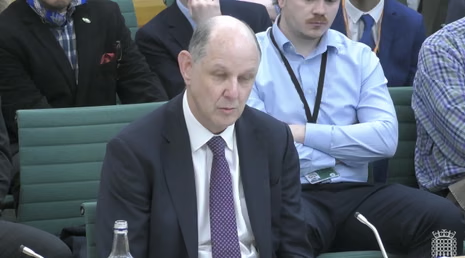
Philip Barton at the foreign affairs committee Photograph: Commons TV
Barton says he thought Mandelson's links to Epstein would make his appointment as ambassador difficult
Q: If you had been consulted, would you have raised concerns about Mandelson?
Barton suggests he would have raised concerns.
At no point did anyone consult me, ask me. I was presented with a decision … and told to get on with it.
He says he had been deputy ambassador to the US, and knew the US well.
But he says he had concerns that Mandelson’s links with Jeffrey Epstein could be a problem.
Epstein, through both the presidential election campaign in the US and more generally in US politics, was a controversial figure. And I was worried that [Mandelson’s links to Epstein] could become a problem in future – not because I was expecting that we were going to find outmore, because to be honest I wasn’t.
I just thought that it was a potentially difficult issue politically in the United States.
Barton says he does not think his reservations about Mandelson contributed to his being asked to leave early
Q: Do you think your concerns about Mandelson had any influence on David Lammy asking you to leave early?
No, says Barton.
He says he told the department he was leaving on 4 November. The Mandelson decision was not announced until a month later, he says.
Barton says he was told Cabinet Office initially suggested Mandelson would not need security vetting
John Whittingdale (Con) is asking the questions.
Q: Did you ask if developed vetting (DV) had taken place when you heard about the appointment?
Barton says it was clear it had not taken place. Due diligence (a different process, led by the Cabinet Office) had taken place.
Barton says initially he was told the Cabinet Office that that Mandelson did not need developed vetting.
He was surprised by that. He says he knew that, to the ambassador’s job, you had to have access to the deepest secrets.
But, after conversations with the Cabinet Office, it was agreed that developed vetting was needed.
Q: Was it definitely the Cabinet Office who initially said that DV was not needed? We have also heard the Foreign Office first suggested that.
Barton says he was told the Cabinet Office suggested that Mandelson did not need DV.
But he says he does not want to give the impression the centre was trying to block DV. By the end of the week everyone had agreed DV was needed.
The final decision is what matters, he says.
(Olly Robbins told the Commons last week that it was the Cabinet Office that first suggested DV was not needed. But later Darren Jones, and then Keir Starmer, said that it was the other way round, and that it was the Foreign Office that initially suggesed DV might not be needed because Mandelson was already a peer and a privy counsellor.)
Barton says he was not consulted about Mandelson appointment - but suggests he should have been
Q: Where you ever asked your view about appointing Peter Mandelson?
Barton says he was first told about this on 15 December 2024.
He was not told this was being planned. He was not told a decision was coming.
Q: Should you have been?
Barton says the head of the Foreign Office would expect to be told.
But, given it was a political appointment, he can see why he was not involved.
He says he is “a bit conflicted” on whether or not he should have been consulted.
He says he thinks this would have been decided by a small circle of political advisers.
He goes on:
In the end, this is an appointment to the most senior job in our foreign service. I was head of the diplomatic service. So I think it is possible, without asking me as a civil servant, I think it is possible [a civil servant] to be involved in a conversation, for example, around what is what are the requirements, what does the UK need in the period ahead and that sort of thing – even if that you’re not then involved in the absolute decision making discussions around individuals who are politicians because it’s a political appointment.
Philip Barton at the foreign affairs committee Photograph: Commons TV
Barton says, when the Tories were in office, the Foreign Office started the process to find a replacement for Karen Pierce, the outgoing ambassador. He says a potential candidate was identified.
But that process was put on hold when the election was called.
Former Foreign Office chief Philip Barton tells MPs leaving office 8 months early wasn't his choice
Philip Barton, the former permanent secretary at the Foreign Office, is starting his evidence to the Commons foreign affairs committee.
Emily Thornberry, the chair, welcomes him. She says he has given evidence to the committee many times before. But once he retired he did not expect to come back, she suggests.
Barton jokes about how it is “nice to be back” – before saying he does not want to be accused of misleaing the committee.
Q: Why did you leave office eight months early?
Barton says it was not his choice. He says David Lammy, the foreign secretary, wanted a new person in place to drive through transformation.
Top Foreign Office official ‘felt pressure’ for ‘rapid outcome’ on Mandelson vetting
Last night the foreign affairs committee published a long memo from the Foreign Office giving answers to questions it had for Ian Collard, who was head of security at the Foreign Office at the time of the Mandelson appointment. Collard was the person who briefed Olly Robbins on the outcome of the Mandelson vetting interviews and who recommended that vetting should be approved, because the risks highlighted in the vetting interviews could be managed.
Here is Henry Dyer’s story about the document.
Keir Starmer to face vote on Mandelson vetting scandal as key figures give evidence to MPs
Good morning. The former US president Lyndon Johnson is credited with saying the most important skill in politics is knowing how to count, meaning that ultimately what matters is being able to win a vote. But sometimes in politics what matters just as much, or even more, is the ability to win the argument. Today Keir Starmer will be tested on both these measures.
Winning the vote should be easy. Here is our overnight preview story by Pippa Crerar on the events setting up today’s vote on a motion tabled by Kemi Badenoch, as well as MPs from five other opposition parties (the Lib Dems, the SNP, the DUP, Restore Britain, TUV) and a string of independents, referring Starmer to the privileges committee.
Labour MPs are on a three-line whip to vote against the motion, and the government should win easily. “We’ll vote it down,” Jonathan Reynolds, the chief whip, told Sky News last night.
Badenoch, who will be opening the debate, is hoping to persuade MPs, and the public, that Starmer lied to the Commons over the appointment of Peter Mandelson as ambassador to the US, just as Boris Johnson lied to MPs about Partygate. That will be quite a challenge; the case for Starmer deliberately misleading MPs is flimsy, and the comparison to Johnson is wide of the mark. Labour is saying the vote today is just a stunt ahead of next week’s local elections. On the Today programme this morning Alex Burghart, the shadow Cabinet Office minister, dismissed this claim, saying: “There aren’t any political games going on here.” He is lucky MPs can’t get referred to the privileges committee for lying to Radio 4.
But the Mandelson affair isn’t really about whether Starmer misled MPs. In the view of the public, and most MPs, the real problem is that Starmer appointed Mandelson in the first place. Then, two weeks ago, Starmer compounded the problem by sacking Olly Robbins as permanent secretary to the Foreign Office after the Guardian revealed that Robbins approved Mandelson’s security vetting clearance even though the UK Security Vetting team who interviewed Mandelson originally recommended that vetting should be denied. Robbins did not know that at the time, and the decision to sack him is now widely seen as grossly unfair.
This morning, before the Commons debate starts, the Commons foreign affairs committee will hear from two witnesses who will give evidence who will probably reveal a lot more about how Mandelson came to be appointed in the first place. They are Philip Barton, the former permanent secretary at the Foreign Office, and Morgan McSweeney, Starmer’s former chief of staff. McSweeney’s evidence should be the most interesting, because he was instrumental in helping Starmer become Labour leader, and then prime minister, and he has never questioned at length in public in this sort of way before. While Starmer is almost certain to win the Commons vote, the committee evidence may have a more significant impact on how he is viewed by his MPs.
Here is the agenda for the day.
9am: Philip Barton, the former permanent secretary at the Foreign Office, gives evidence to the Commons foreign affairs committee.
Morning: Keir Starmer chairs cabinet.
11am: Morgan McSweeney, Keir Starmer’s former chief of staff, gives evidence to the foreign affairs committee.
Noon: Downing Street holds a lobby briefing.
After 12.40pm:Kemi Badenoch, the Conservative leader, opens the debate on referring Keir Starmer to the privileges committee. MPs will vote at 7pm.
Afternoon: Starmer chairs a meeting of the government’s Middle East response committee
After 3pm: Peers vote on Commons amendments to the childrens’ wellbeing and schools bill.
If you want to contact me, please post a message below the line when comments are open (between 10am and 3pm), or message me on social media. I can’t read all the messages BTL, but if you put “Andrew” in a message aimed at me, I am more likely to see it because I search for posts containing that word.
If you want to flag something up urgently, it is best to use social media. You can reach me on Bluesky at @andrewsparrowgdn.bsky.social. The Guardian has given up posting from its official accounts on X, but individual Guardian journalists are there, I still have my account, and if you message me there at @AndrewSparrow, I will see it and respond if necessary.
I find it very helpful when readers point out mistakes, even minor typos. No error is too small to correct. And I find your questions very interesting too. I can’t promise to reply to them all, but I will try to reply to as many as I can, either BTL or sometimes in the blog.