








There’s a new war in the Pacific brewing, with the Super Rugby side Moana Pasifika collapsing and rugby league on a new signing spree in union’s traditional heartlands.
The conflict spells trouble for Rugby Australia (RA), whose federal government is funding a $600m NRL franchise in Papua New Guinea, $240m of which will go into poaching talent and creating pathways throughout Fiji, Tonga, Samoa and the Cook Islands.
For more than a century, since British soldiers introduced it to further the Empire, rugby union has been the national sport of all four Pacific countries. Fiji have led the way with two Olympic gold medals in sevens (2016 and 2020) and a 15s side are now neck-and-neck with Australia in the world rankings. Players with Pacific and Polynesian blood are now an invaluable part of almost every international side.
“Rugby sits at the heart of village life, tradition, and national pride in the Pacific,” RA’s CEO, Phil Waugh, told the Guardian. “It also has clear political links. Rugby networks intersect with leadership structures, communities and diaspora influence, shaping relationships well beyond the field. That combination of cultural depth and political connectivity enables engagement in ways formal diplomacy alone cannot achieve.”
But, according to RA insiders, the NRL has been given a war-chest which it will use to “kill rugby in the Pacific” by siphoning off the best rugby players to league.
The plan has provoked fierce debate in Australia’s corridors of power, with one political leader saying it has “colonial intonations” and the former Wallaby captain David Pocock, now a senator, saying it “seems designed … to set up a talent pathway for league”.
Australia’s prime minister, Anthony Albanese, is a South Sydney Rabbitohs diehard and the NRL is a passion he shares with PNG’s PM James Marape. However, Albanese’s gift to the code’s 19th club, the PNG Chiefs – who will woo players with tax-free dollars and a $66m luxury living compound and access to a private island – is really soft-power politics to combat China’s fast-growing influence in the Pacific.
“Australia is no longer operating alone,” Dan Millis, RA’s head of Pacific partnerships, said. “China has become more active in rugby diplomacy. We’re seeing it through Beijing’s investment in sporting infrastructure and their partnerships with national rugby bodies. These aren’t symbolic gestures, they’re long-term, visible investments that reflect a broader strategic effort to build influence in the region.”
Unable to compete with the flood of Australian funding for NRL into their countries, the governments of Fiji, Samoa and Tonga are now signing sponsorship deals with China.
The Fiji team are getting around Suva in a new team bus emblazoned with two Pandas and the strapline “Love from the People of Guangzhou”, and two China women’s sides recently played in the 2025 Coral Island Sevens tournament.
Samoa, Tonga and the Cook Islands merged as Moana in 2022 to help fill the void when South Africa withdrew its four franchises – the Bulls, Lions, Sharks, and Stormers – to play in the northern hemisphere. World Rugby initially funded Moana to the tune of $7m-$10m a year until 2024, when Pasifika Medical Association became its majority owners.
But the PMA has now declared the franchise “unviable” and is winding it up. “Stand by your team today,” urged the club chair, Kiki Maoate, in his announcement last month. “Our story has been one of resilience – not just as a franchise, but as Pacific people. While this will be devastating news to process, we continue to look ahead and navigate these next steps together, just as our people always have.”
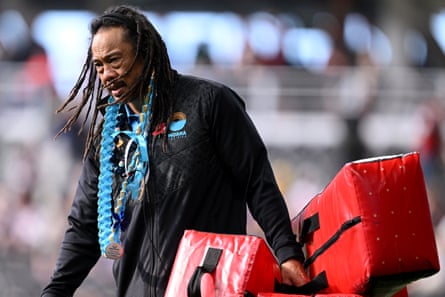
Those next steps may include fresh investment to save Moana, or finding a new Pacific side. Tana Umaga and the 55-Test All Black, Sir Michael Jones, are exploring interest from Kanaloa Rugby, a pro-rugby franchise from Hawaii. Meanwhile Rugby Australia has proposed the Veimoana Partnership in collaboration with the governments of Fiji, Samoa, and Tonga to develop a Super side via domestic competitions, and is currently seeking funding from Australia’s government.
Licence holders New Zealand Rugby will “remain supportive of Moana Pasifika’s vision to create pathways from the Pacific. There may be parties exploring financially viable and sustainable plans for the future of the team. NZR is open to engaging with those parties to discuss the club’s continued participation in Super Rugby Pacific.”
It won’t be easy. In their first three Super Rugby Pacific seasons, Moana Pasifika finished 12th, 12th and 11th. In 2025, with the All Blacks star Ardie Savea as captain and Umaga as coach, they improved to seventh. But this year, with Savea on a sabbatical in Japan and Umaga last month taking an assistant coach role with Dave Rennie’s new-look All Blacks, results have nosedived, with one win from 11 games.
Why has Moana failed and Fiji succeeded? “Because they play at home where every second person wears a Drua jersey and they’re crying out for more rugby,” says SRP’s CEO, Jack Mesley. Aside from one game each in Tonga, Samoa and Fiji across five years, Moana have played as wanderers in empty arenas across New Zealand, and their base city of Auckland is dominated by SRP rivals the Blues, and NRL’s NZ Warriors.
Compare that with Fiji. Since entering the competition alongside Moana in 2022, the Drua’s men’s and women’s teams have played home games in Suva and Lautoka before huge crowds at fortress arenas in an electric atmosphere. All games are broadcast live on more than 360,000 local devices and viewed by more than half the population. Drua tourism – advertising, merchandise, hospitality – last year injected $F108m ($68.5m AUD) into the Fiji economy.
Fiji has almost a million citizens and Papua New Guinea between 11 million and 17 million. Without global support, how can tiny rugby-loving nations such as Samoa (220,000) and Tonga (104,000) retain homegrown talent to empower their people (and the game) at future World Cups?
“The gap between where we are, internationally, to where we need to get to, is very big,” Umaga says. “Without Moana to bridge that gap, it’s going to be tough.”