








Pablo Picasso may be the artist most famously associated with the Spanish civil war, but as the rifles fired in revolutionary Catalonia, it was those on the frontlines who first captured the conflict. One of the most important was José Luis Rey Vila, whose sketches brought the rhythms of war to life in bold, blocky lines with splashes of intense colour.
Full of urgency and movement, many of his sketches document anarchist militias engaged in street battles; others depict more sanguine scenes after the fighting stopped. In charcoal and watercolours, Rey Vila produced arresting portraits of red-capped volunteers, nurses tending the wounded, and the women of the milicianas raising their fists on the move. His work travelled far at exhibits and in widely reproduced booklets, raising international awareness before Picasso’s cubist horrors relayed the destruction of Guernica to the world.
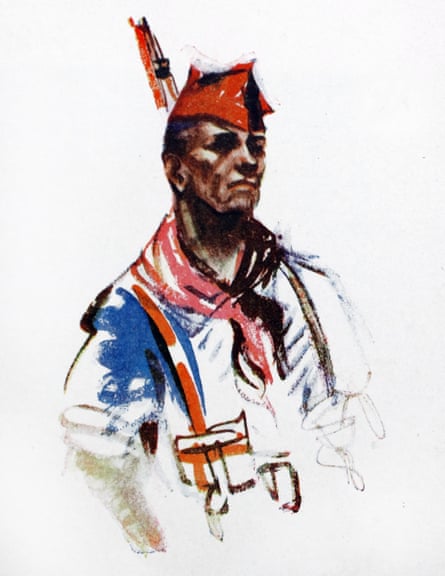
Yet after the war, Rey Vila, who signed his illustrations as Sim – named for his friend, the philosopher-mystic Simone Weil – fell into obscurity and, after his 1937 exile to Paris, died in 1983 in near-anonymity.
“He was very, very well known at the time of the war,” says Eduard Vallès, head of collections at Barcelona’s Museu Nacional d’art de Catalunya (MNAC)). “In the beginnings of the conflict, on its first days, he was there.” Now, on the 90th anniversary of the conflict, MNAC is showing 40 recently acquired Sim illustrations that tell the remarkable story of the anarchist draughtsman.
Born in the port city of Cádiz, Sim studied art in Gibraltar before being conscripted as a navy gunner in the disastrous Rif war in Morocco, the horrors of which moved him to become a pacifist. Sim settled in Barcelona but on 17 July 1936, just as his graphic design career was taking off, the nationalist general Francisco Franco staged his military coup from north Africa.
As Popular Front territories fell to Franco’s rebels, some collaborators expected an easy conquest of Barcelona. But on a tense hot night in the anarchist heartland before the nationalists revolted, citizens stormed armouries, stripped gunsmiths bare, and fixed machine guns to hastily armoured trucks in preparation for the attack.
Gunfire woke Rey Vila in the early hours of 19 July 1936. He grabbed his sketchbook and sped to the streets, where he witnessed the first fierce clashes between the fascists and the republic.
As workers blocked the cavalry with huge rolls of newsprint and hurled homemade explosives from rooftops, Rey Vila wove through Barcelona’s plazas and avenues, ducking into cover to sketch the barricades, the blood-spattered bandanas of volunteer militia, and vehicles emblazoned with the red-and-black flags of the anarcho-syndicalists.
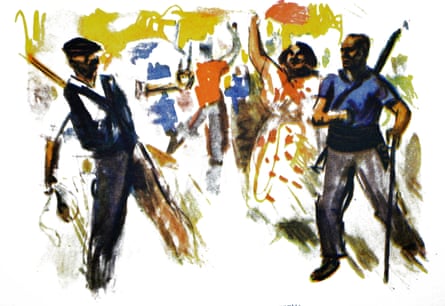
Surprising everyone, the Guardia Civil gendarmerie sided with the republic and by the end of the day the Francoist forces were largely routed, unleashing a wellspring of revolutionary triumph.
Sim immediately offered his sketches to the Sindicat de Dibuixos (SDP), the recently formed artists’ union, headquartered in a requisitioned palace and a centre for republican propaganda. Although the celebrated poster artist and SDP member Carles Fontserè found Sim inspirational – describing his work as “capturing the tragically festive atmosphere of that memorable day” – others rejected him on political grounds, disliking his anarchist sympathies and accusing him of being a fascist spy.
Instead, Sim went to the anarchist CNT-FAI (Confederación Nacional del Trabajo/Federación Anarquista Ibérica), whose propaganda office published his work in a book called Estampas de la Revolución Española 19 Julio de 1936. The next year, the government of Catalonia published 12 Escenas de Guerra.
Isolated due to the non-intervention pact of the European powers, it was only with enormous effort that anything, including art and propaganda, travelled in or out of Spain, says Morris Brodie, a historian at the University of Aberystwyth and author of Transatlantic Anarchism during the Spanish Civil War and Revolution, 1936-1939.
The France-Spain border was shut, so enterprising propagandists had to smuggle artwork through illicit channels. Complicating matters was the split between the anarchists and the communists, who fought one another. “If there was an anarchist militiaman at the border, they wouldn’t look too kindly on communist party stamps, and vice versa,” says Brodie.
But Sim’s work did make it abroad, and Estampas de la Revolución Española was seen in the US and Canada. The exhibits raised funds for essential goods, and urged citizens to campaign against the non-intervention pact. Copies appeared as far afield as China, reproduced by the Esperanto-speaking Chinese anarchist Ba Jin.
Shortly after the conflict began, the international press streamed into Spain. By the time Robert Capa snapped his famous Falling Soldier photo in September 1936, the propaganda war was in full swing.
In 1937, at the height of the chaos, Sim left for France to help with the Spanish pavilion at the Paris International Exposition, where Guernica was first shown outside Spain, along with art by Joan Miró, Alexander Calder and Julio González. The exhibit helped push international opinion in favour of the republic, but by then it was too late: the nationalists had the advantage and by 1939, they won the conflict, with Franco proceeding to rule over Spain for nearly four decades.
In exile, Sim drew distinctly Spanish scenes such as bullfights and Don Quixote, but he never returned to Spain – though, remarkably, much of the Paris Exposition artwork did, where for decades it was hidden from the Franco regime by staff at the MNAC.
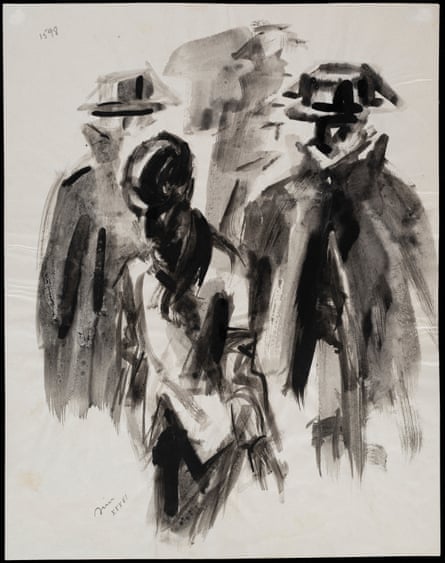
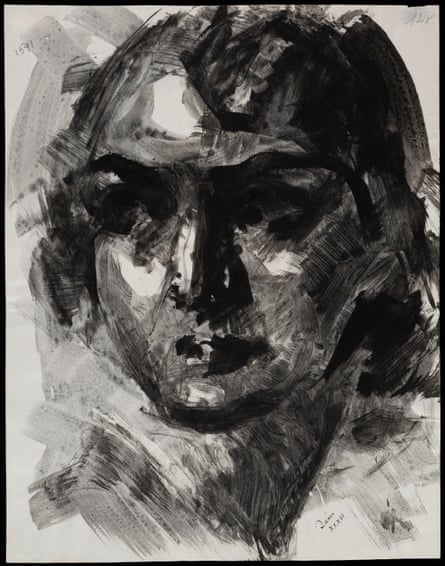
Rey Vila dropped his pseudonym but continued depicting the tumultuous politics of the times. He was wounded by a bomb while sketching the Nazi invasion of Paris, and portrayed the social upheavals of the city in May 1968. Although he exhibited in Paris and continued to work, his once celebrated civil war art faded from public consciousness, including in Spain, where it was only revived thanks to the efforts of his family, historians, the MNAC, and artists such as Carles Fontserè.
Decades after the conflict ended, the communists dominated the visual memory of the war, says Brodie, proud of their role in arranging the international brigades. But the result was that other perspectives, such as those of anarchists and Catalan nationalists, were blotted from the history books.
“A lot of artists painted the war later, when they were at home,” says Vallès. “Sim’s illustrations were made during the war. He wasn’t a fighter but ideologically, he was a soldier.”