





For years they operated as government mouthpieces, using their sprawling reach into homes across Hungary to bolster Viktor Orbán and vilify those he cast as enemies, from the philanthropist George Soros to Ukraine’s Volodymyr Zelenskyy.
But on Saturday, as Péter Magyar’s swearing-in officially ends Orbán’s 16 years in power, the country’s once powerful state media is facing the prospect of going dark.
“Everyone is afraid. How far will this purge go? And to what extent?” one state radio employee told the Guardian. “Nobody knows what’s going to happen,” said another.
It’s a hint of the broad transformation expected as Magyar and his Tisza party take power after winning a supermajority in elections last month. When it comes to the country’s media, it’s a particularly tough task – one likely to be watched around the world as other countries grapple with far-right movements intent on emulating Orbán.
Since taking power in 2010, Orbán and his Fidesz party reshaped the country’s media to promote themselves and demonise their opponents, sending press freedom rankings plunging and leaving swathes of the country living in an alternative reality.
“It might be very difficult to imagine from America or western Europe what the propaganda and the state machinery is like here,” Magyar told the Associated Press in July 2024. “This parallel reality is like the Truman Show. People believe that it’s reality.”
Soon after last month’s election, Magyar – who during the campaign was smeared by state media as a puppet of Brussels, an absentee father and a traitor – vowed to suspend state media coverage, describing it as a “factory of lies” whose coverage was akin to propaganda from North Korea and Nazi-era Germany.
He said his government would seek to pass a new press law and create a media authority that would allow state media to resume under better conditions and “to actually do what it is meant to do”.
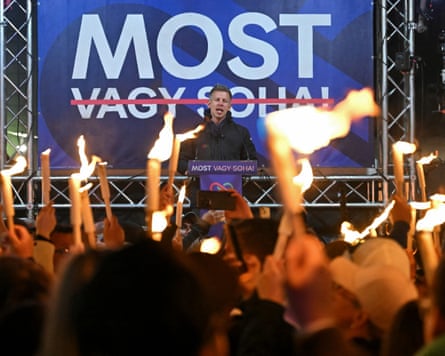
The result is an unparalleled opportunity for Hungary to reckon with the failures of its past, said Gábor Polyák, a professor of media law and policy at Eötvös Loránd University in Budapest. “This is our best chance in Hungary’s history.”
Under Orbán, media had developed into two parallel tracks: an estimated 80% was controlled by Fidesz loyalists, including state media and private outlets, whose loyalty was richly rewarded with state subsidies and advertising; opposite them was the independent media, who had long struggled to stay afloat as it fended off a steady stream of Fidesz-linked attacks, from smear campaigns to bureaucratic hurdles aimed at tying up their time and resources.
The strategy was spectacularly successful, Reporters Without Borders noted early this year. “Without imprisoning or killing a single journalist, press freedom predator Viktor Orbán has nearly wiped out Hungarian independent journalism,” said the director general, Thibaut Bruttin.
Despite this, the recent election underlined the independent media’s resilience as it continued, against all odds, to report accusations of corruption and cronyism that swirled around Fidesz. “In the last months, the independent journalists were the players who really destroyed the Orbán regime,” said Polyák.
He described it as a perfect storm. As Hungarians grappled with a soaring cost of living and fraying social services, many were more open to the kind of hard-hitting coverage that most independent journalists were doing.
As the journalists broke scandal after scandal – from the zebras imported by Orbán’s top brass to his government’s servile tone with Moscow – Magyar laced their reporting into his campaign as he visited 700 towns and villages over two years, bringing it to audiences that had seldom heard more than Fidesz-curated messaging on their local news.
Several of the Fidesz-linked private media companies are expected to survive the change of government, as they remain popular, said Polyák. “But in the end it will be a smaller empire,” he said. “And the question of whether they will continue to be loyal to Orbán also depends on his position. It’s not clear what will happen with Fidesz and what will happen with Orbán himself.”
But the election had laid bare a readiness for change in some quarters. Days after Magyar’s victory, more than 90 journalists from MTI, a state news agency that ranks as one of the world’s oldest, signed a letter calling for the restoration of “editorial autonomy”.
As Krisztina Balogh, who worked in state media from 2016 to 2018, put it: “Public media was not about informing – it was about constructing narratives.”
She had often watched as scripts were provided in advance for live coverage of state events, containing government-approved guides on what could and could not be said. “Editors were instructed to use specific keywords: migrant, Brussels, terrorism,” she said. “Reports were torn apart and rewritten again and again to fit the government’s narrative.”
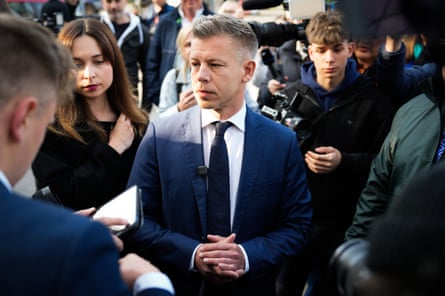
The goal was simple: to stoke fear, she said. “Instead of teaching people to think, they conditioned them to react with fear, hatred, suspicion. And millions believed they were watching real news.”
Among state media, emotions have been running high since Magyar’s landslide victory. “Honestly, what Magyar said was so vague. Shutting down state media. What does that mean?” said one employee of MTI, who asked not to be named. “But what I can see is that everyone, regardless of their political beliefs, is hoping we’ll have a normal, impartial news service.”
Many of those who work at state media had stayed on for years, weathering the government’s blatant interference because they felt they had few other options, said an employee of a state radio station.
Those who left often felt the brunt of Fidesz’s wide reach, she added. “They went after you to make sure you couldn’t find a job. They completely crushed people.”
The years of propaganda meant Hungary was now facing a gargantuan task, one that went beyond simply restoring press freedoms, said Balogh, the former state media employee. “What remains is unprocessed trauma: a system of lies, constant manipulation, and fear-based communication that has left deep scars.”
For the wider world, it was a cautionary tale of what remains after the media are hijacked for political purposes. “Recovery will require time and deliberate societal effort; media literacy, critical thinking and the ability to distinguish between information and propaganda,” Balogh said. “The key question is not only what kind of media system will emerge but whether there will be a genuine societal demand for the truth.”