


Starring in more than 70 movies is all well and good, but Juliette Binoche can still get the jitters. Right now, the Oscar-winning actor is biting her lip on the third floor of a Manhattan high-rise. In 20 minutes, she will step into a sold-out movie theater to introduce her directorial debut at New York’s Museum of Modern Art. Titled In-I In Motion, the vérité-style documentary follows Binoche’s late-2000s plunge into the world of contemporary dance for a series of daring and bewitchingly strange performances with the British dancer Akram Khan. “So,” she asks me, “how do you think I should present it?”
Which is how I find myself giving advice about public speaking to arguably the most celebrated French actor working today. She did a great job last night introducing the film at the buzzy Metrograph cinema downtown, I say. But it’s tough to know how to prepare an audience for the film’s poetic (and sometimes confusing), nonlinear narrative: maybe you just have to let them have at it. She smiles slyly. “Should I say: ‘This film isn’t going to hold your hand’?”
That would be a very Juliette Binoche thing to do. The actor has rarely coddled audiences in a four-decade career that has swooped between cerebral experimental theater and virtuosic performances guided by international auteurs, as well as the occasional Hollywood popcorn flick. After her breakthrough role in Jean-Luc Godard’s Hail Mary, the actor became the toast of the European arthouse in the late 80s and broke through as an international star with roles in The Unbearable Lightness of Being, The English Patient and Chocolat. As well as leading some of the most celebrated films (in any language) of the 21st century to date (Michael Haneke’s Caché, Abbas Kiarostami’s Certified Copy), the past decade has brought some of Binoche’s career-best work in the historical romance The Taste of Things, social realism drama Between Two Worlds and Let The Sunshine In, where she is as raw as an exposed nerve as a fiftysomething desperately searching for love.
In-I In Motion is nothing quite like what has come before: Binoche is laid abrasively bare as she takes fledgling steps into completely unfamiliar creative territory. There is emotional vulnerability and lots of sweat as she embarks on six grueling months of dance rehearsals with Khan; at one point she is flung repeatedly against a wall. The actor is no stranger to pushing herself to extremes, but I couldn’t help but be blown away by her complete lack of self-consciousness while dancing, as if every cell in her body was vibrating with the kind of intensity that she brings to her most indelible roles. As I was leaving my screening last night I overheard a conversation by a pair marveling at her commitment. “That was like Leo in The Revenant, but with dance.”
Binoche smiles politely as I recount the anecdote; I don’t think she necessarily loves the comparison to DiCaprio’s bombastic performance. Sipping from an eco-friendly water bottle in a meeting room, she says that she was more interested in chipping away at the world’s glamorous image of La Binoche. “I wanted the audience to experience what it feels like to be in a process of creation,” she says. “That’s not a red carpet. It’s searching, and it’s finding a common place between two very different people.”
She relished being in what she calls the “blurry place” of inexperience; the way she talks about it is almost Buddhist. “Being a beginner meant to not know,” she says, her eyes widening for emphasis. “It’s about orienting into a truth within you. It’s not about being confident, it’s about allowing yourself to be nothing.”
Binoche and Khan shaped their characters’ arc through numerous therapy-like conversations with acting coach Susan Batson and improvisation guided by movement director Su-Man Hsu. “Why do we need the other so much?” Binoche asks reflexively at one point in the documentary. “What does it mean to love? And when do we give up on it because it’s so hard, and when do we carry on?” These heady questions are brought to life in the full In-I performance that closes the documentary: Binoche’s limbs fluidly glide through the air; her hands rest to caress Khan’s face before being slapped away. They kiss, mouths tearing at each other like feral beaks on raw meat.
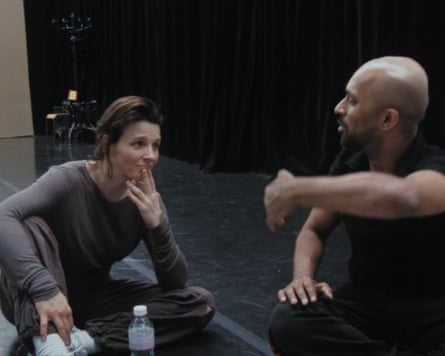
When it premiered in London in 2007 In-I drew mixed notices, but Binoche views the project, which ran for more than 100 international performances, as a personal landmark. Her sister, the film-maker Marion Stalens, had shot nearly 200 hours of raw footage of rehearsals, which Binoche painstakingly cut down for the finished two-hour documentary. She already had an early blessing from a Hollywood great: after one performance at the Brooklyn Academy of Music in 2008, the late Robert Redford came into Binoche’s dressing room and insisted that she make a film of the show. “He repeated it several times, and I was like, ‘Yeah yeah, I know,’” says Binoche. “I thought, ‘One day I have to find a way.’ And I was lucky enough that two and a half years ago, a producer and a financier came to me and said: ‘Do you have a project you’d like to do?’”
Following her inner voice has resulted in an absorbing film, and I tell Binoche that I wish I had seen the original dance production on stage back in 2007. “But you must have been five years old then!” she jokes, eyes twinkling. She is 15 years off the mark, but I’m not too modest to accept the compliment. Binoche is in New York for a few days to screen the film; there was a time in her 30s when she considered moving to the city “because you hear all about the energy here”. She casts an appraising eye out at the gloomy March afternoon. “But when I see all the concrete, all the buildings, I feel like, no way.”
The actor lives in Paris in a little stone house with a garden, and keeps a place in the country too. She grew up in the French capital and has described her childhood self as “a little warrior”. The opening of In-I is inspired by one of Binoche’s most striking – and unusual – childhood memories. At just 12 years old, she became infatuated with an older man while watching Fellini’s Casanova in 1976 at the cinema: in the dance piece, it’s the initial spark for Binoche and Khan’s romance, setting off a relationship arc that moves from honeymoon period and sexually charged pas de deux to fights over pee on the toilet seat amid a messy breakup.
At the visceral climax of In-I, Binoche is suspended against the backdrop of Anish Kapoor’s blood-red set and mimes being choked. The actor drew from the violent memory of being mugged as a young girl for the scene. “It became a big fight, and I was strangled,” Binoche recalls. “I said to him: ‘Go ahead, do it.’ And then he stopped because I said that.”
It’s almost impossible to imagine the self-possession that Binoche must have had to look her assailant in the eye and call his bluff. I suggest that it must have been painful to revisit such a traumatic experience, but she’s having none of it. “A lot of people go through it, hello?! In France, the percentage of women who go through violence like this is huge.”
Binoche had previously considered directing (“of course”, she notes), but says that she never felt a particular urgency to make her own film because she always made sure to have a say in her projects. “As an actor, you’re so involved in the directing because you’re in the middle of it,” she says. “I never felt the desire somehow, because I felt that I was in it.”
She says that she didn’t take tips from any of the past directors she has worked with, but absorbed something of their ethos in her decades spent on sets. “What I learned from most directors is that they follow their intuition,” she tells me. “So you go with your intuition but mainly your need. I think any art form starts from the sensation. Because that’s what your body and gut feeling is telling you.”
I can imagine Binoche starting from a place of spiritual truth for her intense character studies and auteur-led experimental work, but less so for her supporting parts in smooth-brained blockbusters. It’s the same for Ghost in the Shell as Mauvais Sang? “Yeah, yeah, yeah,” she says, before backtracking slightly. “Well, with Mauvais Sang I was not that aware of it,” Binoche adds of the surreal 1986 Leos Carax thriller for which she received her second César nomination. “That was more my relationship with Leos and being in love and wanting him to love me.” That role saw her jumping out of an airplane. Could she do it again? “It depends for what and for who!”
Last year, Binoche was president of the Cannes jury that awarded the Palme d’Or to Jafar Panahi’s It Was Just An Accident, a dark comedy that was partly based on the Iranian director’s experience as a political prisoner. It was a full-circle moment of sorts for Binoche, who drew attention to Panahi’s imprisonment while accepting Cannes’ best actress award for Certified Copy in 2010. It wasn’t Binoche’s smoothest Cannes. In a press conference, she was criticized for sidestepping a journalist’s questions about why she did not sign a letter condemning film industry silence over Gaza. “I cannot answer you,” Binoche said at the time. “You will maybe understand it a little later.” That evening at the official opening ceremony, she read a tribute to a Palestinian photojournalist named Fatima Hassouna, the subject of an in-competition documentary. When I mention it today, she is still frustrated by the episode. “Because they didn’t know what I was going to do in the evening,” she says. “I had a plan! The journalist kept repeating, and I kept repeating – it was ridiculous!”
In general, Binoche prefers to let her work do the talking. “What I like in choosing a story, a script or a play is when there’s transformation,” she says. “Because I think we can transform. And we have to transform and let go of stuff from our education and where we come from.”
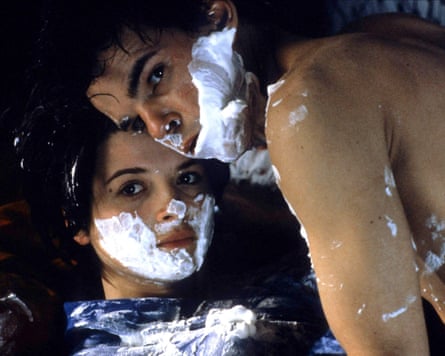
She says the film that changed her the most was The Lovers on the Bridge, the utterly crazed 1991 masterpiece directed by Carax, her former boyfriend. Bincoche is majestic as Michèle, an unhoused artist who is slowly going blind. At Carax’s request, she spent time living on the streets to prepare for the role. “It was such a difficult film to make,” she says. The production blew through several deadlines and ended up taking over two years to complete, and Binoche turned down numerous opportunities to dedicate herself to the role. “There was a lot of depression around me,” she says. “And also, it was: ‘How are we going to find the money?’”
At its time of filming Carax’s movie was reported as the most expensive French film to date, with a chunk of its estimated $28m budget coming from grants through the CNC, a department of the French ministry of culture that supports film. “In France, some people are still angry because there was some money from the CNC,” Binoche says, shrugging. “But it’s also about jealousy: because they are not part of it and it has great recognition in the world.”
It’s hard to imagine getting state funding of that scale for a project these days. Does she think it’s tougher to be a film-maker today than in the 90s? “Well, in France we have a system that protects artists,” Binoche says. “So there’s some cinema that’s been helped, but recently they took away money from the CNC. [The funds are] probably for the army,” she says grimly. “All the money has to go towards making weapons or in case of war.”
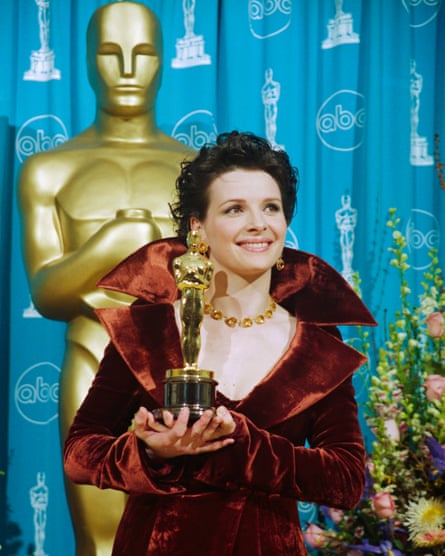
Binoche truly crossed over to English-speaking audiences in the 90s after her roles in Krzysztof Kieślowski’s masterpiece Three Colours: Blue, for which she won the Volpi cup at Venice film festival, and an Oscar-winning turn in the 1996 period romance The English Patient. With a history of sensual roles in films such as The Unbearable Lightness of Being and Damage, as well as her increased presence in English language films, the British press pronounced Binoche a sex symbol. Higher-brow publications were not immune: a 2000 Sight and Sound cover dubbed her “The Erotic Face”, no matter that the actor was promoting a literary biopic of 19th-century author George Sand.
“It never bothered me,” she says of her image at the time. “Each time you have to do nude scenes, it’s always difficult. You have to focus on why you’re doing them so you’re not worried about them in a heavy way. It helps when you trust the director.”
She says that she learned that the hard way. In the mid-90s, director André Téchiné assured Binoche of sensitivity when she agreed to shoot a nude scene for his drama Alice and Martin, and the actor was crushed when she found out that he hadn’t kept his promise. She’s reticent to go into details when pressed, saying only: “I felt betrayed. I liked André. He’s gay. But for me, something was then broken.” Binoche managed to sidestep the director by persuading the film’s producer to remove the shots, but she never worked with Téchiné again.
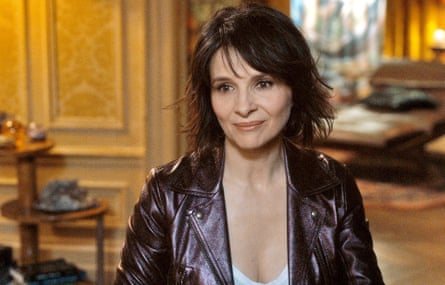
I wonder if things might have been different with an intimacy coordinator: Kate Winslet has said that she wishes that they were the norm in her early career, while actors including Jennifer Lawrence and Gwyneth Paltrow have spoken about feeling more comfortable without them. “I’ve been approached about that,” Binoche says with an eye roll. “The vocabulary is all: ‘Are you agreeing that he touches this?’ The body becomes a puzzle!” While she “of course” recognizes that safeguards can be helpful for less seasoned female actors, she’s quite pleased that In-I In Motion takes a more raw and intuitive approach to body contact. “Our film goes against what is being said today,” she says, before cracking a wide grin. “And I like it!”
“It’s not as simple as having an intimacy coordinator on set,” she goes on. “When you’re in a love scene it needs to come from the heart, the guts, the need. And so if you’re thinking of the movement you’re going to do and not of the feeling, you’re in a bad situation. When you’re embodying lovers, you overcome some fears of touching bodies. You really have to go beyond your comfort zone because otherwise you become a prude and not truthful to what’s happening in life.”
“Truth” is getting to be a fuzzier concept in Hollywood in the age of AI, with the Oscars recently clamping down on AI-generated scripts and performances, even as acclaimed directors including Steven Soderbergh and Darren Aronofsky begin to embrace the technology. “I’m not thinking about it too much,” Binoche says. “They were saying that painting was going to disappear because we had cameras, or that theater was going to die when cinema arrived. So I don’t think you should be worried. It’s called artificial intelligence. It’s not spiritual intelligence or human intelligence.”
As well as memorable supporting parts in recent American productions such as HBO’s The Staircase and starring along Ralph Fiennes in The Return, Binoche says that she has recently been drawn to work that helps her stay grounded. Later this year, she will appear in the devastating drama Queen at Sea as the daughter of a woman with dementia; the film took home the prestigious jury prize at this year’s Berlin film festival. And she’ll return to France this week to finish shooting on North Loire, a rural thriller from emerging director Antoine Chevrollier. “My agent said to me, ‘There’s this French director and I think you should meet with him, but it’s only his second film,’” she recalls. “I met with him and loved him, so I jumped.”
It’s proved to her once again the importance of listening to her gut. “It feels so freeing,” she tells me, as she gathers up her things and prepares to head to the movie theater for the screening. “If you’re attached to status and thinking, ‘I’m not going to descend,’ I think you’re losing possible opportunities for art.” And that is not in Juliette Binoche’s nature.
-
In-I In Motion is out on 3 June in France with a UK, US and Australian release to follow