








On a brisk winter’s evening in Europe’s automotive heartland, a cyclist who had pushed for safer streets went out on his bike for a final time. Andreas Mandalka had documented dangerous driving and shoddy cycling infrastructure for years, measuring the margins at which cars zipped past him and posting videos of blatant violations. While quick to remind readers that only a small proportion of drivers behaved badly, the 44-year-old blogger in Baden-Württemberg, Germany, had grown frustrated with authorities for failing to act. He felt they viewed him as a nuisance.
As he cycled down a straight stretch of renovated road that runs parallel to a forest path he had flagged for poor quality, lights bright on his bike and helmet firm on his head, he was fatally struck from behind by a car.
“I went to bed that evening, took a quick look at my phone and saw a police report of an accident in our area,” said Siegfried Schüle, a friend of Mandalka’s from a cycling organisation in Pforzheim. “I immediately had a very strange feeling. I reposted this tweet from the police, with typos and everything, and just wrote: ‘Andreas, how are you?’ That was my last message to him.”
Mandalka was one of 19,934 people killed in 2024 on EU roads, which are among the safest in the world. Traffic collisions cause 1.19m deaths around the world each year.
As carmakers flood the market with bigger and more harmful models, the added pressures of air pollution, climate breakdown and volatile petrol and diesel prices are fuelling renewed efforts to break the societal dependence on automobiles.
“It’s not about taking anything away from anyone,” said Schüle, a startup founder. “It’s just about giving everyone the same freedom – even if they don’t have a driver’s licence – to move safely.”
Public health experts struggle to convey the risks that cars pose to people without sounding alarmist. Loud machines in steel cages, the vast majority of which burn fuels that foul the air and heat the planet, zoom past schools, homes and hospitals. Rubber tyres kick road dust and microplastics into the air. The outsized infrastructure deprives cities of cycle paths, forcing commuters to drive more and exercise less, while limiting space for parks to socialise and enjoy nature. Paving over greenery leads to hotter heatwaves, heavier flash floods and higher stress levels.
“The list goes on,” said Dr Audrey de Nazelle, an environmental epidemiologist at Imperial College London. Yet it is partly the diffuse nature of the dangers that hinders efforts to reduce car use, she said, with policymakers pursuing isolated fixes such as electric vehicles to avert climate damages and added safety features to cut crash deaths.
“In governance, there’s a separate solution for everything but no way to embrace all the benefits – and that’s what hinders change,” De Nazelle said.
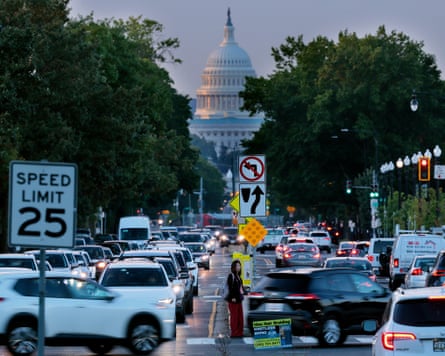
Signs of frustration have begun to emerge. Mayors around the world have felt emboldened to reallocate road space in their pursuit of clean air, and many drivers – motivated by money, comfort, health or the environment – want to get out from behind the wheel. In Europe, an Ipsos poll found more people than not report more walking and public transport use in the last five years, while personal car use has fallen slightly out of favour. Even in the car-centric US, almost one in five vehicle-owning adults in cities and suburbs are “strongly interested” in living car-free, a study found in February, with two in five open to the idea.
Surprisingly, the latest pleas to get off the road have come from energy experts rather than doctors or environmentalists. In March, the International Energy Agency (IEA) encouraged carsharing, driving slower and working from home to cushion the shock from soaring fuel prices caused by the Iran war. It cautioned countries against fighting high prices at the petrol pump with blanket subsidies – as many did during the last energy crisis – and advised targeting financial support to vulnerable groups instead.
Yet even as the reasons to limit car dependence mount, the vehicles themselves keep growing in size. Like for like, bigger cars waste more fuel, spew more pollution, take up more space and pack more punch in a crash. In Europe, where most new cars sold are SUVs, the average vehicle mass has risen since 2010 by 9% for combustion engine cars and by 70% for battery electric ones, according to data from the International Council on Clean Transportation, an nonprofit research organisation. On top of the direct harms, the supersizing of electric vehicles may also have slowed the transition away from fuel-burning ones by pricing people out of clean alternatives.
“Europe is at a crossroads,” said Lucien Mathieu, the director of cars at Transport and Environment (T&E), a nonprofit in Brussels. He said the choice ahead was to manufacture the “compact affordable electric vehicles” that China has begun to popularise across the developing world or to embrace the expensive “mega SUVs and monster trucks” that the US has championed. More than 80% of cars sold in the US are now an SUV, van or pickup truck, official data shows.
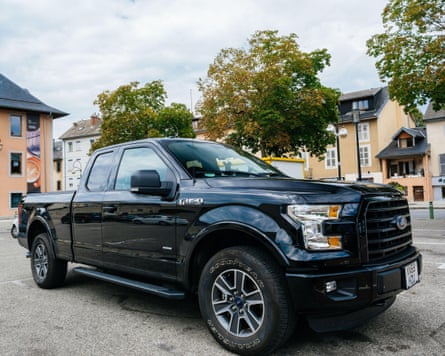
For now, the SUVs clogging European roads are fairly dainty by North American standards, with the additional threat to human health coming more from higher bumper heights rather than the added pollution that extra weight entails. But even bigger vehicles are revving their engines around the corner. Thousands of pickup trucks such as the Dodge Ram 1500 and Ford F-150 have been driven on to European streets in recent years, evading EU safety standards through a backdoor process that allows individual vehicles to be imported under less stringent conditions. Efforts to close the loophole have been complicated by a US-EU trade deal last year that calls for “mutual recognition to each other’s standards” on automobiles.
The agreement, which to the frustration of Donald Trump has been signed but not ratified, is helping carmaker efforts to get big vehicles into Europe. In December, the American Automotive Policy Council (AAPC) wrote to Howard Lutnick, the US commerce secretary, to protest against planned changes to the EU’s import approval process. Last month, in a follow-up seen by the Guardian, the lobby group claimed the latest draft proposal constituted “a significant trade barrier” that ran counter to the agreement. Among its objections were requirements to test vehicles to European emissions standards, fit them with gas particulate filters and equip them with pedestrian protection sooner than the AAPC deems feasible.
Carmakers in North America and Europe have sought to justify the shift to bigger cars by saying they are meeting consumer demand for spacious vehicles. Even amid a cost of living crisis, customers have been willing to pay premiums for vehicles that are more expensive to buy and run, with an increase in drivers defaulting on automobile loans ringing alarm bells on Wall Street. Critics complain that the automotive industry is obscuring the role its adverts play in generating demand while it chases the higher profit margins that SUVs offer.
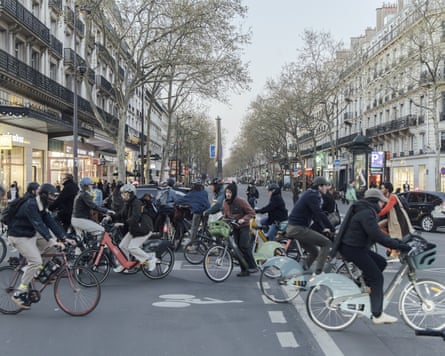
Is Europe doomed to follow North American car bloat? There are some signs that the rise of SUVs may be spurring resistance to car culture more broadly. A handful of European cities began the process of reducing car dependency decades ago, such as the Dutch and Danish cities that removed urban motorways and built bike lanes after the oil crises in the 1970s, but other frontrunners such as London and Paris have only recently taken transformative steps. Their efforts to bolster public transport systems, share road space with cyclists and restrict motorists are being cited across the continent as proof that a shift away from cars is feasible and desirable.
Yet even places of progress show mixed support. In London, the introduction of an ultra-low emissions zone generated so much backlash that it became the face of a widespread conspiracy theory that painted “15-minute cities” as a globalist plot of government control. In Paris, whose transformation under the city’s former mayor Anne Hidalgo was celebrated around the world, public referendums on pedestrianising school streets and charging big cars more to park were won with tepid, single-digit percentage turnout – even though recent municipal elections showed little appetite for backsliding.
Even the IEA’s fuel-saving call has been largely ignored outside of Asia, where shortages are hitting hardest. The EU has relegated demand-cutting measures to an annexe of “good national practices” in the emergency response package it released last month. In the US, the failure to provide public transport and build walkable neighbourhoods means few even have the luxury of alternatives to the automobile.
At the heart of the problem, some transport researchers and campaigners say, is that measures that restrict motorists are portrayed as an attack on civil liberties and lower-income households – while the costs of car culture are ignored outright.
“If someone buys a new SUV and puts it on the street, the space is gone,” Schüle said. “We don’t have a problem as a society with putting that private property in the public space – that’s completely OK and accepted. But the moment someone explicitly says ‘hey, we’d like to build a cycle path here’, the uproar is huge.”