






One year ago today, all of Spain, and much of Portugal, suffered through a blackout of unprecedented scale and duration. In mere seconds, a cascading sequence of events burst through the grid and created Europe’s first “system black” event in recent memory.
Traffic signals failed, mobile networks stopped working entirely, petrol stations could not pump fuel and supermarkets couldn’t process payments. Madrid’s metro came to a halt and people had to be pulled out of carriages. “People were stunned because this had never happened in Spain,” Carlos Condori, a 19-year-old construction sector worker, told AFP at the time. “There’s no [phone] coverage, I can’t call my family, my parents, nothing: I can’t even go to work.”
Power was mostly restored in the days after, but the political debate – domestic and global – began just hours after the blackout occurred. Spain’s grid collapsed when solar power generation was high, triggering intense discussions around Spain’s transition away from fossil fuelled power and, controversially, nuclear. The media published headlines such as “Renewable energy triggered Spain’s blackouts”, “Spain at risk of fresh net zero blackouts” and “Spain power cut caused by solar farm failures”.
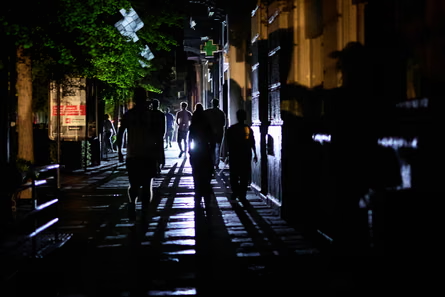
But despite a widespread theory assigning blame to renewables for a lack of “inertia” – the heartbeat of the grid traditionally provided by large spinning masses in fossil fuel and nuclear plants – subsequent investigations have found conclusively that this was not a factor. The final report published by the pan-European grid operator ENTSO-E ultimately blamed the blackout on a “perfect storm” of several governance failures relating in particular to voltage. This is the pressure of electricity on the grid, and when it is too high or too low, power lines and generators tend to automatically disconnect. This in turn triggers a cascading failure through the grid.
And while some might have expected the blackout to lead to a move away from renewables, it is clear the opposite has occurred. A year on, there is no material reduction in Spain’s efforts towards the replacement of its coal and gas-fired power stations with non-fossil alternatives. According to data from global energy thinktank Ember, Spain added 13.8 gigawatts of new solar in 2025, compared with 12.3 gigawatts in 2024, and the country’s highest-ever month of capacity additions was July 2025.
Chris Rosslowe, a senior energy analyst for Europe at Ember, told the Guardian that Spain’s “trajectory towards reducing fossil power and increasing renewables and their enablers has strengthened since the blackout”.
There was some increase in the use of gas-fired power generation post-blackout, running in “reinforced mode” to allow gas plants to help control the grid’s voltage. But this was not a sign that returning to gas is the best long-term course of action. Rather, Rosslowe said, “Spain lacked alternatives”, including large lithium-ion battery storage, or the use of large spinning motors that can provide the same heartbeat of stability to the grid provided by the spinning turbines in coal and gas plants, without the emissions. Rosslowe also highlighted that half of the gas increase in 2025 was simply down to less wind and lower hydro capacity.
One of the reasons voltage oscillated outside normal bounds this time last year was because Spain’s grid operator has traditionally limited the capacity for wind and solar generation to contribute to voltage control. Fakir pointed out this has very recently changed, with renewable technologies providing voltage compensation services since April. She added that “it is unfortunate that a blackout had to occur to change regulation and allow renewables to control grid voltage”.
In the intervening months since the blackout, a devastating conflict has broken out in the Middle East, and the closure of the strait of Hormuz has sent gas prices steeply upwards. But Spain has been relatively protected compared with other countries because of its existing investment in renewable energy. Jan Rosenow, a professor of energy and climate policy at the University of Oxford, said, “wholesale electricity prices would have been 40% higher in the first half of 2024 without the wind and solar growth of recent years”.
The crisis has also flipped the focus back towards reducing reliance on gas in Spain’s grid. José Luis Rodríguez, an analyst and the head of organisation at the Meridiano Institute, said: “All the chatter around renewable insecurity has collapsed with the energy shock that is brewing. The shield of the sun and wind is the only thing guaranteeing relatively affordable energy prices for the majority, unlike elsewhere in the EU, and protecting our economy.”
In 2025, gas was framed as saving the grid from renewables. But in 2026, renewable energy is protecting consumers from the acute impacts of gas. Rosslowe said: “Spain’s average power prices in March (€43 per MWh) were the third lowest in Europe, after Finland and Portugal, twice as low as Germany (€99 per MWh) and three times as low as Italy (€144 per MWh). That’s because of the weakened link between Spanish electricity and gas prices.”
Frustration that it took such an acute blackout catastrophe to spur action to further protect Spain’s power grid users from the gas price crisis is a common theme among energy experts and advocates. But far from any structural return to fossil fuels, the long-term trendlines in Spain all continue to point in the opposite direction, while the political and social fallout from the April 2025 blackout shows that tackling disinformation is as important as fixing the grid.