




It seems unbelievable now, but a decade ago we were debating the potential positive merits of mobile phones in schools. Back then, some private school headteachers insisted these mini-computers were a “powerful resource” teachers should “harness” rather than fear. To counter what I can now only call a fantasy, in these pages I argued the opposite case. To introduce them into classrooms would widen the attainment gap between rich and poor students. It would also heap more pressure, I wrote, on children whose parents could not afford the eye-watering costs of the latest smartphone. Looking back, both the defence of phones in schools and my rebuttal of it appear painfully naive.
Phones have proved far worse than either side of the debate could have conceived. Schools know all too well the threat phones pose to pupils’ attention. But it’s more serious than just classroom disruption. Smartphones, and their symbiotic relationship with social media apps, have proved themselves the tobacco of our age. The government’s announcement on Monday that it would turn its existing guidance in England on phones in schools into a statutory ban sounds less like a bold intervention and more like a simple recognition of reality.
Smartphones expose young people to a range of harms, from sleep loss due to doom scrolling and crippling feelings of inadequacy driven by the compulsion to “compare and despair”, to radicalisation by the manosphere and easy access to violent pornography. The list goes on. Schools have already concluded that unless pupils are safeguarded from the dangers of smartphones, teachers cannot adequately teach.
Schools also know that enforcing such a ban is anything but straightforward. In February, research by Birmingham University found that staff at English schools with “restrictive” smartphone policies – those that require pupils to turn phones off and place them in a bag or hand devices in – spent more than 100 hours a week enforcing those rules. That’s the equivalent of a week’s working hours for three full-time members of staff. Researchers concluded that at a potential cost of £94 per pupil, enforcement was a “huge drain” on already stretched resources. The question then is, will the government increase school funding considering this reality?
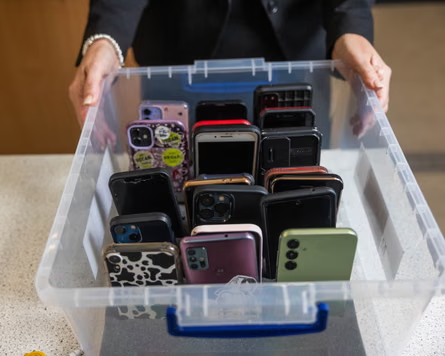
Given that the government has proposed a 6.5% pay rise for teachers over three years without funding it, meaning schools themselves must absorb the cost, the answer is probably no.
The problem of enforcement will not magically disappear. Some teachers, too scared or tired of the disruption that will come when they ask for a pupil’s phone, will continue to “tactically ignore” the ping of WhatsApp notifications. A head of year working at a school with a “restrictive” smartphone policy told me of the typical reactions of pupils caught with their phones: “denial and resistance”, “verbal abuse” and “serious hostility”. They spoke of one colleague who was forced to “lock themselves in their office” when confronted by a raging student demanding the return of their phone. They described some pupils who happily opt for a day out from the routine of the normal school day rather than hand over their devices.
Then there were the students who carried multiple phones so that when challenged by a teacher, they could offer up a decoy and appear compliant with school rules. One student’s complete dependency on their phone resulted, the head of year recounted, in a total “meltdown” at their parent’s attempt to place boundaries on their usage. They ransacked their home like an addict desperate for a fix.
In another school, an assistant head recently told me that a parent, furious at the school’s confiscation of their child’s mobile, called the police. That example speaks to the complexity at hand. A Smart Schools study published in the Lancet Regional Health – Europe found no evidence that restrictive phone policies in schools resulted in better mental health. Or, crucially, that they lower phone or social media use overall. While schools can curb the use of phones during the day, they are powerless to enforce those boundaries beyond the school gates. Pupils compensate for their daytime sobriety with heavier phone use at home.
So, yes, a mobile phone ban is necessary and welcome. But schools are allowed to ask what support they will be given to manage the transition period. The solution must include families, government and, most importantly, the social media companies themselves, which can do more to build safeguards against teens’ misuse of platforms. Teachers can confiscate a handset, but they cannot, on their own, cancel out childhoods shaped by addiction to “infinitely scrollable” feeds. Pretending that they can would be painfully naive.
-
Lola Okolosie is an English teacher and writer