


惯性聚合 高效追踪和阅读你感兴趣的博客、新闻、科技资讯
阅读原文 在惯性聚合中打开

推荐订阅源

MongoDB | Blog
MongoDB | Blog
AI
AI
B
Blog RSS Feed
CTFtime.org: upcoming CTF events
T
Threatpost
I
Intezer
P
Proofpoint News Feed
Cyber Security Advisories - MS-ISAC
Scott Helme
Scott Helme
Threat Intelligence Blog | Flashpoint
T
Threat Research - Cisco Blogs
Google DeepMind News
GbyAI
GbyAI
H
Hackread – Cybersecurity News, Data Breaches, AI and More
S
Schneier on Security
Webroot Blog
Webroot Blog
Recorded Future
Recorded Future
aimingoo的专栏
aimingoo的专栏
L
Lohrmann on Cybersecurity
Simon Willison's Weblog
MyScale Blog
MyScale Blog
Project Zero
Project Zero
L
LangChain Blog
B
Blog
D
DataBreaches.Net
Microsoft Security Blog
F
Fortinet All Blogs
美团技术团队
Engineering at Meta
Engineering at Meta
Cisco Talos Blog
Cisco Talos Blog
D
Docker
WordPress大学
WordPress大学
人人都是产品经理
人人都是产品经理
S
Security Affairs
Attack and Defense Labs
N
News | PayPal Newsroom
钛媒体:引领未来商业与生活新知
钛媒体:引领未来商业与生活新知
量子位
Exploit-DB.com RSS Feed
W
WeLiveSecurity
V2EX - 技术
V2EX - 技术
TaoSecurity Blog
TaoSecurity Blog
博客园 - Franky
P
Proofpoint News Feed
Jina AI
Jina AI
Google DeepMind News
OSCHINA 社区最新新闻
OSCHINA 社区最新新闻
雷峰网
雷峰网
The Hacker News
The Hacker News
G
GRAHAM CLULEY

The Guardian

New Zealand’s North Island braces for Cyclone Vaianu with thousands ordered to evacuate Artemis II splashdown – in pictures Swalwell denies allegations of sexual assault as calls grow for him to withdraw from California governor race Trump news at a glance: Epstein survivors have words for Melania Trump after surprise statement Multiple people face charges, including murder, in California fireworks blast Rory McIlroy surges into six-shot Masters lead with stunning second-round flourish Roberto De Zerbi targets ‘Ange-ball’ revival to save Spurs from relegation Bath hit back to reach semi-final after stunning Northampton in 11-try epic Australia crash out of BJK Cup after Britain secure upset with doubles win Zebras, wealth and power: Hungary’s election tests Orbán’s grip on power ‘TikTok effect’ brings sellout crowds and younger fans to Grand National meeting King signs up David Beckham to his Chelsea flower show team The war over Omagh’s gold: the £21bn mine plan tearing a community apart Britain’s shadow workforce is paid as little as 65p an hour. Who cares for the carers? Tim Dowling: my wife is on a quest to restore my thinning hair SUVs are making Britain’s potholes worse, say scientists Blind date: ‘She claimed she was usually shy. I wouldn’t have guessed’ I’m a sauna person now: the Becky Barnicoat cartoon ‘I got everything I dreamed of – when I had no ability to handle it’: Lena Dunham on toxic fame, broken friendships and her ‘lost decade’ Six great reads: the man who let snakes bite him, masked heavy metal and the brutal reality for foreign students in the UK Meera Sodha’s recipe for noodles with rose beancurd, spring greens and egg Cuba’s doctors were a lifeline for the world. Now the Caribbean is shamefully complicit in the US drive to expel them An environmental disaster in Moldova has Russia’s fingerprints all over it ‘This is as important as your teeth’: are you skipping this key part of mouth hygiene? Man arrested after four die trying to cross Channel in small boat Ukraine war briefing: doubts linger in Kyiv over Moscow’s promise to uphold Orthodox Easter ceasefire Ichiro Suzuki statue unveiling goes awry as bronze bat snaps during ceremony Arrest of national war hero Ben Roberts-Smith cuts deeply to core of Australian psyche European football: Real Madrid held at home by Girona to extend winless run ‘You come back different’: how rugby players change after motherhood Human rights groups decry US plan for Guantánamo camp for Cuban migrants Potential US host cities for 2031 Women’s World Cup games mull withdrawal over Fifa concerns Arne Slot insists he is ‘aligned’ with Liverpool board and fans as squad is rebuilt Kamala Harris ‘thinking about’ running for president again in 2028 JD Vance warns Iran against trying to ‘play’ the US in peace talks West Ham double up twice to thrash Wolves and put Spurs in relegation zone Trump administration releases new renderings of so-called ‘Arc de Trump’ Bafta apologises for events surrounding John Davidson’s Tourette’s outburst Cocktail of the week: Bar Shrimp’s la rosita – recipe New drug may extend survival in aggressive ovarian cancer, trial shows One dead and 27 injured after bus with British passengers crashes in Canary Islands OpenAI CEO Sam Altman’s home targeted with molotov cocktail Alarm as acting CDC director delays report showing Covid vaccine benefits Argentina just ripped up its pioneering glacier law. What does this mean for millions of people’s drinking water? ‘Illegal’ forest service overhaul risks causing ‘chaos’ across US public lands, union claims Prince Harry sued for defamation by charity he co-founded Anthropic’s new AI tool has implications for us all – whether we can use it or not Concerns raised about motorbike tourist trail after death of British teenager in Vietnam The Guardian view on Trump’s civilisational threats: the words that fuel war must be condemned The Guardian view on dystopias for our times: the American nightmare Weather tracker: Cyclone Maila batters Solomon Islands with 115mph winds Doctors’ leader claims new reduced pay offer killed chances of ending strikes in England Netanyahu-ism has achieved nothing for Israelis – and come at a monstrously high price Deborah Levy: ‘CS Lewis’s White Witch terrified me – but I wanted to meet her’ How I Shop with Michelle Ogundehin: ‘We grownups have enough stuff already’ ‘Butter Birkin’: popcorn plastic It bag in demand by Devil Wears Prada fans Trump’s war and Melania’s Epstein statement, with US editor Betsy Reed – The Latest Orbán and Magyar trade accusations in last days of Hungary election campaign Reckonwrong: How Long Has It Been? review | Safi Bugel's experimental album of the month Martin Rowson on Middle East peace talks – cartoon Fears of UK and EU flight cancellations as airports warn of jet fuel shortages Peers vote to ban pornography depicting sex acts between stepfamily members Week in wildlife: an ostrich on the lam, a tortoise crossing a road and surfing seals ‘There’s no shortage of terrifying technology’: how AI became TV drama’s new go-to villain Texas court overturns sentence for man on death row for nearly 50 years Power up! Could force be the secret to supercharging your fitness? ‘Irresponsible failure’: Google, Meta, Snap and Microsoft slam EU over child sexual abuse law lapse Blank canvas: what to wear with white trousers Critics assemble! Here’s my list of the greatest superhero movies of all time Amazon to finally launch Leo satellite internet in ‘mid-2026’, says CEO Pete Hegseth’s holy war: the militant Christian theology animating the US attack on Iran Toxic putdowns, brutal zingers ... and an unexpected love story – inside the joyful climax to brilliant sitcom Hacks Add to playlist: the beautifully dazed, countrified indie-rock of Tracey Nelson and the week’s best new tracks ‘I’m worried there’s too much of me,’ says a birch: inside the interspecies council giving nature a voice Dolce & Gabbana says co-founder Stefano Gabbana has quit as chair Why is anyone surprised by the US and Israel’s latest war? It’s only what the world allowed them to do in Gaza Super Mario what?! The seven best obscure Mario games Holly Humberstone: Cruel World review – Taylor Swift fave trades gothic melancholy for pop glow-up Thrash review – cursed shark thriller sinks like a stone on Netflix ‘The biggest, baddest, saltiest chick you would ever see’: why no one sang the blues like Big Mama Thornton Go Gentle by Maria Semple review – a joyfully clever New York romcom ‘Tranquil, natural and barely a tourist in sight’: readers’ favourite hidden gems in Spain Benjamina Ebuehi’s sweet and salty chocolate chip cookies recipe ‘I’m not a commercial director – I’m not even a professional film-maker’: Jim Jarmusch on the seven-year journey to make his new film Malcolm in the Middle: Life’s Still Unfair review – the TV magic they’ve created here is absolutely miraculous The Miniature Wife review – Matthew Macfadyen is wasted in this pointless comedy From soups and greens to roots, how to survive the ‘hungry gap’ From fat transplants to LED mittens: how the fear of ‘old lady hands’ mobilised the beauty industry Anna Wintour’s Vogue cover is more than a cameo – it’s a power play ‘They’re gonna make me cry’: I competed at a speed puzzling championship You be the judge: should my girlfriend stop mixing gold and silver jewellery? Maritime and port workers: how is the Middle East conflict affecting you? How games capture the awe and terror of cosmic isolation Why does alcohol make us both happy and miserable – and what else does it do to our minds and bodies? I never text back – and it’s ruining my relationships The pet I’ll never forget: Beau, the labrador who saved my life Life Is Strange: Reunion review – a decade-long story comes to an impassioned close Why is gaming becoming so expensive? The answer is found in AI Sign up for the First Edition newsletter: our free daily news email Sign up for the Feast newsletter: our free Guardian food email
From V2 rocket-scarred London to Ukraine: how nature thrives in bomb craters
Words, video · 2026-05-06 · via The Guardian

In February 1945, towards the end of the second world war, a German V2 rocket struck Walthamstow Marshes in east London. The explosion tore a crater into the marshland. Left untouched, it slowly filled with water, sediment … and life. Today, this wartime scar has become a thriving pond.

“It’s small but it really punches above its weight,” says Luke Boyle, a ranger for the Lee Valley Regional Park Authority, as he kneels at the edge to examine aquatic plants sprouting their early spring shoots. “We can’t manage the hydrology here, so it is actually a vital part of the ecosystem – it supports a range of plants, insects and amphibians, more than you might expect,” he says.

Bomb Crater Pond holds clean water all year round supporting wildlife and cattle

Walthamstow’s Bomb Crater Pond lies within a fenced-off section of the marshes, protected as part of a site of special scientific interest. Its clear waters provide a year-round refuge for wildlife in an otherwise highly managed urban landscape. More than a million people visit Walthamstow Marshes each year, most unaware that the modest pond near the perimeter fence began its existence due to an instrument of destruction.

“It’s like an engine room for the marshes,” Boyle says. “Despite its size, it supports the wider ecosystem around it.”

Unlike most wetlands, there are no sluice gates here, no managed hydrology – the pond’s natural depth means it holds water all year round, reliable and clean. The cattle drink from it too, and their hooves disturb the ground around the margins, creating a patchwork of habitats that allow different species to take hold.
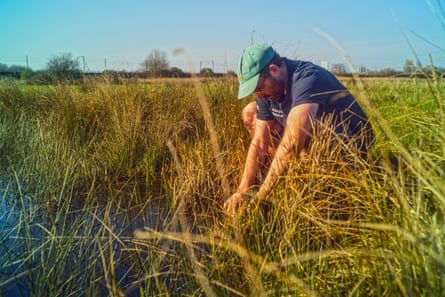
Luke Boyle crouches in long grass
Park ranger Luke Boyle examines emerging spring growth at the edge of Bomb Crater Pond

“In winter, you get snipe and lapwing out on the wetlands,” Boyle says, scanning the margins of the pond. “Then, by late spring, this becomes a breeding ground: newts and grass snakes. The dragonflies and mayflies come, butterflies along the edges.” Frogs and herons are regulars. “Last year was good nationally for butterflies,” he adds. “But, here, it’s like that every year.”

One species is creeping marshwort, among Britain’s rarest aquatic plants, recorded at only two sites in the UK. It is too early in the season to see it but Boyle knows it is there, somewhere beneath the surface, waiting. “We watch that carefully,” he says. “It’s about keeping the balance between open water and the vegetation that wants to take over.” Under a countryside stewardship agreement overseen by Natural England, he is required to maintain at least 80% open water, pulling out reedmace by hand when it encroaches.

It is, he adds, his favourite spot on the marsh. As he speaks, the Stansted Express flashes past on the elevated line beyond the fence. A grey heron circles above as if signalling it would like to land.
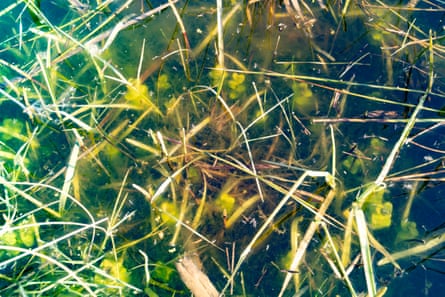
A mixture of plants seen from above
Aquatic plants push through the surface of Bomb Crater Pond in early spring. The pond supports a wide range of freshwater species

The power of small ponds

Small ponds have been one of ecology’s most underestimated assets. “Historically, because they are small, ponds have been dismissed as insignificant,” says Prof Jeremy Biggs, CEO of Freshwater Habitats Trust. “In fact, the evidence shows the opposite: across a landscape, they support a wider range of freshwater plants and animals – including more rare and protected species – than other freshwater habitats, such as big rivers or lakes.”

Part of the reason is counterintuitive. Bigger water bodies attract bigger problems. Rivers accumulate diffuse pollution from the land they drain. Lakes receive runoff from vast catchments. Ponds, by contrast, are small enough to avoid the systems that damage larger waters. Nobody routes a sewage outflow into a pond – it’s too small to dilute it.
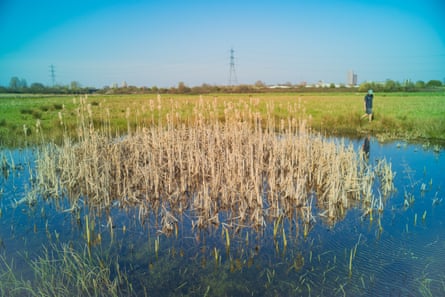
A man can be seen on the far side of a pond, in which species of plants can be seen growing. In the background are city buildings.
Boyle circles the pond, which by late spring will be alive with newts, grass snakes, dragonflies and mayflies

“Ponds are powerful precisely because they are small,” Biggs says. “Many still hold clean water – something now increasingly rare in the wider countryside.” That, he adds, is why creating and protecting clean-water ponds is such an effective way to support freshwater biodiversity. They are also astonishingly varied – acidic or alkaline, shaded or open, grazed or undisturbed – and create a mosaic of conditions across any landscape that no single large water body could replicate.

“Darwin famously proposed that life began in a ‘warm little pond’, and freshwater species have spent millions of years evolving to colonise exactly these kinds of small, still waters,” says Biggs. “While it takes many decades or even centuries for most types of habitats to become established, wildlife arrives at new ponds almost immediately, and these small waters can become ecologically rich within just a few years.”

Evidence from bomb craters makes this vivid. Biggs says: “At Tommelen in Belgium, 144 ponds – many created unintentionally by second world war bombs – now form a nature reserve supporting seven amphibian species, including great crested newts and tree frogs.

“At Ashley Range in the New Forest, craters left by bouncing bomb tests, including one made by a 10,000kg bomb, have filled with water to create a network of ponds in heathland. These examples demonstrate how quickly ponds can become colonised. If the ponds are clean and in the right place, they can become rich habitats for a wide range of species.”

Every crater tells a different story

Some 1,500 miles (2,400km) east of Walthamstow, the ground tells a different story. Since Russia’s invasion of Ukraine in February 2022, the scale of destruction written into the landscape defies comprehension. Satellite imagery studies have identified more than 600,000 craters in just two southern regions (Mykolaiv and Kherson) alone. Across the country, researchers estimate the number now runs into millions.
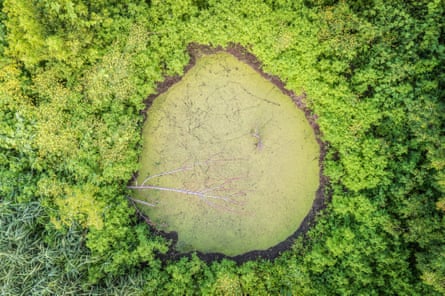
Seen from above, a pond covered in green growth surrounded by bright green trees.
A bomb crater on the Irpin floodplain, north of Kyiv, Ukraine

The human cost has been devastating: tens of thousands killed, millions displaced, entire cities reduced to rubble. For Anastasiia Splodytel, a Ukrainian soil scientist who has worked across the country’s devastated regions, each crater marks a moment of violence.

What happens to the land afterwards is what she has spent years trying to understand. The answer, she says, is never simple. “It all depends on who is standing at the edge: their professional background, how they perceive what they see and a range of natural factors: soil type, the landscape-geochemical structure and the type of weapon used.”

A bomb does not simply tear a hole. The shock wave disrupts the layered structure of soil built up over centuries, deeply embeds metal fragments and recasts the microrelief. Some of the most extreme cases that Splodytel has encountered involve phosphorus munitions. White phosphorus burns at up to 2,760C – hot enough that fertile black soil turns into cracked stone. Ukraine’s chernozem, its famous black earth that is among the most productive agricultural soil on the planet, can be reduced in seconds to something inert. The thermal shock kills what lies beneath: the bacteria, fungi and microorganisms that drive fertility and regulate moisture.
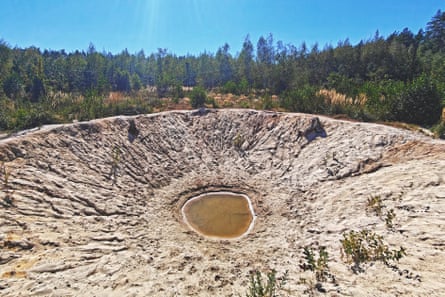
A huge crater with a small amount of brown water at its centre, with some plants growing in the rocky, ridged surrounds.
Early plant growth tentatively returns to the slopes of a missile crater in Buda-Babinetska, Bucha district, formed in February 2024

Heavy metal contamination in individual craters does not always reach catastrophic levels, often rising only modestly above the natural background before stabilising. But Splodytel is careful about what reassurance that offers. “The main threat is not toxicity, but the loss of soil fertility – disruption of soil structure and reduction in microbial populations.”

Explosive compounds in the soil have barely been studied, and for communities living nearby, invisible contamination is easily underestimated. “It is precisely this underestimation that presents a significant threat,” she says.

Yet there is hope for even the most damaged soils Splodytel has examined. “I was pleasantly surprised by how quickly nature begins to heal itself without waiting for human intervention.” In shallower craters, she has observed accelerated pedogenesis – the rapid reformation of soil structure, new layers beginning to build almost before the dust has settled. Something, quietly, is trying to return.

For Bohdan Prots, a Ukrainian ecologist who has spent decades studying his country’s natural landscapes, there are few straightforward answers. His starting point is pragmatic. In up to 90 % of cases, the right course of action is simply to fill a crater with clean soil and return the land to use. “It is not as big a deal as people think when they talk about craters causing huge pollution. Not when you are looking at a single explosion.”
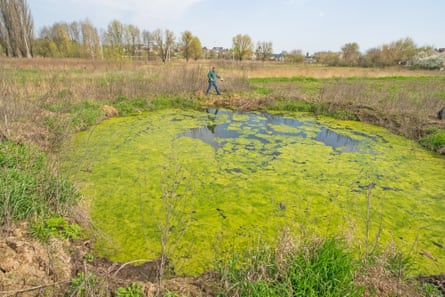
A man stands on the far sife of a pond with green growth over the top of it, surrounded by scrubby grass.
Dr Bohdan Prots examines a crater in Makariv, Bucha district. Four years after the strike, the crater holds water year-round – a pattern repeated across Ukraine

Scale changes everything. In the heavily bombarded zones of eastern Ukraine, where explosions have occurred every few metres, the cumulative effect is catastrophic, with entire forests reduced to bare earth, soil overturned to depths of several metres and the layered structure that took centuries to form pulverised beyond function.

And then there are the mines. “The problem is not really the crater,” Prots says. “The problem is unexploded devices.”

He describes a colleague’s father in the Kherson region who, on just half an acre of land, discovered 36 unexploded devices over three years, even after military deminers had certified the area clear multiple times. There is, he notes, a well-known rule: one year of war equals an average 10 years of demining. Ukraine, now four years in, already faces 40 years of that work ahead.
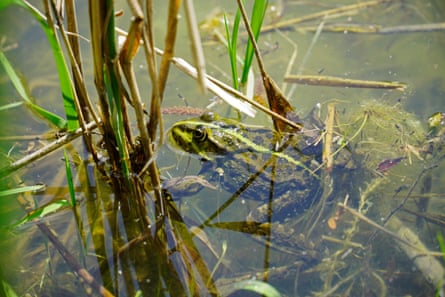
A frog head appears above the surface of water while its body can be seen below
A marsh frog surfaces in a flooded bomb crater near Moschun, Bucha district, Ukraine, where conflict has reshaped the landscape into a mosaic of temporary wetlands

Yet he keeps coming back to something he has observed across a lifetime in the field. Growing up in western Ukraine, decades after the second world war, he found old bomb craters in the forest – depressions slowly silting over, but still functioning as miniature reservoirs. “They were already not as deep as before,” he recalls, but were “still a good resource for animals to drink and frogs to breed”.

He pauses over the observation for a moment. “Diversity of habitats, even created by war, leads to species diversity.”

Nature’s return is not always straightforward. The first species to arrive in damaged habitats are often pioneer or invasive ones, filling the vacuum before native plants and animals can re-establish. “People see green and think it is fine,” Prots says. “But green is not always beneficial.”

Each landscape must be read on its own terms, he says, whether that is wetland, forest, farmland or urban ground. Every crater carries a different story, depending on the soil, location, power of the explosion, intensity of the battle and whether clean water is present.
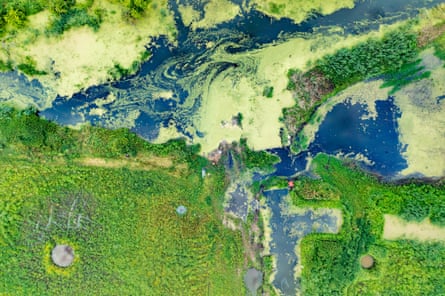
A view from above of different areas of green with blue areas of water cutting through
A drone’s view of the Irpin valley, where abandoned positions, cratered ground and standing water mark the frontline of the 2022 battle for Kyiv

When asked about the postwar future – the tens of thousands of water-filled craters that will remain across Ukraine once the fighting ends – Prots’s answer is measured but not without hope.

“When it is in the forest,” he says, “it becomes a biodiversity hotspot. At the bottom of these explosions, which go three to eight metres deep, there will always be water in the end, even in very dry periods. It is like establishing a small wetland.”

He pauses. “And that is a place where animals are always eager to come.”

Find more age of extinction coverage here, and follow the biodiversity reporters Phoebe Weston and Patrick Greenfield in the Guardian app for more nature coverage