


Like many in Tehran, Mehdi, 36, an IT professional, had fled the capital in the early days of the war to stay with relatives in the north.
Returning to the city, he was confronted by bombed-out buildings, debris and rubble still scattered across the roads. His home has been damaged by the blasts, the glass shattered and bedroom window frames blown out. In his first days home – just before the ceasefire was agreed – a series of explosions sent him scrambling for shelter.
“There’s a whistling sound I hope you never hear … a missile so close that you don’t know if it’s going to hit your house or your neighbour’s,” he says. Three missiles hit the street in a matter of seconds.
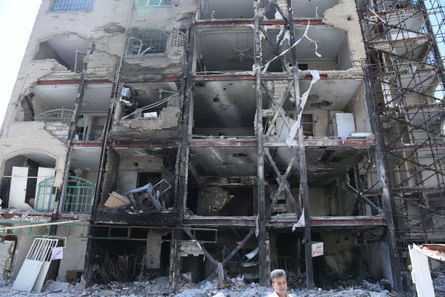
Now Mehdi, along with thousands of other Iranians who have filtered back to their homes or workplaces during the fragile truce, is navigating a city riddled with ruined buildings, destroyed infrastructure, an economy in turmoil and looming anxiety over the approaching ceasefire deadline.
“There’s a lot of talk about precision strikes,” he says. “Let me tell you: my favourite fast food place has been hit by a missile. The clinic we used to visit whenever a new wave of Covid or a cold came around is gone. Even the garden where I spent some of the best moments of my childhood was hit.”
Mehdi and his wife now sleep in their living room – the least damaged part of the house. He is trying to piece together paperwork for insurance, as they wait for whatever comes next. “Our home is now barely livable. In some sense, we’ve become war refugees.”
An economy in turmoil
The toll on civilian infrastructure across Iran has been immense, says Noor, an activist based in Tehran who stayed through the US-Israeli onslaught. Explosions have destroyed “schools, universities, pharmaceutical production centres, hospitals … civilian homes, private cars and city buses”.
Now, although the streets are full again, many people, especially those who rely on the internet, have lost their livelihoods. The internet blackout imposed by the Iranian authorities continues and has crossed a 45-day mark, leaving most of Iran’s population cut off from the world, and a few paying large sums to get online through Starlink and VPNs.
“Internet shutdowns have destroyed online jobs,” Noor says, “which were a source of income for many people, especially young people.” According to some estimates, about 10 million Iranians depend on internet access to run small businesses or make an income.
Iran had an affordability crisis before the war but now, Noor says, medications for patients with serious or chronic illnesses are difficult to find and, while food remains available in shops, “we can’t afford it”.
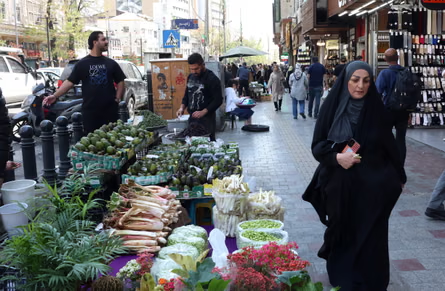
The economic pressure, dire before the bombing began, has now become unbearable, she says. “Almost all food items have become more expensive. Most people can no longer afford red meat and fish. Dairy products have increased in price by more than 40%.” Other people in Tehran say affording basic grocery items has become very difficult.
Adding to the worsening economic crisis, Noor says, factories are struggling to operate owing to a lack of raw materials, some construction workers have lost their jobs and many workplaces are laying off staff or reducing their workforce. Banks, international businesses and government offices are all under strain, as unstable internet disrupts basic operations.
Many schools remain shuttered and “mothers working in the private sector are facing difficulties in caring for their children, since kindergarten and schools are closed”.
‘Trapped between two wars’
Arash, 21, a student from Tehran, drove out of the city to stay with relatives after 10 days of war. The lack of information on what was happening around their neighbourhood, because of the internet blackout, had caused them to be worried and fearful. He has since returned to the city.
Even with a pause in the bombing, “I am hyper alert all the time,” he says. The atmosphere in the capital feels tense and heavily surveilled with security forces – including police forces, the Islamic Revolutionary Guard Corps (IRGC) and the Basij [state-backed militia] – running roadblocks and checking vehicles.
“They search vehicles and phones. One day, I saw all three [sets of security forces] in a single street and crossed all the three checkpoints. They are all heavily armed with Dushka rifles and AK-47s.”
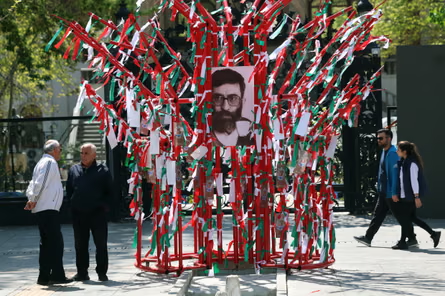
Some checkpoints have recruited children, he says. There have been reports of children used at checkpoints across Iran, a practice that amounts to the use of child soldiers, which is a war crime. In a March campaign to enlist civilians, called “Homeland Defending Combatants for Iran”, an IRGC official in Tehran said the minimum age for recruits had been set at 12.
“Some of them are kids [who look as if they are aged about] 10 or 12, and are armed. One of them told me he was 11 and he had a Kalashnikov,” says Arash, who says he feels devastated that children are “trapped between two wars” – the US-Israeli assault and the regime’s abuse of them.
Describing the feeling of facing a repressive state and the prospect of a return to war, Arash says: “You know the story of the person cooking the frog in water and slowly increasing the temperature? That’s how we feel right now. Slowly dying, but not realising.”
Fears for the future
As the two-week deadline marking the end of the ceasefire nears, all of those who spoke to the Guardian were deeply apprehensive. “Even if we think of rebuilding, we can’t: the ceasefire is fragile and the war can start anytime,” Arash says. “Hope is all we have, but that’s fragile too. I think of what [Donald] Trump said – that he would bomb us back to the stone ages. I am laughing now, thinking about it. But I am deeply worried he thinks that of us. Does he really think that of us Iranians?”
Despite the economic hardship and a “fragile ceasefire” that feels like a “ticking timebomb”, Noor says the people of Iran are still hopeful. But she worries that there is no clear plan on how to protect civilians during the war and its aftermath.
“We just have to be hopeful in ourselves. We believe in the power of our nation,” she says.
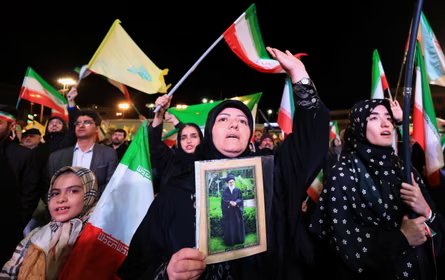
The controversial comments by the US president, threatening to “unleash hell” and “destroy Iranian civilisation” are also on the mind of Mehdi, who fears a future filled with “one-tonne bombs, nightly bombardments, the destruction of this country’s infrastructure. It feels like nothing awaits us but [Trump’s threat of] ‘a return to the stone age’.”
For Arash, this period stuck in a limbo is “the worst outcome … the city is in ruins and we are in a worse economic situation than we were in.”
“I don’t know who is winning this war, but we know who’s losing,” he says. “It’s us, ordinary Iranians.”