








Three months ago, Manpreet was looking forward to her 11th birthday party. Her brother Guri, 12, was excited about his class field trip for Black history month.
Now their future looks like a void.
The siblings and their parents have been detained since February at the Dilley immigration processing center in Texas, after they were taken into custody during a routine check-in appointment.
Their father, Jagdish, worries that months of detention have changed his children.
Manpreet is often angry or cranky. Guri has more or less stopped listening to his parents. “They were never like that before,” Jagdish said. But he understands why.
“The kids keep spinning on the same questions: ‘what will happen next? When will we get out? Where will we go?’” Jagdish said. It hurts that he can’t give them any answers.
The family said they fled Punjab, India, because Jagdish, who had converted from Sikhism to Catholicism, faced persistent threats and violence in his community due to his religion. They arrived in the US in 2022 seeking asylum, and settled in central Los Angeles, near Jagdish’s brother and his family.
When they received notice to check in at an immigration office, they assumed it was because the government wanted updated photos of the kids – they were growing up fast, and their faces were changing. Then an immigration officer told them they were being detained. “In that moment, it was like my life force was sucked out of me,” Gurwinder, their mother, said.
They joined more than 5,200 parents and children who have been detained at Dilley since it reopened after Donald Trump resumed family detentions last year. Pediatricians, psychiatrists and physicians have repeatedly warned that any amount of time in detention can be detrimental to children, and that prolonged detention can cause profound physical and mental harm.
In recent months, reports of the conditions inside Dilley have sparked protests and national outrage. Celebrities including Madonna, Pedro Pascal and children’s educator Ms Rachel joined lawmakers in calling for an end to family detention.
In February, the Department of Homeland Security (DHS) imposed quarantines at the detention center after detecting at least two cases of measles. In interviews with journalists and oral testimonies included in ongoing litigation against family detention, parents have reported that their children have caught respiratory illnesses and gastrointestinal issues, and experienced vomiting and other severe health complications that the facility seemed ill-equipped to treat. A nine-month-old lost 8lbs over the course of a month at Dilley; a child with a severe ear infection wasn’t treated in time and suffered partial hearing loss.
Parents have also repeatedly described children falling asleep crying, developmentally regressing and becoming anxious, angry or listless. Older children have started wetting the bed again; teenagers have started to self-harm.
In a report published this month, the legal services non-profit Raíces and advocacy group Human Rights First documented “widespread due process violations, inhumane conditions, and lasting physical and psychological harm inflicted on families” incarcerated at Dilley. The report included testimonies from children who said they stopped playing in the facility’s yard because guards yelled at them, and stopped attending school because an instructor kept talking about why they had been detained, and made them feel scared about what would happen next.
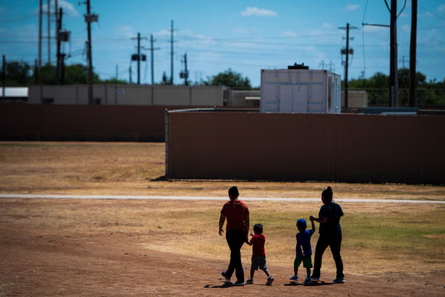
In interviews with the Guardian, Manpreet said she’d lost at least 6lbs after a week when she couldn’t stop vomiting. Guri said he worried he was going to go “crazy” inside Dilley.
He feels sad, he said, but also bored. “We sometimes entertain ourselves,” Guri said. They collect empty plastic water bottles, and take turns hitting them on each others’ heads: “Like, I hit it on her head, she hits it on me.”
On Manpreet’s birthday – which came about one month into the family’s detention – her parents assembled a sort of “cake” made with snacks they bought from the center’s commissary, and everyone in the cafeteria sang Happy Birthday to her. But there were no candles. If there were, she said, she would have blown them out and wished that she and her family could get out of Dilley.
Each member of the family has been sick since they arrived.
Jagdish – who had been in a car accident prior to arriving in Dilley – has been experiencing pain in his leg, but said the medics at Dilley have been unable to offer him anything other than over-the-counter painkillers. Guri has been noticing blood in his stools – an issue that began prior to his detention – but said the staff at Dilley haven’t been able to refer him to a specialist to diagnose the root cause. Manpreet, meanwhile, has been experiencing bouts of intense stomach pain and vomiting – she believes it is due to the tap water at the facility, she said. She said her symptoms went away after she started drinking bottled water from the commissary – the cost of which was reduced after a congressional group visited Dilley.
Gurwinder’s health has declined the most dramatically. Her arthritis symptoms have flared to an unbearable level since arriving at Dilley. Back home, she used to manage it with medications as well as regular massages and hot soaks. The medical center at Dilley was not able to provide the same medications she used to take, she said – instead, she was prescribed ibuprofen, which did nothing, and steroids, which made her diabetes harder to control.
So each morning, her daughter helps her out of bed, fixes her hair and gets her dressed, and then the duo walk over to the cafeteria to meet up with Jagdish and Guri, who sleep in a separate room.
Neither of the kids has much of an appetite. Back home, Manpreet used to like making herself cake, fried rice or slushies – her mom had taught her the basics of cooking, and she learned new recipes on YouTube or created her own concoctions. Guri, meanwhile, preferred the traditional Indian fare: aloo parathas and lassi that his mom or his aunt made.
Now, they mostly get mystery meats, or unseasoned vegetables, they said. For Gurwinder and the kids – who practice Sikh-Hinduism and are required by their faith to eat vegetarian on Tuesdays and Thursdays – there haven’t been meat-free options available. “So on those days we often go hungry,” Gurwinder said.
During stretches when Gurwinder needs to stay at the medical center, Manpreet sleeps there with her, on a cot set up next to her mom’s bed. Despite having a “perfect attendance” award at her school in Los Angeles, she hasn’t been taking classes at Dilley. She likes to stick near her mom in case she needs help. And anyway, the only class that was being offered for her grade was geared toward students who primarily speak Spanish, which she doesn’t understand. There aren’t many age-appropriate kids’ books at the library, and the few ones they do have are in Spanish, Guri explained. “They don’t have, like, Diary of a Wimpy Kid in English,” he said.
It’s hard to see his mom in such a state, Guri said. He used to attend school at Dilley regularly – at least the morning classes on math, science and English. But he stopped as his mom’s health began to deteriorate; it became too difficult to concentrate.
So instead he tries to see his mom when he can, and he spends the rest of his day watching TV in his room with his dad. Sometimes he plays volleyball with the other kids in the evenings. He gets sad, he said, each time one of his new friends leaves: “It makes me think about how I wish we could leave too.”
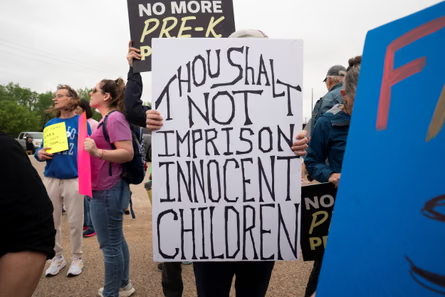
In recent months, the daily population of children at Dilley has dropped from more than 450 in January to about 80 in March.
The facility is operated by the private prison company CoreCivic under a contract with DHS. DHS did not respond to the Guardian’s specific questions about detained children’ s access to schooling and educational materials, and complaints about the food quality or medical care. Acting DHS assistant secretary Lauren Bis did not specify whether Dilley accommodates special diets as required by detainees’ religions. Bis did write that the agency generally provides three meals a day, as well as access to education and healthcare. She also said there are no active cases of measles at the facility.
The Dilley facility is operated by the private prison company CoreCivic under a contract with DHS. In a statement to the Guardian, Ryan Gustin, senior director of public affairs, disputed “many of the claims about the facility” that the Guardian raised, but did not specify which ones.
Asked about the family’s specific medical concerns, Gustin said CoreCivic does not comment on individual cases but said the company “continually evaluates our practices to ensure that families in our care receive safe, appropriate, and timely medical attention”.
The US government has been detaining immigrant families for decades. The George W Bush administration was the first to open a large-scale family detention facility. Then, when the Obama administration first opened Dilley in 2014, the move was immediately met with public outrage. In lawsuits, human rights advocates provided testimonies from parents and children facing medical neglect and mental anguish. Still, Donald Trump continued the practice during his first administration, until Joe Biden ended it in 2018.
In the interim, lawsuits and studies continued to show the profound and lasting harm that detention can have on children. In 2023, researchers affiliated with Harvard University and Massachusetts general hospital analyzed the medical records of 165 children detained from 2018 to 2020 at another, former family detention facility, and found evidence of medical neglect and mental and physical harm resulting from detention.
Jagdish begins to cry thinking about what his children are now facing. He worries that the children will blame him for what’s happened, because they needed to flee India after he changed his faith. “I worry I came here to save myself, and I ended up ruining three lives,” he said.
At the same time, he and Gurwinder feel helpless to change things. “My kids’ lives are being ruined. Their education is being messed up,” she said. “But we don’t know – what can we do?”