


In the novel Rabbit, Run, John Updike has one of his characters, a groovy and progressive 1960s priest, calling round to talk to his fellow minister, a hard German Lutheran, about the secret doubts he harbours about his faith. Is the doctrine really necessary? Is hell just, you know, a metaphor? He likes Jesus. But maybe he also likes sinful things, like sex and recklessly open attacking football.
The hard German Lutheran takes one look, curls his lip and tells the groovy progressive priest to get down on his knees in the kitchen and beg for forgiveness. Who is he to reason with divine suffering? Life is pain. Joy is pain. Pain is pain. Frankly, the groovy priest who likes flying full-backs and an open midfield disgusts him. He will burn in hell for his spineless debauchery. The groovy priest leaves in tears.
Cutting straight to the views of Clarence Seedorf on Amazon Prime after the 5-4 between Paris Saint-Germain and Bayern Munich on Tuesday night felt a bit like this. Seedorf is an excellent pundit, hugely informed and quietly twinkly, with the brow, the jaw and the eyes of some terrifyingly austere US president, all brackish integrity and ramrod restraint, but dressed in golf clothing and stood next to Wayne Rooney.
What Seedorf said about the virtues of structure, about entertainment versus restraint, was in many ways very Dutch, even perhaps quite Lutheran in tone. Yes, goals are good. Fun is fine. But football is also control and defence. Football is not conceding four goals at home. Arsenal and Atlético Madrid can study this, feed on it as a weakness to be gouged open. And good luck to them both with that.
Seedorf is clearly right on his own terms. He played in a great Dutch possession team. He understands on a cellular level the high Italian church of defensive discipline. It was also undeniably pleasurable, astringent, vinegary to hear this proselytising tone after the wild guilty pleasures of Parc des Princes. Oh yes, Clarence. Lash me, daddy. I am weak. I am human. I am scum.
But like so many contrary thinkers, Seedorf also found his message piggybacked by zealots with other axes to grind. In the rage-fuelled brain-blurt of the internet, Seedorf has been cast by some as a roundhead, a spoilsport and thief of joy. How much more attractive just to coo at the future-football, to ask why everyone can’t be like this, to make the mistake people often do in sport, of confusing spectacle and content, assuming that to be beautiful is to be righteous, good, moral.
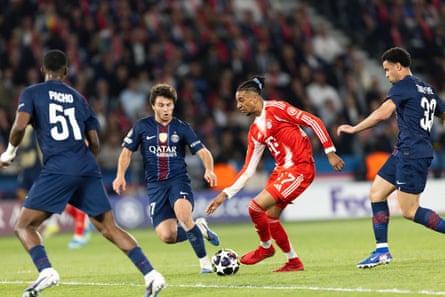
Let’s put something out there. It’s OK to love Paris Saint-Germain and Bayern Munich chewing pieces out of each other in Paris like doomed existentialist lovers. And it’s OK also to love Seedorf being everyone’s dad about proper defending. Both can be good. Nobody has to feel bad. But he also raises a very interesting point of tension in the strange, unplanned journey of the world’s dominant pop-cultural product.
PSG versus Bayern was wildly entertaining, a game of creative hyper-ball between two teams at the peak of their technical and physical capacities. This was a glimpse of the outer limits of what is possible now, fine-tuned by fitness, technique and high-level coaching. The question, asked more widely, is why don’t Premier League teams have this attacking verve?
Why do English clubs choose control? Where do they get off, not being twinkle-toed beautiful boys scoring five to your four? Why choose instead the path of pigeon-chested defence, crouched inside their tactical pillbox? Why not choose sunlight and fearlessness, Michael Olise constantly one-on-one against a flying full-back?
So: in defence of the Premier League. A more objective response is that you can only really have one of these things. You can have a brutally competitive league, with live games right to the end. Or you can have just one domestic team of brilliantly fresh elite attacking footballers, primed to reach their peak levels in April.
To consider this properly it is necessary to understand what Bayern and PSG are. Which is, single-issue superclubs. Their entire season is planning for nights like these, gearing everything – recruitment, tactics and workloads – to that peak of urgency in late spring.
Luis Enrique has made this happen two years in a row. Bayern also came to Paris fresh and mono-focused, already German champions, averaging four goals a game since March. Both clubs can do this because they have the income and status to hire elite players; and because they play in domestic leagues that are dysfunctional and subservient, where weekends from autumn to spring are essentially high-end practice and conditioning.
Compare this with Arsenal, the most disdained of all the insufficiently sparkly English teams. Mikel Arteta’s players are currently risking their own careers in pursuit of the Premier League title, taking bites out of their own futures to keep playing these games. It makes for a haunting spectacle at times. You can feel the damage being done. Bukayo Saka has sacrificed his highest levels to the twice-weekly churn. Are Ben White and Martin Ødegaard ever really going to be right again?
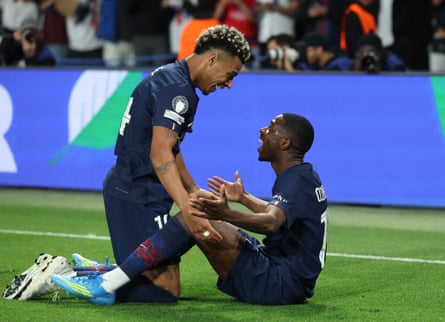
Are the players of PSG and Bayern killing themselves in the same way? Ousmane Dembélé is carrying the usual strains, but has also played only one full Ligue 1 game this year, and only really turns out in earnest for the Champions League.
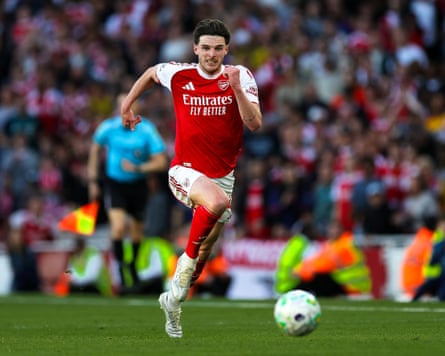
Declan Rice, meanwhile, is burning through his reserves every week, taking on the most draining games of his career in a state of near-exhaustion. And doing so in a league where every team is out to get you, high-class players desperate to impress, sustain, find a platform to the next level.
A team as well-resourced as Chelsea gets run out of town on a regular basis. The ninth-richest club in the world is staring at relegation, one of the great modern sports stories. Arsenal and Manchester City play a final every week. But at the same time, why aren’t they out there running all over these box-fresh hyper-talents who have essentially been tuning up for the past three months?
The same applies to the expression of individual talent. Why doesn’t the Premier League have truly elite creative stars? It does. They’re just not being encouraged to show it. The best players in England are asked to function twice a week through a brain-fogging season.
Want some evidence it might be easier to find your creative peaks at a club like Bayern? Check out their former Premier League contingent. These include: a very talented ex-Crystal Palace winger, the manager of relegated Burnley and a Spurs striker incorrectly dismissed as a trophy dodger.
At Bayern, Olise has become the most improved player in Europe, Vincent Kompany the next elite manager and Harry Kane a much-revered Ballon d’Or contender (he also gets games off when he’s injured now). Liverpool let Luis Díaz go; now he is out there running about like a baby impala, playing with his footballing third eye wide open.
It is possible Bayern would still be able to manage their players like this if they competed in the Premier League. More likely they’d be tied to the same wheel, forced to buy for depth, steeling themselves for a perky and prepped Brighton away in midweek.
There is, of course, an irony here, a wheel of cause and effect. The Premier League is entirely acquisitive, a clearing house for other people’s talent. It is English football’s own economic might that has stripped European leagues of depth, creating these mono-structures where the sole Champions League mega-predator can run its season as it pleases.
Give Kevin Schade and Fabian Hürzeler back to the Bundesliga, raise some of your own coaches, your own golden boys, and the Bayern you face in April might be stretched just as thin.
For now it is hard to avoid the sense of two distinct codes in play. If the football looks different, that’s because it is. If the players look primed and creatively fresh in the European version, that’s because they are. By accident, not design, this is what we have, something that is both beautiful and wild, a perfectly pitched reflection of the forces that brought us here.
We can pine for the fun version every week, sport as an endlessly addictive series of high-end reels. We can fall to our knees and beg forgiveness from the deities of free market economics and nation-state soft-power projects.
Or we can accept what Seedorf was really getting at on Tuesday night. That it is still entirely possible Arsenal or Atlético will end up winning the final with an own goal from a corner after 90 minutes of migraine-ball. And that this really would be entertainment – or at least, confirmation that sport retains its gallows sense of humour.