






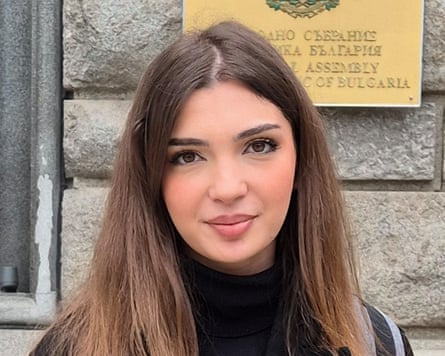
Anna Bodakova’s days tend to be rather hectic at the moment. Hopping between meeting voters on the street, political debates and recording videos for social media, the 23-year-old is standing to become an MP in Bulgaria’s general election.
Last year she was among the many young Bulgarians who participated in countrywide mass protests over the government’s economic policies and perceived failure to tackle corruption. Those protests ultimately resulted in the resignation of the prime minister, Rosen Zhelyazkov, and his cabinet in December.
Bodakova, a recent sociology graduate from Sofia University, is standing for the pro-European We Continue the Change-Democratic Bulgaria (PP-DB) coalition.
“The protest is only half of the work,” she said. “I’m a firm believer in the parliamentary republic. I’m a firm believer in the democratic process. I want to turn what was expressed in the protest into laws and into rules.”
On Sunday, four months after the government’s resignation, Bulgarians will head to the polls for the eighth time in five years. Like Bodakova, many Bulgarians born around the turn of the millennium hope their country can surf on the protests’ wave and finally, after years of political turbulence, take a decisive step towards a more democratic, pro-European and corruption-free future.
But the hopes of this generation look likely to collide sharply with the ambition of the former president Rumen Radev – known for his pro-Russian rhetoric and opposition to Bulgaria’s adoption last year of the euro, as well as to military support for Ukraine – to become prime minister.
Compared by some to Viktor Orbán, Hungary’s recently defeated rightwing populist, Radev is leading in the polls, buoyed up by the support of older, rural voters who hope he can smash what he calls an “oligarchy” of corrupt veteran politicians.
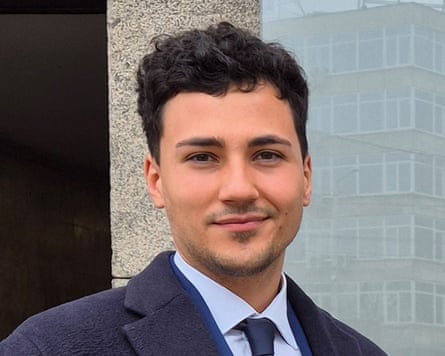
For voters like Aleksandar Tanev, 22, Radev is not a credible option. The law student believes Radev, who resigned as president in order to run in this election, “is part of this same model” of politicians and “had the opportunity to use the caretaker governments to fight this mafia” as president but did not.
Dimitar Keranov, a Bulgarian fellow at the German Marshall Fund’s European resilience programme in Berlin, said voters were split along broadly generational lines. “I don’t think [Radev] would be a straightforward vote for young Bulgarians, because I think he represents the same status quo young Bulgarians would like to see dismantled,” he said. “He’s representing the same old guard or the usual political elite.”
A victory for Radev’s Progressive Bulgaria (PB), a left-leaning but Moscow-friendly coalition, could prove another headache for Brussels and its allies just as the EU breathes a sigh of relief over Orbán’s demise. On Wednesday, amid concern over the rising cost of living, Radev took aim at the previous government for its introduction of the euro “without asking” voters. “And now, when you pay your bills, always remember which politicians promised you that you would be in the ‘club of the rich’,” he said.
In July 2023, his apparent sympathy with the Kremlin prompted a scolding by Volodymyr Zelenskyy in Sofia’s presidential palace. “You would say ‘Putin, please grab Bulgarian territory?’” asked the Ukrainian president.
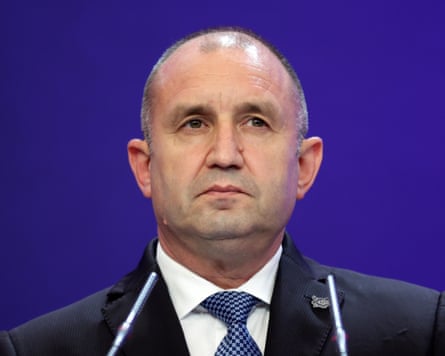
Last year Radev said EU support for Ukraine was a “doomed cause”, and last month he criticised a security agreement signed between Ukraine and Bulgaria. In a recent interview, he said Bulgaria’s status as “the only member state of the European Union that is both Slavic and Eastern Orthodox” meant it could be “a very important link in this whole mechanism … to restore relations with Russia”.
Bulgaria, a country of 6.5 million people sandwiched in the south-east corner of Europe between Greece and Romania, has struggled to find a way out of a long-running political crisis in which successive weak coalitions have failed to survive and trust in democratic elections has waned.
The political turmoil, alongside allegations of endemic corruption and a captured judiciary, have contributed to historically low trust among voters in their governments and institutions – and election fatigue. The turnout at the last election in 2024 was just 39%, suggesting many did not see a point in casting their ballot.
The run-up to the election on Sunday has been chaotic. Parties have accused each other of wanting to steal the election, several hundred people have been arrested and at least €1m has been seized in police operations against alleged vote-buying.
Meanwhile, the Sofia-based Centre for the Study of Democracy (CSD) has said the country has been targeted by a disinformation campaign spreading pro-Russian and anti-western content, highlighting its vulnerability to outside threats.
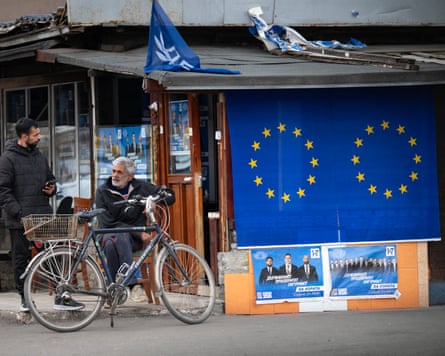
Some analysts believe the Hungarian election, in which Orbán’s defeat after 16 years in power was caused at least in part by high numbers of young people coming out to vote for his opponent, will prove a galvanising force in Bulgaria.
Asen Lazarov, 26, a co-founder of Active Politics, an NGO that aims to make politics more accessible, said he was hopeful of a higher turnout than last time.
“We believe that once you increase voter turnout, no matter which party goes to power, they will feel more responsibility towards the people, towards the institutions,” he said. “And once we get higher voter turnout, the power of manipulated votes goes down.”
Others are less optimistic. Polls show Radev’s PB is leading with about 30% of the vote but is likely to fall far short of an outright majority, meaning he will probably have to form a coalition that could well end prematurely, leading to yet another election.
Keranov said: “Honestly, I highly doubt that these elections right now will produce any real change.”
Tanev, however, cautioned that ousting an entrenched political elite was necessarily a lengthy process. “That’s not ‘five protests, one election and Bulgaria’s a democratic, normal country’,” he said. “No, that’s a very long-term fight. This election is a very good opportunity. We need to try to decrease the influence of this status quo.”
此内容由惯性聚合(RSS阅读器)自动聚合整理,仅供阅读参考。 原文来自 — 版权归原作者所有。