







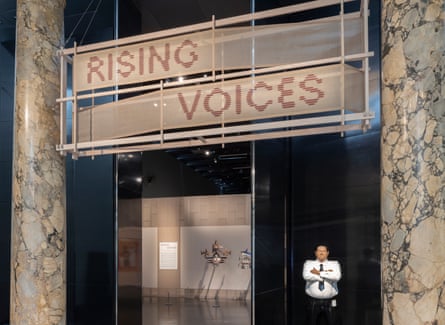
An imposing new figure is greeting visitors inside the main entrance of the Victoria and Albert Museum (V&A) in South Kensington. Standing on one side of the domed hall, across from the galleries dedicated to medieval and Renaissance European art, is a lifesize, fibreglass sculpture of a burly bouncer. The Māori nametag hanging from his belt loop suggests he has travelled a long way from home.
This character, Kapa Haka (Whero) by Michael Parekōwhai from Aotearoa New Zealand, is a symbolic guardian for the exhibition Rising Voices: Contemporary Art from Asia, Australia and the Pacific. Produced in partnership with the Queensland Art Gallery | Gallery of Modern Art (QAGOMA) in Brisbane, the show includes more than 70 works which have never before been exhibited in the UK, by artists from 25 countries who have featured through the decades in QAGOMA’s Asia Pacific Triennial of Contemporary Art (APT).
It’s the latest in a recent wave of shows that have brought works from Australian galleries to international institutions. Last year, Tate Modern hosted Emily Kam Kngwarray in collaboration with the National Gallery of Australia, and the National Gallery of Victoria’s exhibition The Stars We Do Not See: Australian Indigenous Art is now touring the US.
Daniel Slater, director of exhibitions at the V&A, thinks these exhibitions are overdue. “The responsibility has been on us to bring these incredible works here,” he says, and until recently, “we simply haven’t.”
When it was established in 1993, the APT was the first major exhibition dedicated exclusively to contemporary art from Asia and the Pacific. Since then, it has drawn more than 4 million visitors to QAGOMA and been a launchpad for some of the biggest names in art, including Cai Guo-Qiang, the Chinese artist famous for working with fireworks, and the South Korean star Lee Bul, best known for her sci-fi-inspired installations.
Despite the APT’s influence in Asia and Australia, QAGOMA has only toured a selection of works from one triennial once before – to Santiago, Chile, in 2019; this is the first ever triennial survey to be held anywhere in the world.
Slater began dreaming of the exhibition in 2018, when he visited APT 9. At the time, he was working for Tate. “I couldn’t believe we weren’t falling over ourselves to try and make this into an exhibition for a UK audience,” Slater says.
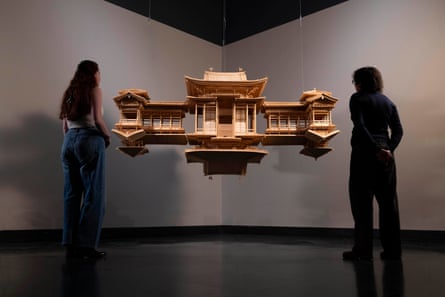
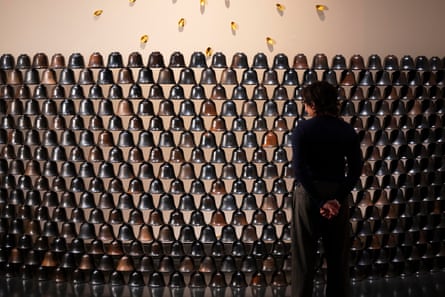
Turning that idea into a reality was a challenge. For more than two years, conservation specialists at QAGOMA have been navigating the practical challenge of safely transporting the works across the globe. Among those that have made the journey are Thai artist Montien Boonma’s monumental installation Lotus Sound, a curved wall made from hundreds of stacked terracotta bells; Japanese sculptor Takahiro Iwasaki’s intricate wooden model of the Phoenix Pavilion in Kyoto, which measures nearly three metres long and is installed suspended from the ceiling; and delicate works made from feathers, shells and shark’s teeth.
Then, there were questions about how to condense three decades of triennials into one exhibition. “How can we capture the essence?” says Tarun Nagesh from QAGOMA, who co-curated Rising Voices. “What values are we going to bring to a project like this, taking this collection and idea to the other side of the world and a whole new audience?”
Slater and Nagesh devised a four-part show. The first room gives visitors a “subtle introduction”, Nagesh says, featuring paintings, textiles, a video and more to illustrate the diversity of works; visitors then move through thematic sections dedicated to politics, materiality and spirituality.
Two of the works in the introductory space are by Judy Watson, an Aboriginal artist from Waanyi country in north-eastern Australia. Watson was featured in the very first APT and has visited almost all of them since.
One of Watson’s paintings is Memory Bones, which depicts a series of white, rib-like shapes lying over a splash of red, symbolising the broken bones and blood of Mulrunji Doomadgee, an Aboriginal man who died in police custody in 2004. The overincarceration of Indigenous people and the number of deaths of Aboriginal and Torres Strait Islander people in custody remains a national crisis in Australia. In 2025 alone, 33 First Nations people died in custody, the highest number since records began in 1980.
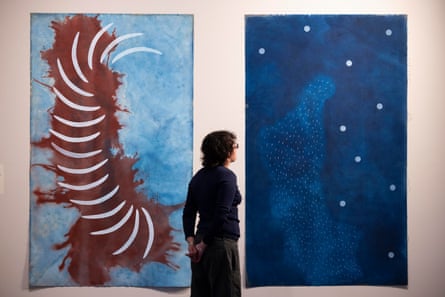
Watson describes making the work as a “grieving process”. She says it reflects on the “colonial violence, I would call it, that’s still ongoing within Australia”.
Beneath the red stain is a wash of watery blue pigment, a nod to Waanyi country, which is dotted with springs and crisscrossed by creeks and rivers. “David Attenborough talks about it being one of the most special places in the world,” says Watson; Attenborough has spoken with particular fascination about the fossils found in the region, including bones of ancient marsupials the size of sheep that grazed in the treetops. This paleontological record gives an extraordinary glimpse into deep time. “Often when I’m using the colour blue, I talk about the blue being the colour of memory, of water, of the subterranean springs,” says Watson. “It’s like the idea of memories washing over you.”
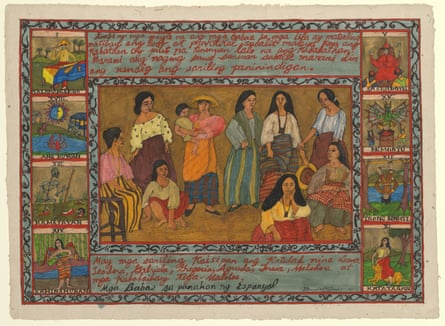
Other reflections on colonialism include work by the Filipino artist Brenda V Fajardo, whose vibrant paintings are framed by characters from tarot cards, through which she presents a reading of Filipino history during Spanish and American rule, highlighting the resilience and courage of women.
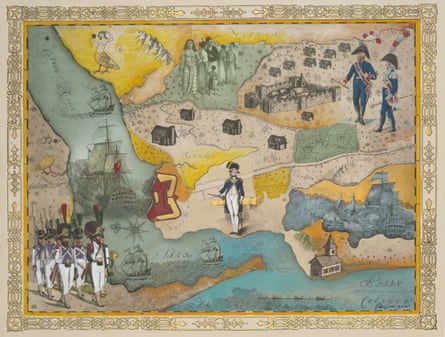
Sri Lankan artist Pala Pothupitiye reappropriates colonial maps to show how waves of European imperialism have shaped Sri Lanka’s art and society. In Kalutara Fort, he depicts a garrison that was built by the Portuguese, taken over by the Dutch and surrendered to the British. Today, no trace of the fort remains. On the site stands a Buddhist shrine.
To have so many works from former British colonies hanging in London – in a museum housing masterpieces from British history, and monuments to the monarchy itself – is itself a challenge to historical hierarchies. Slater and Nagesh hope visitors will take meaning from the juxtaposition: the flecks of blue in the shell necklaces by Tasmanian Aboriginal artist Lola Greeno, for example, might spark thoughts about the sapphires in one of Queen Victoria’s coronets, which is on display upstairs. “I know all those visitors who have seen those other exhibitions will see [Greeno’s necklaces] and they will experience them in the same way as they have 50 million pound tiaras,” says Slater.
At Rising Voices, Slater hopes visitors will experience the same sense of “absolute discovery” he felt when he first visited the APT. “It’s a chance for us to try and really make clear to the public that the story of Asian and Pacific art is not a story on the periphery of global art-making, but is absolutely at the core of it.”