





It’s set to be hot in North America this summer. The “seasonal temperature outlook” for the US, compiled by the National Weather Service, suggests every part of the country will experience temperatures above the historical average in June and July. It’s into this environment that 48 men’s national teams will arrive, all competing to win the World Cup in the US, Canada and Mexico.
As the tournament approaches, the Guardian has taken an in-depth look at the meteorological conditions players could face, how they have changed since the last time the World Cup was held in North America in 1994 (when the US was the sole host nation), and the locations most likely to expose players to stressful levels of heat.
Included among the findings is that each of the matches staged in Miami is likely to exceed key temperature thresholds, while every venue bar the Azteca Stadium in Mexico City has had heat levels rise over the past 30 years. Researchers warn that many games will be unsafe for players and fans. Fifpro, the global players’ union, nonetheless credits Fifa with listening to their concerns and taking some steps to ameliorate the risk to player health.
High levels of heat and humidity will impact the ability of teams to perform on the field. Wet bulb globe temperature (WBGT) is a measure that captures this risk. WBGT takes into account not just the temperature of the air but three further measurements: humidity, radiant heat (eg direct sunlight) and wind speed. Sporting bodies use WBGT to define limits at which elite sport should be played and, under published Fifa rules, if WBGT measurements reach 32C before a match, consideration should be given to suspending the fixture. According to Fifpro, however, that level should be set lower, at 28C.
Research published earlier this year in the journal Temperature found that in 31 of the 57 matches played during last summer’s Club World Cup the mean WGBT temperature was above 28C. Analysing performance data for each match, researchers found “the higher the WBGT, the lower the distances covered by players at all analysed speeds, including at high speeds”. The research concluded that “environmental heat stress significantly affects the physical performance of soccer players”, with findings emphasising “the importance of adopting heat mitigation strategies to protect elite soccer players’ performance and health”.
Using data compiled by the group World Weather Attribution (WWA) we can build an assessment of which matches are likely to be subject to heat risk this summer. Their findings suggest 26 matches at the World Cup will be played when the temperature is at or above 26C WBGT, a threshold beyond which Fifpro argues cooling breaks should be used. Raise that threshold to 28C and probabilities fall starkly, with only five matches expected to hit that mark, but there are still 45 matches that have up to a 20% chance of reaching that level. Going higher still, the WWA data suggests a one-in-four chance that a game is played in WBGT of 30C. When compared to the World Cup of 1994, the numbers are starker: the total number of matches expected to exceed 26 has risen by 52%, while at 28C the number has grown by 75%.
The lead researcher on the WWA data, Theodore Keeping, a research associate in extreme weather and climate change at Imperial College London, believes it is “more likely than not” that the 28C threshold will be breached. He also says it is possible the WWA’s assessments turn out to be conservative.
“If there is an anomaly above the mean temperature, it will be conservative,” Keeping said. “Where direct sunlight is going to be an extra factor it could also have an impact.”
Loading ...
“Around half of human-caused climate change has occurred since the World Cup was last hosted in North America in 1994. As a result, the climate that the tournament is being played in today has fundamentally shifted in just 32 years,” says Joyce Kimutai, also a research associate in extreme weather and climate change at Imperial and part of the WWA. “While organisers have attempted to reduce the risk by scheduling some games in high-risk – uncooled – locations like Miami and Kansas City later in the day, there’s a very real risk that we’ll be faced with games taking place in conditions that are unsafe for players and fans.”
Three of the cities most exposed to possibly dangerous levels of heat – Houston, Dallas and Atlanta – have air-conditioning in their stadiums, effectively eliminating the risk inside these venues, though not outside them, which could yet impact spectators. Fifa announced a series of mitigating measures at the time of the World Cup draw, with kick-off times for matches in hotter environments often scheduled for the evening and a mandatory three-minute cooling break to take place in each half of every match. Fifa says it has gone further since, adding extra cooling capacity at stadiums and creating a “heat illness mitigation and management taskforce” to standardise responses when thresholds are exceeded. “Cooling bags” will be deployed to help treat those with “exertional heat illness”, while spectators will now be allowed to bring a full bottle of water into the stadium, something which was not the case last year for the Club World Cup.
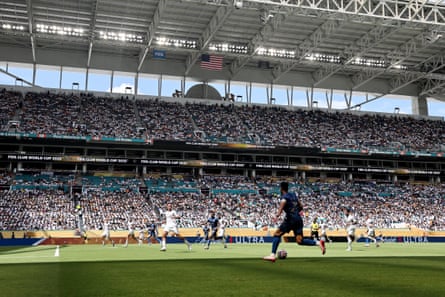
Again the Miami Stadium stands out as the exception, with none of the seven games scheduled to take place at the venue kicking off later than 7.30pm local time. Unsurprisingly perhaps, the two stadiums being used in Canada, in Vancouver and Toronto, are among the least at risk; but the three stadiums in Mexico also appear likely to be spared the worst.
If we look at the fixtures that are most likely to breach the WBGT thresholds and order them by team, it’s also possible to get a sense of which sides are most likely to be exposed to heat risk. Two of Uruguay’s three fixtures fall into a high-risk category, while Brazil, Cape Verde, Saudi Arabia and Scotland have one fixture each. At the other end of the scale, the USA have a low risk of heat impact for each of their three matches.
Loading ...
A Fifa spokesperson said: “Fifa is committed to protecting the health and safety of players, referees, fans, volunteers and staff. Climate-related risks are assessed as part of overall tournament planning and managed in close coordination with host cities, stadium authorities and national agencies.
“When forecasts indicate elevated temperatures (eg above defined thresholds), spectators will be permitted to bring one factory-sealed water bottle, and venues will activate additional cooling capacity, including shaded areas, misting systems, cooling buses and expanded water distribution.
“Work-rest cycles for staff and volunteers are adapted accordingly, and first-aid readiness is reinforced with clear triage and escalation pathways for suspected heat illness. These measures scale dynamically based on real-time conditions before and during each event.”
A Fifpro spokesperson said: “You can clearly see an effort to align the competition schedule planning and venue selection with the concerns around player health, but also player performance. The competition organiser has learned a lesson and has adjusted the schedule. It’s a normal and necessary thing to do. The lesson for everyone in the industry is that with a warming planet, heat conditions will play a bigger part in tournament and league scheduling decisions in the future.”