






Three vessels have been hijacked off the coast of Somalia in the past week, raising fears of a resurgence in piracy around the Horn of Africa, and adding to the woes of the global shipping industry.
The merchant vessel Sward was taken over on 26 April, a day after a dhow was seized. These followed the 21 April hijacking of Honour 25, a motor tanker carrying 18,000 barrels of oil, according to the Maritime Security Centre Indian Ocean (MSCIO), the tracking service of the EU’s naval force.
“All incidents remain ongoing …,” the MSCIO said in a statement on Monday. “Vessels operating in the area are strongly advised to maintain heightened vigilance … particularly within 150NM [nautical miles] of the Somali coast between Mogadishu and Hafun where feasible.”
Piracy around Somalia jumped in the late 2000s, peaking in 2011 with 212 attacks, according to EU naval force data. Pirates became more audacious, raiding ships as far as 2,270 miles off the Somali coast in the Indian Ocean.
An international naval coalition then stemmed the tide of attacks, cutting them to just a handful each year from 2014. However, incidents began to rise again in 2023.
Global shipping is already reeling from the near-total closure of the strait of Hormuz by Iran and attacks by the Iranian-backed Yemeni Houthi rebels around the narrow Bab el Mandeb strait. Ships have to sail through the straits to exit the Red Sea, one of the world’s busiest shipping routes, with many then heading around the Horn of Africa.
Sward is a cement carrier that left the port of Suez in Egypt on 13 April. It was en route to Mombasa, Kenya, when it was captured by pirates about 11km (6 nautical miles) from the Somali port town of Garacad. The ship had 17 crew members, 15 from Syria and two from India, according to three security officials from the autonomous Somali region of Puntland.
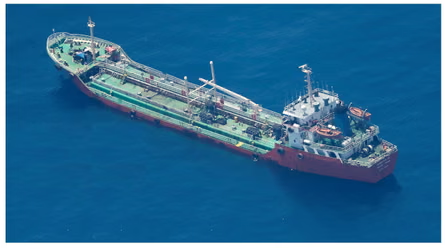
After the hijacking shortly after 8pm on Sunday, the pirates steered the ship towards the coast and anchored it in a remote area near Garacad. Six armed men and an unarmed interpreter fluent in English and Arabic then boarded the ship.
“He’s not only speaking with the crew but also dealing with the owner of the ship,” one of the security officials said. A second official simply put it: “The interpreter is in charge.”
As of Tuesday morning, four more armed men had boarded Sward, bringing the total number of pirates on board to 20, according to the officials.
Jethro Norman, a senior researcher with the Danish Institute for International Studies, said pirates had taken advantage of international navies diverting resources towards the Red Sea to combat the Houthi attacks, and Puntland’s Emirati-backed security forces being stretched.
Norman said: “Pirate networks are testing the waters again and they are better equipped than the last generation. GPS, satellite communications and hijacked dhow motherships let them operate hundreds of miles offshore.”
A third Puntland security official said that a shipment of khat, a narcotic stimulant widely used in the Horn of Africa, was taken out in a small boat to the pirates on the cement carrier on Tuesday morning. It had been driven about 150 miles from the inland city of Galkayo on Monday, suggesting that the pirates have a network on land and are potentially preparing for a long siege out at sea.