


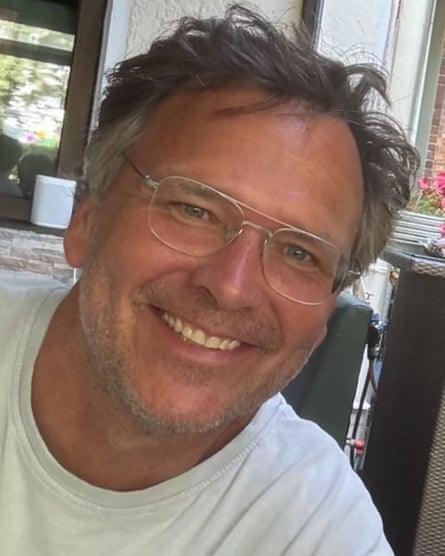
Olaf Köndgen is 64 years old, a German citizen and a senior European human rights expert who has lived and worked in France for several years. Last month, Köndgen learned that he is also the son of a Nazi.
Despite a strong interest in history and its lessons, Köndgen is typical of many 21st-century Germans in having had only the roughest outlines of his own family’s complicity with Hitler’s regime.
That began to change in early April, when the newspaper Die Zeit launched an online search engine for the vast archives of the National Socialist German Workers’ party (NSDAP), making information about individuals’ Nazi membership easily accessible for the first time.
Die Zeit has described an extraordinary response from the public, reflecting intense interest in unearthing long-buried family secrets more than eight decades after the end of the second world war.
The tool has been accessed “millions of times” and shared “by the thousands”, with more than 1,000 reader comments appearing on the site, according to Christian Staas, the newspaper’s history editor.
He said: “You have two things in play here: the passage of time and new technological possibilities to do research.”
After 1945 the majority of Germans saw themselves as “victims”, he said.
“There was little discussion of their own involvement, of their role as bystanders or accomplices, or of their knowledge of the regime’s crimes.
“Now that the generation of witnesses is passing away, many find it easier to ask critical questions and to verify the stories passed down within their families.”
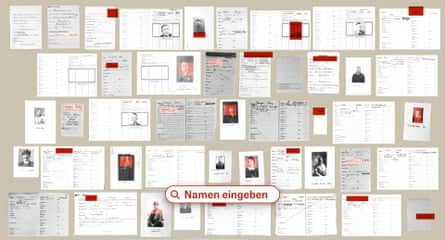
For Köndgen, the search engine took him from a decades-long academic engagement with the darkest chapters of his country’s history to a highly personal and emotional confrontation with the actions of his own flesh and blood.
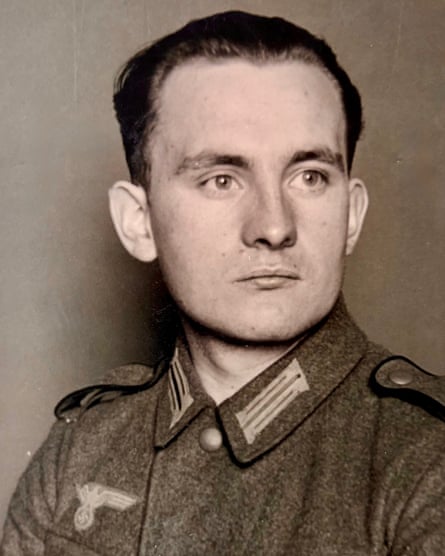
His father, Ernst, died when Köndgen was just a teenager, leaving a hole in his family that was filled with a degree of myth-making.
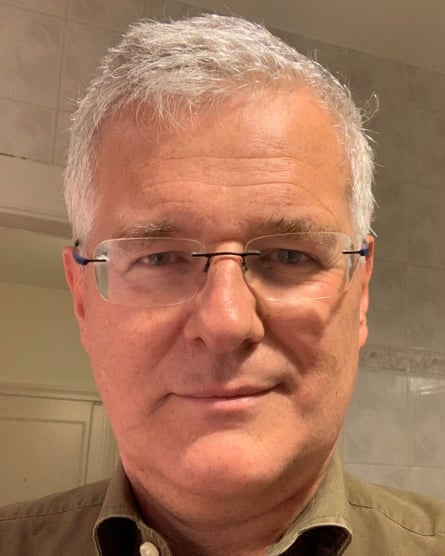
“When you lose your father at 16, you try, to the extent possible, to have a positive image of him,” he said.
The truth, he learned, was more complex.
Ernst grew up in a middle-class educated Catholic household as the son of a stern, distant father who had fought on the front in the first world war.
Köndgen said his grandfather Ludwig had gone on to join the Nazi party with sense among many veterans of “enormous humiliation” over the punishing treaty of Versailles, which Hitler exploited. Ludwig became a member in May 1933, just four months after the Nazis’ rise to power.
Köndgen was also previously aware that his father had volunteered to fight in the second world war.
But it took the online archive to learn that Ernst had also become a party member, on the day of the war’s start on 1 September 1939 – a “truly surprising” fact he said coloured his understanding of his motivations and character.
“I’d always convinced myself that he wanted to escape from this authoritarian home by joining the Wehrmacht [the Nazis’ armed forces],” Köndgen said.
“Now I realise that his main motive was perhaps actually ideological. Maybe, at the age of 17, he was truly convinced that this was a just war for the good of Germany and humanity. So that has now completely changed my perspective.”
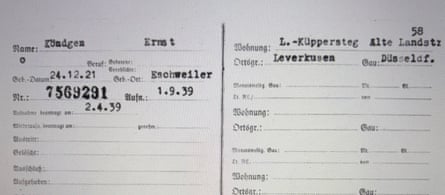
Between 1925 and 1945, about 10.2m Germans joined the NSDAP. Women were always a minority in the party, but their ranks grew sharply after the war began in 1939.
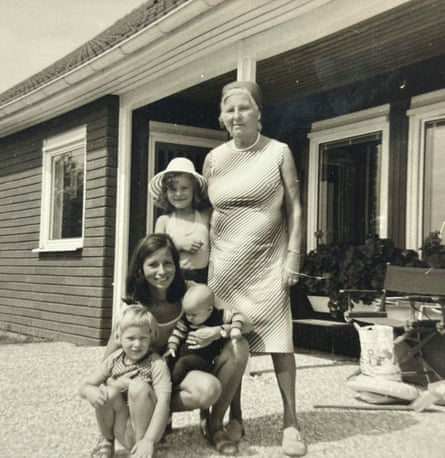
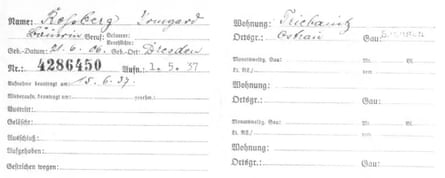
One of them was Irmgard Roßberg, the maternal grandmother of Niko Karsten, who, he learned last month, joined the NSDAP on 1 May 1937.
Karsten, 56, an environmental engineer, has vivid memories of Roßberg and the tension her severe presence produced in the family.
He said: “My mother was always at loggerheads with her – she didn’t like her mother because of her bossy, overbearing manner and racist remarks.
“She [Roßberg] would think of her beloved husband, who died far too young, and tears would start rolling down her cheeks,” he said, referring to his grandfather, a prosperous landowner who was also in the party.
Karsten said his interest in the family’s history was also driven by his fears of the current strength of the far-right Alternative für Deutschland, which has urged Germans to draw a line under its Nazi past. “It really upsets me because if you follow that racist way of thinking, history shows you end up in ruin,” he said.
The reasons for Nazi party membership ranged from ideological conviction, as most often seen among those who signed up early on, to opportunism among late joiners who saw a chance for career advancement.
But there is no historical evidence of Germans being forced by the party to join, or being signed up without their knowledge, as many claimed after the war.
While it was possible to be complicit in the Nazis’ crimes without being a party member, historians say its impressive ranks gave them a constant air of legitimacy.
The party kept notoriously precise records and just before the war’s end removed the membership files – an estimated 50 tonnes of paper – from its headquarters in Munich to a paper mill outside the destroyed city.
The mill’s manager, Hanns Huber, narrowly stopped the index cards from being destroyed. That autumn, American forces brought them to the Berlin document centre to assist in the postwar denazification process.
In the 1990s, the cards were entrusted to the German federal archives while microfilm copies went to the US National Archives, which made its holdings available online in late February.
Tight German data protection laws require families to file a request with the federal archives – a hurdle that long thwarted many of those interested. But the Die Zeit tool has now made the US records easily navigable.
Susanne Beyer, a senior editor at Spiegel magazine, published Kornblumenblau (Cornflower Blue) last year, a book about searching for the truth about her grandparents’ generation during the Nazi period.
She said it was time for a reassessment of Germany’s vaunted Erinnerungskultur or the culture of reckoning with its Nazi past.
She said: “Most Germans harbour illusions about their own families.
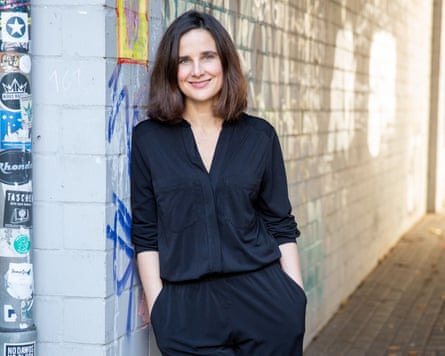
“Erinnerungskultur taught people what the main war criminals did. But when it comes to one’s own family, it still hits too close to home for many people.”
Beyer noted that the Nazis had deliberately tried to build the biggest base they could, also to make Germans as a nation complicit in their crimes.
She said: “It was so the Germans would continue to fight the war, and to fear defeat and retribution.
“That was also why Jews were rounded up in public places. In that respect, almost every German with German ancestors who lived during the Nazi era must assume that their family was involved in some way.”
Louis Lewitan, a psychologist who has researched the long-term effects of the Holocaust on survivors and their descendants, said he believed the festering secrets in many German families had left often invisible scars. He described the latter-day reckoning as potentially liberating.
He told Die Zeit’s weekly magazine: “A psychological legacy of vague anxiety, an unclear sense of identity and unconscious loyalties can take root – silence is a silent poison that continues to take its toll.
“The longer it persists, the more burdensome it becomes.”
Köndgen, who has now learned of another five Nazi relatives, said he can only speculate at his father’s motivation for joining the NSDAP after years of “unbelievable indoctrination” at home and school. He admitted he couldn’t rule out that he would have made the same choices under similar pressure.
He said his work today as a human rights adviser at the Council of Europe was rooted in the postwar credo “never again”.
“You won’t easily find a more convinced European than me,” he said. “European cooperation to prevent something like this ever happening again is the most important thing.”