





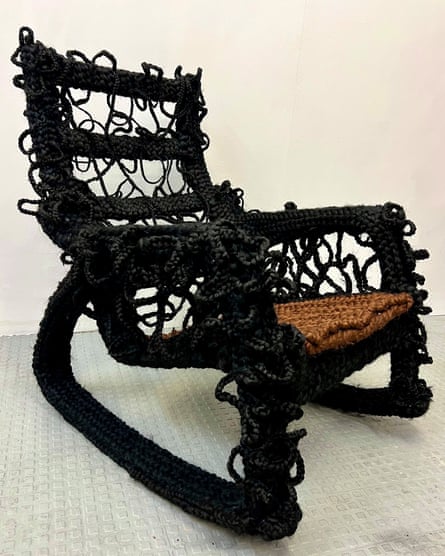
Taiba Akhuetie’s art is uncomfortable to look at. This is mostly because you’re not sure whether you’re in the presence of something alive or dead. She uses hair as her medium, constructing mundane items out of synthetic and human locks. Handbags, mirrors, rocking chairs and umbrellas are adorned with long, chunky braids and loose, pin-straight strands. The result is that these inanimate objects take on the eerie quality of taxidermy.
Akhuetie, whose work is about to go on show at the Sarabande Foundation in London, has memories of being fascinated by hair in her childhood. “We used to go to my mum’s friend’s house …” She stops and quickly corrects herself. “My auntie’s – she would be called auntie, obviously.” Akhuetie would watch her “auntie” braiding her sister’s hair, taken aback by how quickly her fingers moved. She also remembers doing plaits for her friends at school in Kingston, Surrey, and feeling that she was naturally good at it.
Yet for much of her childhood, Akhuetie didn’t like having her hair in braids. “I grew up in a white, middle-class area and wasn’t from money,” she says. “I started to realise that my insecurities were due to comparing myself to people that weren’t like me – and wanting to be like them.” When made to feel different due to her Blackness, she felt “gaslit” and dismissed. She decided to surround herself with people who made her feel secure in her identity.
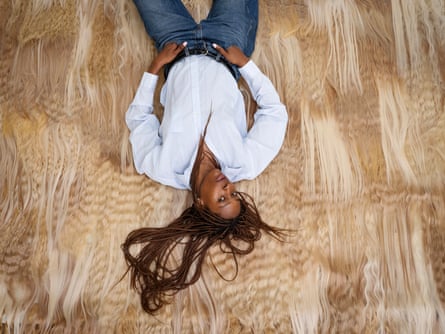
A shift in her perception of braids ensued. “I really started looking at them as something incredibly beautiful and therapeutic,” says the 34-year-old. In 2014, she launched Keash Braids with her schoolfriend Jessy Linton: part pop-up braiding service, part creative brand. Akhuetie “hustled my ass off” to build up clients, eventually establishing a permanent salon in Peckham, London. This was when braids were having a renaissance among Black women, in part sparked by the natural hair movement of the 2010s, when we put down our straighteners in favour of different, less damaging styles.
Then, when lockdown hit, Akhuetie had to find a new way to earn a living from braiding, with human contact not allowed. Was this even possible? “I was like, ‘You know what? I’m just going to do an installation out of these scraps of hair in my house and this random stool.’” The metal stool was wrapped in braids and teased hair, embellished with flowers and a bee. “That’s when I realised I could really use this as a medium ‘off the head’. I knew that was my path. I was like, ‘This is it. This is what I’m meant to do.’”
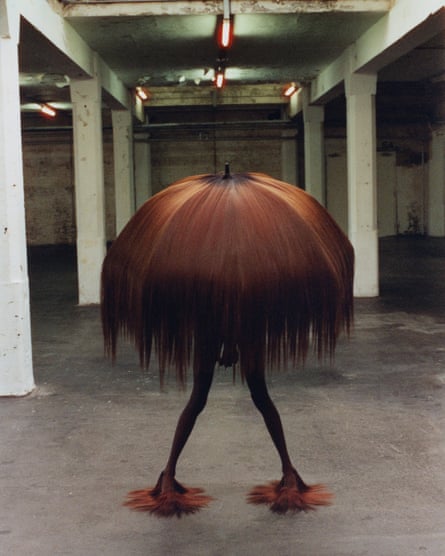
Akhuetie, who is based in Hackney, made her name with one piece in particular: a large umbrella affixed with abundant wefts of dirty-blond hair. She’d got inspiration when heading out one rainy day and looking for a brolly. The creation notched up 100,000 views on TikTok. And the world of couture has naturally taken interest in her wearable art, with Vogue praising her “super textural and avant-garde garments”, saying they give new meaning to the term “body hair”.
Akhuetie has been a stylist and now works with brands, happy to construct custom-made, wearable pieces to order. But she is adamant that she is not a fashion designer. Her work connects with a wide range of people and, while Black hair is clearly a direct inspiration, she describes her work as being “for everyone”.
In 2021, Akhuetie received an Instagram message from Rihanna asking for a bespoke piece and had to reassure herself that it wasn’t some kind of prank. The result – a braided Louis Vuitton handbag – is so intricate that, at first, it just looks like a handbag. Akhuetie has also dressed the Nigerian singer Tems for a Met Gala afterparty, as well as the film star Cate Blanchett.
Yet Akhuetie, who comes across as familiar and relaxed as we chat by phone, is careful to avoid getting too swept up by high-profile collaborations. “I don’t think you should fixate on celebrities,” she says. “It can be easy to be like, ‘Oh my God, a famous person really likes my work! I want to do something with them.’ But you have to ask yourself, ‘Would it really make sense if I made something for this person? Or am I just doing it to get two steps ahead faster?’” She pauses and adds: “‘If someone is wearing my pieces, it has to be someone that embodies my work as art.”
When I ask where Akhuetie sources her hair, I expect her to mention one of the emerging upmarket braiding hair brands that few women can afford. But I’m surprised to find it’s my local, Pak’s in Dalston, which gives her a discount because of how much she buys. The brands she lists – Impression, X-Pression – are all products that have recently been in my own hair, too.
This brings a groundedness, an authenticity, to Akhuetie’s creations, as well as a mirroring between the work and any potential viewer – a sort of cannibalistic gaze. “It’s the same hair I use on my own head,” says Akhuetie, who has also adorned a number of actual mirrors with braiding hair – perhaps playing on, and deconstructing, the idea of looking at one’s own hair in the mirror.
Potentially, there are many elaborate and theoretical interpretations of Akhuetie’s work. As we talk, I proffer a few, but notice she leaves things very open. How does she want people to feel when they look at her work? “A bit confused,” she says. “I want them to be like, ‘What? I don’t really understand how that’s hair.’ I also want people to be intrigued as to why I’m doing it. But actually, I just really love the beauty in what I’m doing.”
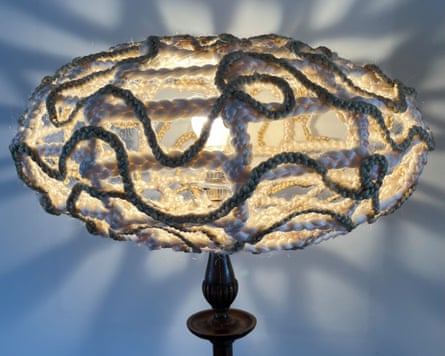
The exhibition will contain what she describes as her most ambitious work to date: a large, cylindrical patchwork of different types of hair stitched together. The show’s centrepiece, it’s composed of numerous colours and textures, speaking to the exhibition title: The Tone. But this has numerous alternative meanings, not least various racialised “undertones”, which Akhuetie describes. “As a Black person, people say the tone of my voice is aggressive. I have to tone myself down for people to relate to me. Then there’s my skin tone.”
Another work in the show is a table studded with resin beads on its underside. “I was reminded of a really beautiful glamorous Black girl with braids and beads,” says Akhuetie. “People who aren’t Black are normally so intrigued they want to touch it and almost treat you like you’re an alien. You wouldn’t ask to touch anybody else’s hair. I named it Don’t Touch My Table.” This is a nod to a phrase “Don’t touch my hair”, which became a slogan of the natural hair movement. “I want people to look at it and go, ‘Why do I want to touch somebody’s hair? What’s making me do that?’”
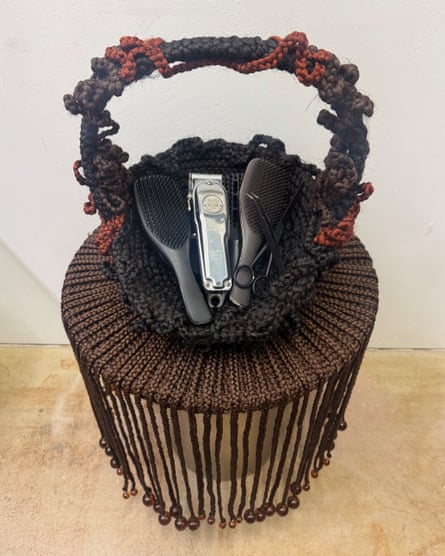
The exhibition marks a personal milestone for Akhuetie. “The reason I didn’t study art was because I was so insecure about being a Black person studying art. I didn’t think it made sense. I didn’t think I could do that. So it’s almost to say, ‘I can do this.’”
She thinks the art world is still very backward, in terms of what it considers to be true art. I think of Akhuetie’s auntie, how quickly she braided, and the deftness, skill and creativity that is so central to styling Black women’s hair. “I hope,” says Akhuetie, “I can show people who think this isn’t art that it actually is.”
Taiba Akhuetie: The Tone: Taiba’s World of Hair is at Sarabande Foundation, London, 22-24 May