


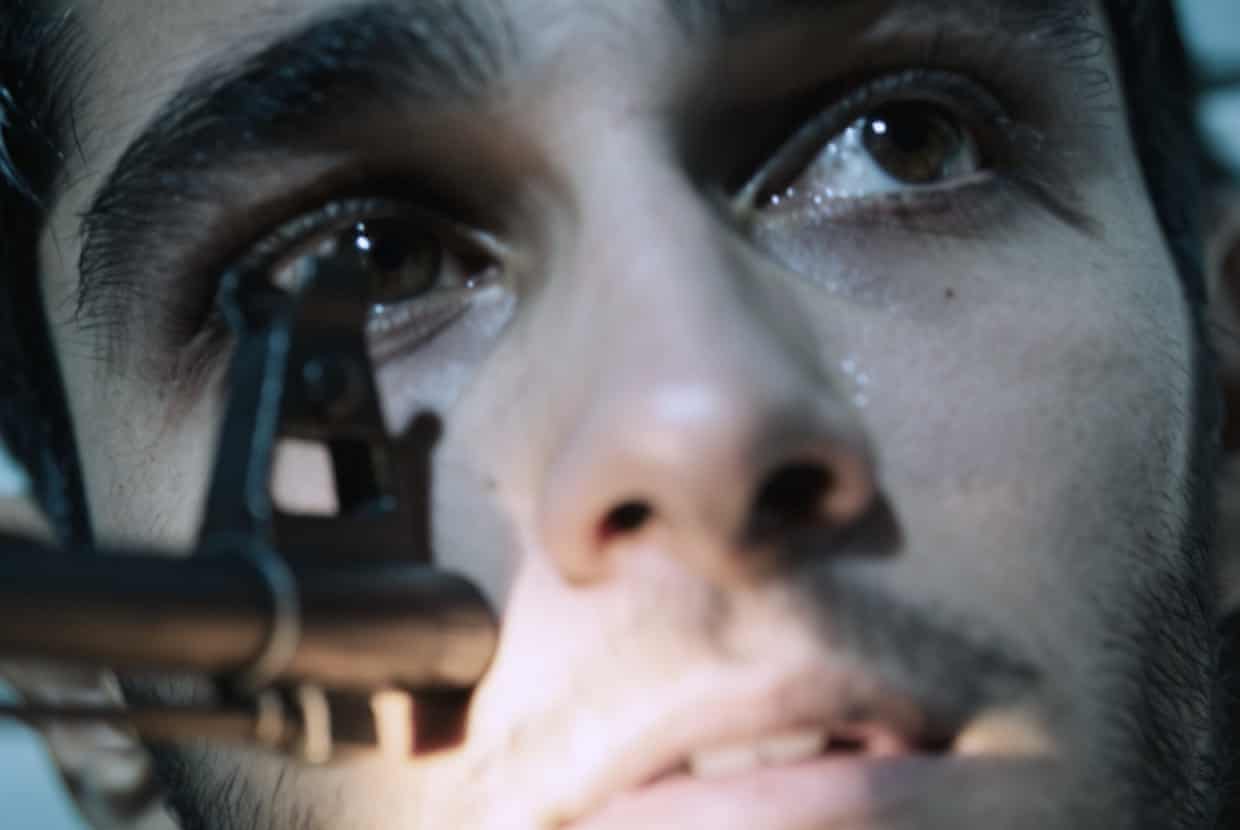
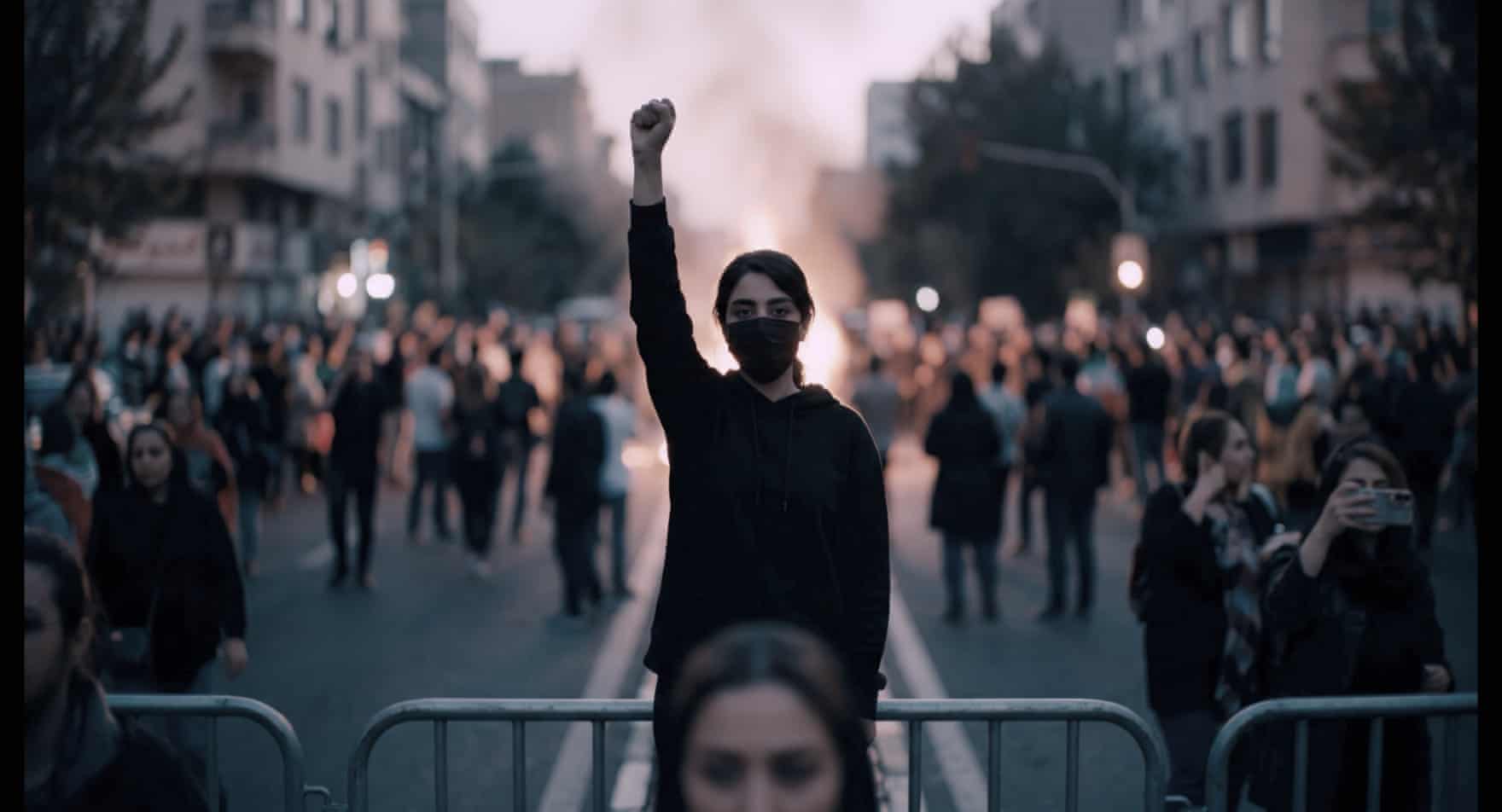
Next week a breakthrough 75-minute drama about the brutal crackdown in Iran on anti-government protesters in January will premiere at the Tribeca film festival in New York. It is called Dreams of Violets and is based on journalism, video footage and eyewitness accounts. “I would say 80% of it is a recreation of events that actually happened,” says its Iranian-British director Ash Koosha. But Dreams of Violets is a work of fiction, not a documentary: a drama following a group of strangers caught up in the protests, who meet by chance in an alleyway. How on earth has Koosha managed to pull together a drama about the killings in less than six months?
The answer, it turns out, is by using artificial intelligence. Every image and character in Dreams of Violets is AI-generated. Koosha says he created the characters by describing their physical appearances, using people he has known in the past as references. It would be too dangerous to base characters on living people in Iran, he says. “Because of the security issue, it would not be safe for the characters to even remotely resemble someone.”
Where Dreams of Violets is breaking new ground is that it is the first fully-AI live action feature accepted at a major film festival. It’s part of a gathering wave: last month AI action-adventure Hell Grind screened at Cannes – though not in the festival’s official selection. An all-AI animated feature called Where the Robots Grow was released way back in 2024. Dreams of Violets, however, seems to be the first AI film to be accruing artistic and critical credibility – not that using AI has made things easy, says Koosha. “A lot of the traditional festivals just don’t want to touch AI. They don’t want to even talk about it. What I’ve realised is that no one wants to be first.”
Koosha is speaking to me in a cafe near the Guardian’s offices in King’s Cross. Born in Iran, he has been based in London for nearly 20 years. His career began in Tehran playing in bands and acting, and he was imprisoned for two weeks in an Iranian maximum-security prison for organising a music festival (“We were playing Arctic Monkeys covers”). After moving to London, he continued to make music. He’s also a technology entrepreneur, co-founding an AI start-up called Claigrid with his brother Pooya. In 2018, he developed an AI singer called Yona who wrote and performed her own music. “Back then it was super sci-fi.” He has also co-founded a studio, Fountain 0, to produce AI-generated films.
What he has never done before, says Koosha, is politics. That changed in January this year, as he watched footage on his social media feeds coming out of Iran, before the internet blackout. “For 72 hours, we saw things that were just horrifying. It was a bloodbath.” Some estimates put the death toll at more than 30,000.
Something in him snapped. “This made me political. This is where I drew the line. I thought: you know what, I’m going to make the first film about this. It’s time to use technology to keep something alive.” It took him two-and-a-half months to make the film, working on it in the evenings at home while continuing his day job as CEO of Claigrid.
The script was not AI-generated, but he did use the chatbot Claude to improve the language and structure his thoughts. The genius of working with AI, he says, is that at any point a film-maker can change their mind, take the plot in an entirely different direction: “You just open another session. You don’t have to worry that you’re rewriting. You multiply your imagination until something hits the right spot.” He also composed the score and edited the film without the use of AI.
For his next AI film project, Koosha plans to create characters using actual people. “Because now you can license real faces.” Does that mean the actor is not involved in the film after selling their features? “They can voice act. And they take a share in the financial gain of the film. I think it’s going to be a new world of opportunities for people. Especially the face and image licensing.”
What about the acting, I ask? A Rada-trained actor with 20 years’ experience under their belt might protest that they bring more to a film than just a face. “That is a very valid point, and I think there are stories that I would never allow AI to touch, that we still need to do in the theatrical way.” The kind of films he’d make with AI, he says, are “impossible movies, a film that requires a $300m budget, and it doesn’t happen on this planet.”
Koosha says that Dreams of Violets would be “100% impossible” to bring to the screen in the traditional way. “If you wanted to do it in CGI, it would cost millions. I spent under $2,000.” He also points out the difficulties in raising finance and pre-production. “It would take probably a year or two to get this right. The notion of making films at the speed of news itself is something I’m super interested in.”
He also sees a role for AI in producing movies that look like massive studio productions at a fraction of the cost – removing the barriers for independent film-makers. “An indie film-maker mind is often a lot more fresh and creative than an industrial film-maker mind. In my view most stories that are told with $100m should be told through the lens of an indie film-maker.”
AI can democratise the industry, he argues. “I’m thinking about the next Jodorowsky,” he says, referring to the psychedelic Chilean film-maker. “How many years do they have to prove themselves to some bourgeois festival to get to a point where they get a $2m budget? I think that a new space will separate from the old space. And these people will start doing interesting things.”
Critics of AI-generated film dismiss it as soulless slop. But Hollywood directors from Steven Soderbergh to Darren Aronofsky are beginning to engage with AI. Last week, the Jurassic World Rebirth and Rogue One director Gareth Edwards described generative AI as a “genius” tool for film-makers, though Guillermo del Toro said he would “rather die” than use it.
Koosha says he’s not generally a fan of AI films. “So far, I hate anything made that is made with AI. It disgusts me. I don’t want to look at it. It gives me a headache.” He also mistrusts some other people on the scene. “They want to make people get used to garbage. I’m somewhere in the middle trying to be the voice of reason. I used AI. I’m an artist. I tried not to use it in a crass way.” He adds: “I’m not selling AI. I’m just trying to use a tool to tell a story.”

Koosha voice-acted all the roles himself for Dreams of Violets then used AI to modify them – to make one sound like a woman in her 20s, another like an older man. Other AI film-makers are using voice actors: “Each team will develop their own method,” he says.
Will audiences buy into AI characters, I ask? Koosha thinks so. “I’m going to give you a silly example. Do you watch Rick and Morty? Sometimes I go so deep emotionally when Rick is regretful. But Rick doesn’t exist. We want Rick to exist because we have the same feelings. Pixar movies make me cry.”
Koosha is convinced that jobs will be created at Fountain 0. “There are so many areas that are new, that are basically unknown. I guarantee that this company will create at least 200 jobs that didn’t exist.”
The lightning speed of change in AI film-making means that no one knows how it will disrupt film production. I ask Koosha what he thinks the industry will look like in 10 years’ time: “Well, I don’t think Christopher Nolan will make another $300m movie. Underwriting a $200m to $300m movie will not make sense any more.” He paints an egalitarian picture of a boom in mini-studios: “Every film-maker will become the studio.” Creatives will be working in newly created jobs sharing in the profits. “So, I see that in the next 10 years there will be a reshuffling of money, hopefully in a better way. AI is going to be a catalyst of that change.”