
惯性聚合 高效追踪和阅读你感兴趣的博客、新闻、科技资讯
阅读原文 在惯性聚合中打开

推荐订阅源

B
Blog
C
Cybersecurity and Infrastructure Security Agency CISA
Microsoft Security Blog
B
Blog RSS Feed
云风的 BLOG
云风的 BLOG
G
Google Developers Blog
Recent Announcements
A
About on SuperTechFans
cs.AI updates on arXiv.org
Google Online Security Blog
Google DeepMind News
S
Schneier on Security
S
Secure Thoughts
T
The Exploit Database - CXSecurity.com
Martin Fowler
Martin Fowler
P
Proofpoint News Feed
Security Latest
Security Latest
Jina AI
Jina AI
D
Darknet – Hacking Tools, Hacker News & Cyber Security
Recorded Future
Recorded Future
T
Tor Project blog
有赞技术团队
有赞技术团队
H
Hackread – Cybersecurity News, Data Breaches, AI and More
N
News | PayPal Newsroom
博客园 - 三生石上(FineUI控件)
MyScale Blog
MyScale Blog
cs.CV updates on arXiv.org
Last Week in AI
Last Week in AI
F
Full Disclosure
Hacker News: Ask HN
Hacker News: Ask HN
Forbes - Security
Forbes - Security
D
DataBreaches.Net
人人都是产品经理
人人都是产品经理
NISL@THU
NISL@THU
C
Cisco Blogs
Recent Commits to openclaw:main
Google DeepMind News
Project Zero
Project Zero
IT之家
IT之家
T
Threatpost
Cyberwarzone
Cyberwarzone
O
OpenAI News
cs.CL updates on arXiv.org
J
Java Code Geeks
P
Proofpoint News Feed
The Last Watchdog
The Last Watchdog
月光博客
月光博客
Latest news
Latest news
MongoDB | Blog
MongoDB | Blog
Apple Machine Learning Research

The Guardian

New Zealand’s North Island braces for Cyclone Vaianu with thousands ordered to evacuate Artemis II splashdown – in pictures Swalwell denies allegations of sexual assault as calls grow for him to withdraw from California governor race Trump news at a glance: Epstein survivors have words for Melania Trump after surprise statement Multiple people face charges, including murder, in California fireworks blast Rory McIlroy surges into six-shot Masters lead with stunning second-round flourish Roberto De Zerbi targets ‘Ange-ball’ revival to save Spurs from relegation Bath hit back to reach semi-final after stunning Northampton in 11-try epic Australia crash out of BJK Cup after Britain secure upset with doubles win Zebras, wealth and power: Hungary’s election tests Orbán’s grip on power ‘TikTok effect’ brings sellout crowds and younger fans to Grand National meeting King signs up David Beckham to his Chelsea flower show team The war over Omagh’s gold: the £21bn mine plan tearing a community apart Britain’s shadow workforce is paid as little as 65p an hour. Who cares for the carers? Tim Dowling: my wife is on a quest to restore my thinning hair SUVs are making Britain’s potholes worse, say scientists Blind date: ‘She claimed she was usually shy. I wouldn’t have guessed’ I’m a sauna person now: the Becky Barnicoat cartoon ‘I got everything I dreamed of – when I had no ability to handle it’: Lena Dunham on toxic fame, broken friendships and her ‘lost decade’ Six great reads: the man who let snakes bite him, masked heavy metal and the brutal reality for foreign students in the UK Meera Sodha’s recipe for noodles with rose beancurd, spring greens and egg Cuba’s doctors were a lifeline for the world. Now the Caribbean is shamefully complicit in the US drive to expel them An environmental disaster in Moldova has Russia’s fingerprints all over it ‘This is as important as your teeth’: are you skipping this key part of mouth hygiene? Man arrested after four die trying to cross Channel in small boat Ukraine war briefing: doubts linger in Kyiv over Moscow’s promise to uphold Orthodox Easter ceasefire Ichiro Suzuki statue unveiling goes awry as bronze bat snaps during ceremony Arrest of national war hero Ben Roberts-Smith cuts deeply to core of Australian psyche European football: Real Madrid held at home by Girona to extend winless run ‘You come back different’: how rugby players change after motherhood Human rights groups decry US plan for Guantánamo camp for Cuban migrants Potential US host cities for 2031 Women’s World Cup games mull withdrawal over Fifa concerns Arne Slot insists he is ‘aligned’ with Liverpool board and fans as squad is rebuilt Kamala Harris ‘thinking about’ running for president again in 2028 JD Vance warns Iran against trying to ‘play’ the US in peace talks West Ham double up twice to thrash Wolves and put Spurs in relegation zone Trump administration releases new renderings of so-called ‘Arc de Trump’ Bafta apologises for events surrounding John Davidson’s Tourette’s outburst Cocktail of the week: Bar Shrimp’s la rosita – recipe New drug may extend survival in aggressive ovarian cancer, trial shows One dead and 27 injured after bus with British passengers crashes in Canary Islands OpenAI CEO Sam Altman’s home targeted with molotov cocktail Alarm as acting CDC director delays report showing Covid vaccine benefits Argentina just ripped up its pioneering glacier law. What does this mean for millions of people’s drinking water? ‘Illegal’ forest service overhaul risks causing ‘chaos’ across US public lands, union claims Prince Harry sued for defamation by charity he co-founded Anthropic’s new AI tool has implications for us all – whether we can use it or not Concerns raised about motorbike tourist trail after death of British teenager in Vietnam The Guardian view on Trump’s civilisational threats: the words that fuel war must be condemned The Guardian view on dystopias for our times: the American nightmare Weather tracker: Cyclone Maila batters Solomon Islands with 115mph winds Doctors’ leader claims new reduced pay offer killed chances of ending strikes in England Netanyahu-ism has achieved nothing for Israelis – and come at a monstrously high price Deborah Levy: ‘CS Lewis’s White Witch terrified me – but I wanted to meet her’ How I Shop with Michelle Ogundehin: ‘We grownups have enough stuff already’ ‘Butter Birkin’: popcorn plastic It bag in demand by Devil Wears Prada fans Trump’s war and Melania’s Epstein statement, with US editor Betsy Reed – The Latest Orbán and Magyar trade accusations in last days of Hungary election campaign Reckonwrong: How Long Has It Been? review | Safi Bugel's experimental album of the month Martin Rowson on Middle East peace talks – cartoon Fears of UK and EU flight cancellations as airports warn of jet fuel shortages Peers vote to ban pornography depicting sex acts between stepfamily members Week in wildlife: an ostrich on the lam, a tortoise crossing a road and surfing seals ‘There’s no shortage of terrifying technology’: how AI became TV drama’s new go-to villain Texas court overturns sentence for man on death row for nearly 50 years Power up! Could force be the secret to supercharging your fitness? ‘Irresponsible failure’: Google, Meta, Snap and Microsoft slam EU over child sexual abuse law lapse Blank canvas: what to wear with white trousers Critics assemble! Here’s my list of the greatest superhero movies of all time Amazon to finally launch Leo satellite internet in ‘mid-2026’, says CEO Pete Hegseth’s holy war: the militant Christian theology animating the US attack on Iran Toxic putdowns, brutal zingers ... and an unexpected love story – inside the joyful climax to brilliant sitcom Hacks Add to playlist: the beautifully dazed, countrified indie-rock of Tracey Nelson and the week’s best new tracks ‘I’m worried there’s too much of me,’ says a birch: inside the interspecies council giving nature a voice Dolce & Gabbana says co-founder Stefano Gabbana has quit as chair Why is anyone surprised by the US and Israel’s latest war? It’s only what the world allowed them to do in Gaza Super Mario what?! The seven best obscure Mario games Holly Humberstone: Cruel World review – Taylor Swift fave trades gothic melancholy for pop glow-up Thrash review – cursed shark thriller sinks like a stone on Netflix ‘The biggest, baddest, saltiest chick you would ever see’: why no one sang the blues like Big Mama Thornton Go Gentle by Maria Semple review – a joyfully clever New York romcom ‘Tranquil, natural and barely a tourist in sight’: readers’ favourite hidden gems in Spain Benjamina Ebuehi’s sweet and salty chocolate chip cookies recipe ‘I’m not a commercial director – I’m not even a professional film-maker’: Jim Jarmusch on the seven-year journey to make his new film Malcolm in the Middle: Life’s Still Unfair review – the TV magic they’ve created here is absolutely miraculous The Miniature Wife review – Matthew Macfadyen is wasted in this pointless comedy From soups and greens to roots, how to survive the ‘hungry gap’ From fat transplants to LED mittens: how the fear of ‘old lady hands’ mobilised the beauty industry Anna Wintour’s Vogue cover is more than a cameo – it’s a power play ‘They’re gonna make me cry’: I competed at a speed puzzling championship You be the judge: should my girlfriend stop mixing gold and silver jewellery? Maritime and port workers: how is the Middle East conflict affecting you? How games capture the awe and terror of cosmic isolation Why does alcohol make us both happy and miserable – and what else does it do to our minds and bodies? I never text back – and it’s ruining my relationships The pet I’ll never forget: Beau, the labrador who saved my life Life Is Strange: Reunion review – a decade-long story comes to an impassioned close Why is gaming becoming so expensive? The answer is found in AI Sign up for the First Edition newsletter: our free daily news email Sign up for the Feast newsletter: our free Guardian food email
Simply divine: the extraordinary supernatural visions of Francisco de Zurbarán
Charlotte Hi · 2026-04-30 · via The Guardian

Against an impenetrable black ground, the crucified figure looms pale and shining. There’s almost no colour, beyond the trickle of blood on Christ’s feet from the nails driven through his flesh. His head slumps, and his carefully modelled face is at peace (no agony here). But the most striking part of the picture is surely the loincloth, which folds and crumples and bunches around his midriff – you can imagine passing your hand over it, feeling the linen’s volume and texture. In its original home, the monastery of San Pablo el Real in Seville, the painting was displayed with “little light”, according to the 17th-century Spanish artist and writer, Antonio Palomino. “Everyone who sees it, and does not know it, believes it to be a sculpture.” The paleness of the body, the fabric, must have loomed out of the dark like a vision.

Francisco de Zurbarán, who painted this solitary crucified Christ, is one of the three great artists of the Spanish 17th century. But, unlike his peers Velázquez and Murillo, he has never had a show to himself in the UK – until now, as his work forms the basis of a major exhibition about to open at the National Gallery in London. Compared with his precise contemporary and friend Velázquez (born in 1599, a year after Zurbarán), his work can seem stilled, becalmed. You can see the contrast clearly, in works commemorating Spanish military success that each of them were commissioned to paint for Philip IV of Spain’s new palace, the Palacio del Buen Retiro. Both are now in the Prado. Zurbarán’s The Defence of Cádiz Against the English has the quality of a frieze, as the Spanish generals look down serenely at the sea battle below. Velázquez’s The Surrender of Breda is all drama, encounter: a quicksilver painting that captures time as it flees.

Zurbarán’s skill is different. His is an artist of inner vision, of meditation and contemplation. Time does not flee, but stands still. He has a paradoxical quality, making you wonder what it is that you are looking at, partly because he can make the immaterial seem solid and touchable, partly because at times his works depict two planes of reality simultaneously.
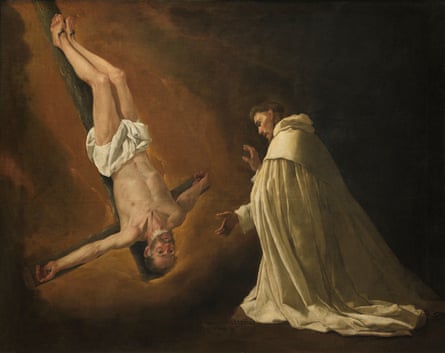
The Apparition of St Peter to St Peter Nolasco, 1629, by Francisco de Zurbarán
A double refraction of unreality … The Apparition of St Peter to St Peter Nolasco. Photograph: Federico Pérez/Photographic Archive Museo Nacional del Prado

Take one of the first in the National Gallery exhibition: The Apparition of Saint Peter to Saint Peter Nolasco, the latter saint being the founder of the Mercedarian order of friars, whose mission was to recover fellow Christians who had been captured by Muslims during conflicts in the Mediterranean. (The work was one of two dozen commissioned in 1629, early in Zurbarán’s career, for the monastery of the Merced Calzada, Seville, now visitable as the city’s Museum of Fine Arts.)

St Peter Nolasco is on the right, enrobed in white, and he “sees” St Peter – crucified upside down – hovering on a backdrop of ochre clouds. But St Peter Nolasco hardly seems to be in the realm of the real himself. We are not “with” him, wherever that might be (the shadowy background is entirely abstract). The painting seems to be offering itself as a double refraction of unreality, as if it was itself a vision.

There were good theological reasons for painting like this at the time: in the wake of the Council of Trent, whose deliberations defined the Counter-Reformation, religious art was charged with a direct, clear purpose: to move the viewer to devotion. Aside from the year or so that he spent in Madrid painting for the court in the mid-1630s, his career was largely based in Seville, and his clients were mostly the hugely powerful religious foundations of the city and the wider region.

Just then, Seville was wildly prosperous. Since 1503, it had had a monopoly on trade with Spain’s viceroyalties in the Americas – a status of which Zurbarán took advantage, sending out over 100 canvases for export to Lima, Buenos Aires and elsewhere. Zurbarán did provide secular scenes for Philip’s Buen Retiro – aside from his sea battles at Cádiz, 10 paintings of Hercules pounding through his labours, as well as a curious, colossal head of a man that startles when it is glimpsed through the enfilade of rooms in the National Gallery. But it is in paintings of the divine and the spiritual that he excelled.
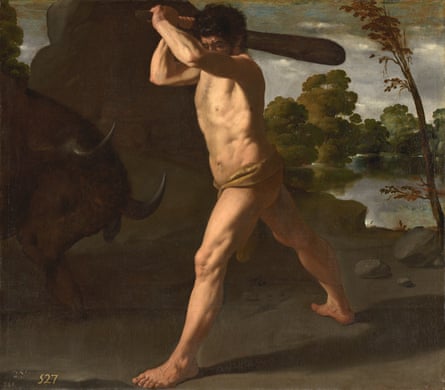
Pounding through his labours … one of many Hercules works.
Pounding through his labours … one of many Hercules works. Photograph: © Photographic Archive Museo Nacional del Prado

Sometimes these commissions were on a stunning scale, and must have required a busy studio – as in the 24 paintings for the Merced Calzada in Seville, or the 15 x 10m altarpiece for the Carthusian monastery of Nuestra Señora de la Defensión, just outside Jerez de la Frontera. The last monks moved out recently, and it is now possible to visit the honeyed-stone establishment, with its baroque facade stuck on to the front of the former 15th-century Renaissance frontage. But there in the church you have to imagine the full force of Zurbarán’s altarpiece, with its dozen paintings set between gilded sculptures since, in the wake of the Napoleonic wars and the dissolution of Spain’s monasteries in 1835 these – like many other works in Spanish churches – were sold off and scattered.

Scholars have debated the altarpiece’s original layout. The National Gallery’s putative reconstruction has Zurbarán’s enthroned Virgin in the most prominent position, flanked by his Adoration of the Magi and Circumcision. If the gallery is right in supporting this reconstruction, it will be the first time the works have been set alongside each other since the dissolution.

From the vast in scale to the intimate and hushed: some of Zurbarán’s most arresting works are not these busy, exciting scenes of saints and biblical stories but his remarkable small-scale still lifes. He was an extraordinary painter of the texture and weight of things. In a work in Seville’s Museum of Fine Arts – not in the London show – the most thrilling part of the scene of St Hugh’s visit to the founders of the Carthusians is, to me, not the miracle of the meat turning to ash, or even the austere faces of the monks, but the exquisite breadiness of the bread rolls, and the smoothness of the blue-and-white ceramic carafes that, at the base, turn rough and unglazed.
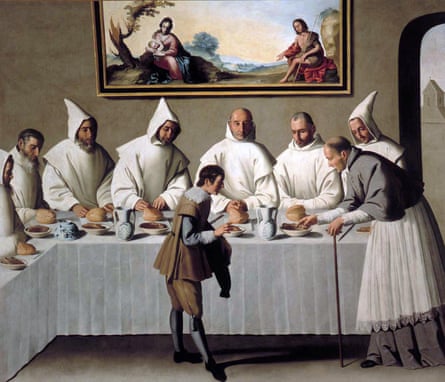
Saint Hugh in the Carthusian Refectory, 1655, by Francisco de Zurbarán,
Exquisite breadiness … Saint Hugh in the Carthusian Refectory. Photograph: Alamy

Zurbarán’s son Juan – who died in the catastrophic outbreak of plague that robbed Seville of its prosperity and half its population in 1649 – made still lifes that provide an interesting contrast to his father’s. They are more luscious, more overflowing with lilies, marigolds, jasmine, pears and lemons than his father’s, where each object sits in its own space, self-contained. As in his paintings of visions of the divine, a small-scale row of dishes and vases made late in his career, around 1650, shines out against a sepulchral background.

An earlier work, from 1633, has a dish of citrons reflecting gold into their silver platter; a basket of oranges complete with a twig of leaves and blossom (accurately, since oranges flower and fruit simultaneously) and a cup of water sitting in a silver dish with a rose lying on its rim. The fruit and the flowers can be read as symbols of the divine. But as with Zurbarán’s paintings of visions, these works seem to invite you into the illusion that you are seeing tangible things, objects over whose surfaces you want to run your fingers – and something otherworldly, things prompting contemplation of the supernatural.
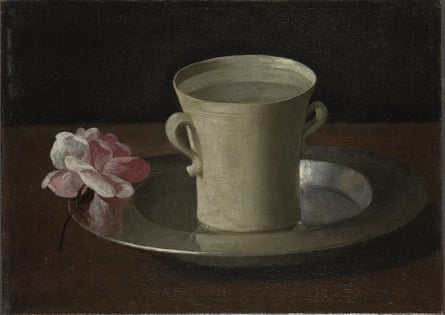
A Cup of Water and a Rose by Francisco de Zurbarán, about 1630.
Almost tangible … A Cup of Water and a Rose. Photograph: © The National Gallery, London

The ambiguity in what we are being invited to see is at its strongest and most compelling in the final work in the exhibition. It is small, and you might whisk past it as you head for the exit, mistaking it for just another crucifixion with a praying figure in the foreground. But look again: it turns out that the figure standing before Christ – against another of Zurbarán’s darkened backgrounds – is a painter. In his left hand are brushes, and a palette loaded with paints that are surely just right for making the figure’s very own flesh tones and robe. The artist’s right hand is clamped to his heart, his ruddy face looking upwards in awe at his saviour – who, by contrast, is grey of skin and quite dead.

Who is this figure with his paints standing at the foot of the cross? At times he has been identified as St Luke, patron saint of artists. But it’s irresistible not to consider him, in a sense, also Zurbarán himself. It’s impossible not to think about the very act of painting when looking at this work. Painting as an act of devotion, wonder and prayer. Painting as a means of seeing the divine. Painting as a way of imparting visions that hover between the real and the unreal, the illusory and the tangible.