


The war in Iran has put the NHS on high alert amid fears about looming shortages and rising costs for medicines and medical products such as syringes, intravenous bags and gloves.
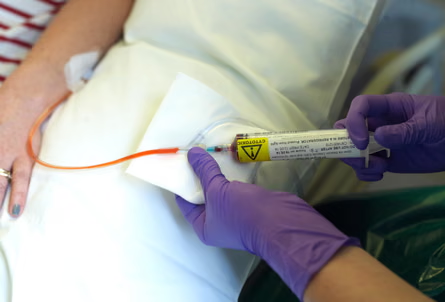
Much of modern healthcare is dependent on the petrochemicals now held up by the Gulf shipping standstill – whether for active pharmaceutical ingredients or to produce the millions of sterile single-use items, ranging from personal protective equipment (PPE) to catheters and diagnostic-device casings.
The NHS is one of the biggest healthcare bulk buyers in the world. It spends £8bn a year on equipment and consumables, from latex gloves and paper towels to stents and prosthetic hips. Its bill for medicines was £21.6bn in 2024-25.
Temporary scarcity of certain drugs and equipment is fairly common and has worsened since Brexit and during the Covid-19 pandemic. However, the Iran war now threatens to widen and deepen such shortages in the UK and globally, pushing up costs and leading to a scramble among countries for supplies.
‘Huge shock’
Jim Mackey, the chief executive of NHS England, is “very worried” about supply chain challenges, telling Health Service Journal that the NHS will need extra government funding if the war leads to a “huge shock” of price increases.

In response, NHS England has increased purchases of drugs and devices to build up buffers. While there are no shortages at present because of its clout to source supplies as a huge single customer, this could change the longer the conflict drags on. Damage to energy infrastructure and mines in the strait of Hormuz are likely to extend any disruption further.
NHS Supply Chain is the central procurement body that manages the sourcing, delivery and supply of more than 620,000 products, ranging from clinical consumables to medical equipment for NHS trusts.
Tom Brailsford, its head of resilience, says that stocks have been increased “where appropriate” and the organisation is talking to suppliers about their continuity plans and logistics routes.
Airports also remain disrupted in the Middle East and airlines are cutting flights amid worries about accessing jet fuel. In normal times, Dubai and Doha are key hubs for medicine air freight moving to Europe from India, known as the world’s pharmacy, where the bulk of off-patent drugs are made.
“You’ve got this dual problem of the airspace and the knock-on problems around logistic chains,” says Richard Sullivan, professor of cancer and global health at King’s College London and director of the Institute of Cancer Policy.
“When you look at the supply chains, for most of the cancer drugs they’re very thin, they often rely on just one supplier. The movement of medicines and active ingredients [and equipment] is absolutely Byzantine. You often see incredibly long supply chain lines … as they can be much cheaper.”
‘Think twice about how much you’re using’
At Gloucestershire Hospitals trust, doctors and nurses get through 67,653 boxes of synthetic rubber gloves a year – more than 6m single gloves, at a total cost of nearly £330,000 – prompting a campaign in 2024 to reduce overuse. The war means those rules for “correct use” – with a greater focus on handwashing – could be enforced more strictly.
“These sorts of extra items are fundamental to parts of our services being delivered,” says Liz Breen, professor of health service operations at Bradford University. “So knowing that we can process patients after surgery with catheters, knowing that we can undertake surgical procedures because we’ve got the gloves and the PPE, these are all very small things, but together can cause problems if there is a shortage.”
Sullivan says: “Generally the message in the NHS is … think twice about how much you’re using. If you’re used to burning through a number of swabs, you can halve that during procedure. Don’t just open single-use instruments and think, ‘Oh, I may or may not use it’, because once it’s open, you have to throw it away.”
He says there is a lot of waste within the NHS, and shortages could force the health service to shift to more sensible use of single-use items and the making up of drugs only when needed, rather than in advance.
Fraying supply chains, soaring prices
The cost of many common medical items has jumped since war broke out. The average price of a box of 1,000 synthetic rubber gloves is now 40% higher at $29 (£21.50), according to Oong Chun Sung, a research analyst at CIMB Securities in Kuala Lumpur.
Sustained disruption to supply chains could lead to glove shortages by late May, he and other analysts warn.
This is because of the surging price of naphtha, a byproduct refined from crude oil that is used to make the petrochemicals that are the basis of many healthcare products. Naphtha prices in north-west Europe soared above $900 a tonne in April, from about $560 a tonne in February.
London-based Polyco Healthline, a big NHS contractor that supplies gloves, PPE and other products, raised its prices by 10.3% to 26.3% from 1 April, and signalled further rises. The Malaysian condom-maker Karex, which also makes gloves, catheters and probe covers and is an NHS supplier, is increasing its prices by 20% to 30%.
Malaysian disposable glove makers account for nearly half of global production. Top Glove, the biggest manufacturer which has supplied the NHS via Polyco, has said it will pass on cost increases of 50%, mainly due to higher prices of nitrile latex.
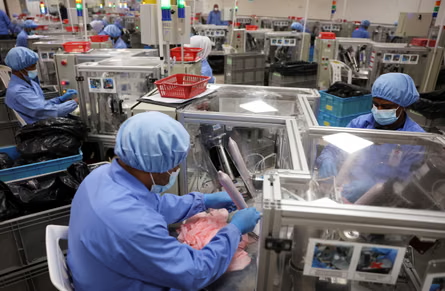
About 60% of the naphtha used in Asia is sourced from or routed through the Middle East, according to Polyco. Shortages have prompted shutdowns at Asian chemical makers, which declared force majeure across their petrochemical supply chains, releasing them from contractual obligations due to uncontrollable events.
Olivia Steele, principal analyst of olefins EMEA at Wood Mackenzie, says European prices for polyethylene and polypropylene, also made from naphtha, roughly doubled between February and April.
The price of polyester fibre, used to make surgical masks, gowns, drapes, wipes, dressings and bandages, has surged by 28% from late February to late March. Fibre shortages are anticipated from the end of May.
The price of PET resin, used in pharmaceutical bottles and blood and other fluid collection tubes, surged by 55% from February to March, according to the data firms Wood Mackenzie and Argus Media.
“I think some of this is probably reasonable, but there’s no doubt there’s price gouging going on,” says Sullivan. “It’s going to make what we’re getting more expensive, and we’re hearing already, over the next few months, components for things like the arms for surgical robots are going to be in short supply.”
The NHS pays some of the lowest prices globally, but shortages will arise if manufacturers prioritise countries that pay more, experts warn.
Breen says: “In the face of this conflict, the NHS may have to pay higher prices for products. I think the NHS and the health department will be prepared for this. They will be calculating how much they’ll have to pay with regard to getting stocks into the UK.”
Volatility and scarcity
As for shortages, drugmakers hold eight weeks’ worth of medicines while equipment makers also have buffer stocks. In many areas, however, there are few suppliers – for example the market in IV bags is dominated by US company Baxter and Germany’s Fresenius Kabi and B Braun Medical.
Scott Lehmann, a supply chain expert at software and consultancy firm Sphera, says: “The incentives aren’t necessarily there to be stocking, for example, syringes … because they’re traditionally always available.”
“Volatility, it’s a feature in the system; it’s not a thing that happens once in a blue moon,” he adds.
“But healthcare is completely different from other industries. Healthcare can’t stop because of supply shortage – it’s not like, ‘Oh, we’re going to put the patient’s needs on hold for a while.’ This isn’t a discretionary purchase.”
The UK’s and other countries’ “just in time” supply chains may come to haunt them. Sullivan says the UK and the rest of Europe must be prepared to invest and bring manufacturing closer to home.
Brailsford says NHS Supply Chain is working “closely with suppliers and system partners to minimise the impact of any cost pressures and ensure trusts are not required to change clinical practice unnecessarily”.
A spokesperson for the UK’s Department of Health and Social Care says: “We have robust measures in place to manage disruption across the health and social care sector to protect patients, including holding buffer stocks and the procurement of alternative products where necessary.
“The vast majority of the UK’s [14,000] licensed medicines are in good supply, and we will continue working closely with industry partners to help ensure the continued supply of medical products.”