


When Kevin first heard about the prediction market Kalshi, he knew deep down it would be wise to stay away. Kalshi reminded him of a weakness of his: sports betting.
Kevin, who is 36 and works in law enforcement in Texas, has been a gambling addict for 18 years. It’s a problem that cost him his first marriage and forced him to file for bankruptcy.
Sports betting is illegal in Texas, so Kevin used a bookie based out of the state – until his second wife changed the passwords to his bookie account. Going to a physical casino required him to get in the car and drive. But Kalshi was right there: “I could still do my sports thing and it was actually legal.” (He requested to go only by first name to speak about sensitive matters.)
Despite being a recovering gambling addict, Kevin created a Kalshi account last summer, assuring his wife he wasn’t gambling. “I kind of swindled her into saying Kalshi was like stocks,” he said – not so difficult a sell, considering Kalshi describes itself as operating “like a stock exchange for events”.
The prediction market Kalshi allows more than 5 million monthly users to “trade” or place wagers on what might happen in pop culture, politics, weather or any real-world event with an uncertain outcome. Sports are an enormously popular category on these platforms, which make money by charging fees for trading. Kalshi’s competitor Polymarket, which operates similarly, is making a return to the states.
In the past year the boom in prediction markets – and their unscrupulous nature – has inspired parodies on SNL and South Park. Viewers of this year’s Golden Globes were treated to real-time Polymarket odds for category winners during the telecast, whether they liked it or not; the collaboration was widely panned as gauche. During the Super Bowl, Kalshi surpassed $1bn in trading, up 2,700% over the previous year.
They have surged in popularity as researchers report a dramatic rise in Americans seeking gambling addiction help. This began even before the introduction of prediction markets: in 2018, the US supreme court legalized sports betting and paved the way for online sportsbooks such as DraftKings and FanDuel, which have also exploded in the US.
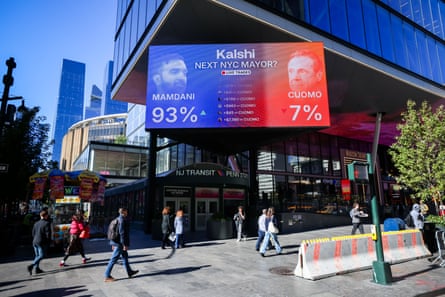
Experts and people who experience problem gambling say that though prediction markets are not subject to the same oversight as sportsbooks, they are just as addictive. They say US regulators are not doing enough to keep users safe.
“The more people gamble, the more activities they gamble on, and the more ways they gamble, the more likely they are to develop a problem,” said Lia Nower, director of Rutgers University’s center for gambling studies, via email. “So, on average, unregulated markets like Kalshi and Polymarket will have an additive effect to the legal forms of gambling. This will likely contribute to increasing rates of problem gambling in the years to come.”
For Kevin, it took less than a year for him to get himself back on the wagon. In that time he estimates that he lost $5,000-10,000 on Kalshi – enough to “substantially impact” his family’s finances. “You can just be in your boxers laying in bed, betting your rent away,” he said.
Most gamblers lose money, and prediction markets are no different. Seven in 10 traders record losses on Polymarket, according to the Wall Street Journal, and a tiny percentage of accounts make 67% of profits. (Polymarket declined to comment on the journal’s numbers.) Kalshi told the journal that there were 2.9 unprofitable users for every profitable one in April.
But prediction markets draw careful distinctions between themselves and gambling platforms in other ways.
In sports betting or at a casino, players bet against a bookie who keeps their own sets of odds. State gambling commissions or tribal gaming agencies monitor for suspicious behavior from bookies, and generate taxes that fund public services. Online sportsbooks such as DraftKings can only operate in states where sports betting is legal, with age restrictions between 18 and 21, depending on the state.
Prediction markets differ in that there is no traditional “house” to bet against, according to the companies. Users trade against each other, similar to futures markets. Therefore, Kalshi and Polymarket do not have to comply with state gambling regulations. Instead, prediction markets are overseen on the federal level by the Commodities Futures Trading Commission (CFTC), better known for controlling the derivatives and commodities markets.
Kalshi is available in all 50 states to users aged 18 and older. As of last week, US users who are 18 and up can start trading on some categories on a new Polymarket app. In 2022, the CFTC fined Polymarket $1.4m and sent it a cease-and-desist order due to regulatory violations. This setback led to Polymarket banning US users, though some still found ways to reach it using VPNs. (Using a VPN to access Polymarket violates its terms and conditions.)
Public health advocates and state lawmakers are increasingly concerned that the distinction between prediction markets and online gambling is functionally meaningless. “The prediction market platforms may take umbrage at the idea that they’re gambling platforms. The rest of the world needs to recognize that they are,” said Benjamin Schiffrin, director of security policies for Better Markets, a non-profit promoting public interest in financial markets and reform on Wall Street.
Kevin, a seasoned gambler, also fails to see much of a difference. “If you look at an app on your phone for bookie betting and Kalshi, it’s the same stuff – numbers and stats, it’s just dressed up a bit differently,” he said. “There’s a language that you already are primed to know through other types of gambling.”
According to the National Council on Problem Gambling (NCPG) nearly 20 million Americans reported experiencing problematic gambling in 2024. Gambling addiction can financially cripple entire families. It can also be difficult to identify – you might not know a loved one has a gambling problem until they burn through half their savings. One in five problem gamblers attempt suicide; this is the highest rate of any addiction disorder.
Nower said that treatment for gambling addiction looks the same whether someone wagered on prediction markets or online gambling sites. “But [abuse] prevention and education will vary, as a lot of people view prediction markets as ‘not gambling’ because they aren’t regulated like other forms of gambling,” she said.
The NCPG runs a helpline; in February the board of directors called on prediction markets to promote the helpline on their platforms like sports betting platforms do. Currently Kalshi links to the 988 Suicide & Crisis Lifeline and Birches Health, a treatment provider for “digital addictions and compulsive behaviors”, on a policy page that does not use the terms “gambling” or “addiction”. Polymarket does not refer users to a helpline.
This week, Kalshi announced a $2m investment in the NCPG that will “expand consumer education campaigns, increase awareness of the warning signs of problematic behavior, and promote responsible trading and healthy decision-making”. It will not start promoting the gambling hotline on its platforms. Kalshi’s head of communications, Elisabeth Diana, said a conversation about doing so “is still ongoing” internally.
Kalshi makes money by charging small fees on trades; traditional gambling venues profit off of players’ losses. This is a message Kalshi representatives push in response to claims that prediction markets can exacerbate gambling addictions. “With prediction markets, there’s no incentive to make people lose, and we think that’s a fundamental difference and creates a less predatory, fairer, more transparent incentive,” Diana said.
Polymarket declined to comment on this story.
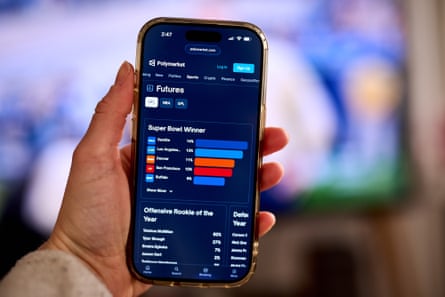
Polymarket and Kalshi advertising can be hard to avoid for people in recovery for gambling addiction.
Rob Minnick placed his last bet in November 2022. Kalshi and Polymarket existed when he was in the throes of dependency (the brands were founded in 2018 and 2020, respectively), but were not nearly as popular. He bet online with sportsbooks and in casinos, spending six to eight hours a day on his habit. Minnick now creates gambling recovery content on YouTube, where he has more than 38,000 followers.
These videos generate money through ads, and he is careful to block ads that have to do with gambling, casinos or “every conceivable category of trading” so people on the brink of sobriety do not have to sit through potentially triggering advertisements. But about a year ago, Kalshi promotions found their way on to his page.
“I have no idea how it showed up on my feed,” Minnick said. “They are sneaking through advertising in places where they really shouldn’t be, such as podcasts about gambling addictions [like mine].”
The fact that the ads got through Minnick’s blocker disturbed him so much that he asked his lawyer to send a cease-and-desist letter to Kalshi. “Common sense, decency, and the consumer protection laws of several states dictate that Kalshi ads should not be running on a channel dedicated to helping vulnerable people struggling with gambling-related harm,” the letter reads.
A Kalshi representative never confirmed receipt of the letter, but the advertising stopped shortly after. “My interpretation is that these businesses are pushing the line until someone says something and then backing off because they know that what they’re doing is not good,” Minnick said. “It’s the same beast in a new set of clothes.” (Diana declined to comment.)
A 2025 study conducted by the American Gaming Association found that 85% of Americans believe prediction markets’ sports categories amount to gambling, and almost as many said they should be regulated as such. At least 13 federal lawsuits have been filed that accuse Kalshi of an operating unlicensed gambling platform or being an illegal service that worsens gambling addiction, according to NPR. In response to the lawsuits, Diana told the Guardian: “We operate fundamentally differently than a casino or a sportsbook, and so we’re confident in our legal position on it.”
But Kalshi and Polymarket have powerful allies: Donald Trump Jr serves as an adviser to both, and Truth Social is developing its own prediction market called Truth Predict. Donald Trump has expressed some distaste for prediction markets, but last month his administration sued Connecticut, Arizona, and Illinois in an attempt to block state regulations on prediction markets.
Last week, US regulators indicated they have no appetite for reclassifying prediction markets as gambling, with the CFTC’s chair, Michael Selig, calling prediction markets and sportsbooks “two separate things”.
Prediction market evangelists are inescapable on social media, where influencers peddle the brands as a way for cash-strapped young people to make money in a difficult economy. Kalshi and Polymarket have zeroed in on college campuses, handing out branded swag and sponsoring frat parties in exchange for mass account signups. And though users still skew heavily male, Kalshi has enlisted female influencers to court more women.
Given the reach and availability to young adults under 21, experts say prediction markets are probably creating future addicts who might not have otherwise stepped foot in a casino or placed a traditional sports bet.
The younger someone is when they begin gambling, the more likely they are to develop a substance-use disorder – this is true for drugs, alcohol and gambling, said Alexandra Plante, a senior adviser on substance-use disorder at the National Council for Mental Wellbeing. “Gambling preys on the adolescent brain in a very unique way,” she said. “The data is starting to reveal this big bus headed straight for us.”
Young men are of particular concern. A July study by Common Sense Media found that roughly a third of 11-year-old boys reported gambling in the past year. By age 17, that amount rose to almost half.
“White guys, 18 to 24. That’s it. That’s all we see,” Timothy Fong, a psychiatrist and co-director of UCLA’s gambling studies program, recently told the science quarterly Nautilus in an interview about gambling addiction in the age of Polymarket. “The last 20 calls I’ve had for help were 18- to 24-year-old white guys with good families, who were highly educated, tech savvy, but had run into some trouble.”
The NBA, PGA Tour and NCAA have called for US regulators to raise the legal age for prediction markets to 21, while Kalshi’s CEO, Tarek Mansour, said that Kalshi’s minimum age should remain 18, to match the minimum age for investing in the stock market. “We’re a financial exchange, and so it’s no different than allowing 18-year-olds to use a financial exchange, which they’re allowed to do,” Diana said. (Polymarket has not commented on its minimum age.)
This month, Mansour announced new rules to curb underage use on Kalshi, including the use of facial recognition technology to make it more difficult for kids to use their parents’ accounts.
Kevin still remembers how his grandma loved to gamble. As a child growing up in Minnesota, his family took trips to casinos located on Indigenous reservations. “There would be six feet of snow outside, but it was warm in there, and exciting,” Kevin remembered. He believes that exposure may have led him to develop a bad habit. As an 18-year-old navy recruit stationed in Japan, he would visit Pachinko slot machines whenever he felt homesick.
Now a father of two children who are under three years old, Kevin wants to shield his kids from any problem gambling. He placed his last Kalshi bet about six months ago, and has not had a “big slip” since then. He attends counseling twice a week, and his wife is in charge of all their finances. He installed an app called Bark on his phone, intended for parents to monitor their children’s screentime, which prohibits him from accessing Kalshi or other prediction markets.
“It sucks, but it’s what I need,” he said.