







In early March a Georgia man was convicted of murder nearly two years after his 14-year-old son allegedly shot and killed two students, two teachers and injured nine others. Though Colin Gray, 54, didn’t fire any shots and wasn’t at the school during the shooting, he was punished as such.
Gray’s case marked the second time the parent of a school shooter in the US has faced a homicide charge, and legal experts say that it won’t be the last. It’s a development both the legal and gun violence prevention fields are watching closely. Will US prosecutors, desperate to stem the number of high-profile mass shootings, cast an ever wider net of responsibility?
“There is some societal sense that the harm is so severe that we’re not getting an equal return when we merely prosecute the school shooter,” said Dyllan Taxman, an assistant professor of law at Baylor University.
****
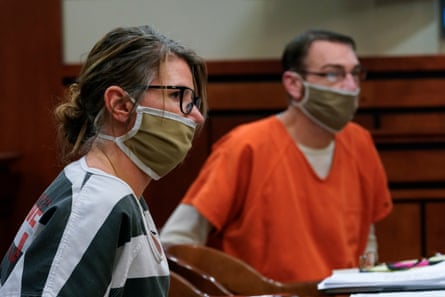
Taxman’s introduction to the topic came through the watershed trial of Jennifer and James Crumbley, a Michigan couple whose then-15-year-old son shot and killed four students in a mass shooting at Oxford high school on 30 November 2021.
The boy had sent his own parents text messages that displayed deep paranoia and a preoccupation with school shootings. And the couple met with school administrators both the day before and the morning of the shooting to discuss concerning behavior of their son, including looking up where to get bullets while in school and drawing a picture of a gun and wounded man on a math assignment with the message “The thoughts won’t stop. Help me. Blood everywhere,” written on it. But the Crumbleys mentioned in neither meeting that their son had access to a handgun that his father had bought four days before the shooting.
The Crumbleys were charged with involuntary manslaughter, with prosecutors arguing that the parents facilitated the shooting by allowing their son to have access to a firearm despite school staff’s warnings that their son was in crisis and a threat to himself and those around him. A jury agreed. In early 2024, the Crumbleys were convicted and sentenced to 10 to 15 years in prison.
Their son pleaded guilty to terrorism and first degree murder in October 2022 and was sentenced to life in prison the following year.
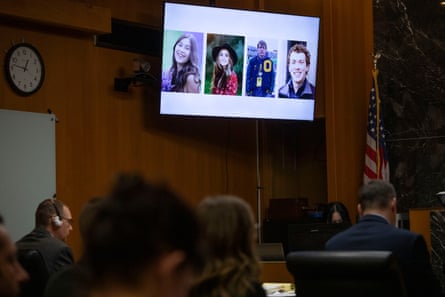
The Georgia shooting took place less than six months after the Crumbleys’ sentencing. On 4 September 2024, a 14-year-old boy was accused of shooting and killing two students, two teachers and injuring nine others at Apalachee high school in Winder. The day after the shooting, Gray, the teen’s father, was arrested and charged with 29 offenses, including second degree murder, involuntary homicide and cruelty toward children.
Local police had already interviewed Gray and his son the year before about online threats to commit a school shooting. At the time, Gray admitted that he owned guns that were accessible to his son and that the two often went shooting together. Seven months after that, he bought his son a rifle as a Christmas gift.
In March, the father was convicted on all 29 charges. He is due to be sentenced at the end of July and faces 180 years in prison.
****
“The goal of these lawsuits and prosecutions is to deter parents from being careless with their guns and put pressure on their children to stay away from firearms,” said Nila Bala, a law professor at UC Davis who specializes in children’s law and parental liability.
The hope is to change the parents’ behavior directly, she added, and that children will factor in their parents’ legal risk when thinking through their own actions.
Prosecutors in the US have been charging parents for crimes committed by their children since the early 20th century, and today, parents are regularly charged in offenses such as truancy and fatal accidents. But the Crumbley and Gray cases marked the first times parents were charged with and convicted of homicide.
Prosecutions like this can serve to hold people accountable for enabling violence, said Sam Levy, the director of policy advocacy of Everytown for Gun Safety.
“It’s not just to address the harms they cause but to demonstrate to the wider world that this type of misconduct has consequences, and hopefully get people to think a little harder about how they’re going to act,” said Levy.
“My preference is to prevent tragedies like this from happening, but when they do, we’re faced with trying to understand who is at fault outside the shooter themselves,” he continued. “And in these cases there are no doubts that these parents made these tragedies possible.”
****
Taxman’s more skeptical that the prosecutions will have the deterrent effect prosecutors are hoping for.
“I had an initial concern and skepticism that we’re just reaching for the most readily available tool rather than the best one,” he said. “It’s hard for us to verify on the backend whether this is an effective prophylactic or effective sort of preventative measure.”
Meanwhile, he says, the strategy could have lasting consequences. It can signal to the public that the ultimate responsibility for stopping students from committing shootings lies with the parents. He cautions that would shift away responsibility from others, including officials who fail to allot funds that equip schools with resources for students in crisis or fail to enact legislation like safe storage laws and extreme risk protection orders that can limit minors’ access to guns.
“It’s easier to measure the effects of gun control legislation because you can see how many people are being charged for unsafe storage. You can maybe track data that helps you evaluate the effectiveness of your protective measure.”
Bala concurred: “We are absolving the state and saying that if parents have all this control over their kids, then they also have all this liability when things go wrong.”
But, she said, this focus on what parents do and don’t do shouldn’t distract from the shortcomings of the US’ mental healthcare infrastructure, especially for parents who see their child going down a dangerous path but have nowhere to seek help.
“These kids need mental health help In some of these cases, parents try to seek help, but they can’t get it,” Bala added. “When we use parental liability as a tool … It’s easier for the state to say, ‘We’re not going to actually look at the underlying issues that cause school shootings or gun crimes.’”
Ben McJunkin, an Arizona state university law professor, thinks there should be a middle road – one that acknowledges the role of parents, but doesn’t attribute them equal blame. “We ought to convict people of things that accurately describe the kind of wrongdoing they did and that accurately sums up the amount of blame that they deserve,” he said. “But [prosecutors] don’t have the tools needed to come up with a lesser punishment that better fits the kind of behavior that these particular defendants engaged in.”
Rather than applying the current criminal statutes to cases where parents are suspected of contributing to their child’s actions, he’s argued for a new category called “reckless accomplice” that can capture the role of parents in their children’s decisions but doesn’t force prosecutors and juries to pass down charges that don’t exactly fit their offense.
“What happens when we hold multiple people responsible is we’re just multiplying punishment. Their son doesn’t get less punishment because they got some. Everyone gets punished as if they had done the entire thing by themselves.”
****
The move to charge parents comes amid a deep frustration among Americans who feel that there has been no movement on preventing mass shootings, especially those on school campuses.
Increasingly, victims, families and their survivors have sought to hold people outside of the shooter to account for the losses of life, injury and trauma that gun violence causes, including companies in industries such as tech and firearms, and various levels of government.
In the past decade, hundreds of millions of dollars have been paid out; dozens are pending; and new ones continue to be filed. In 2022, Remington Arms, the gunmaker, reached a $73m settlement with the families of nine of the victims of the 2012 Sandy Hook school shooting after the families accused the gunmaker of marketing their guns to troubled young men like the shooter, who went on to kill 20 children and six adults. The next year, the US Department of Justice settled for $144.5m with 75 plaintiffs, who were impacted by a 2017 mass church shooting in which 26 people were killed and 22 injured in Sutherland Springs, Texas. The claimants accused the US air force of negligence for failing to send information about the shooter that could have stopped him from legally buying a gun to the federal background check system.
And in April, the survivors of the 2022 mass shooting at Tops grocery store in Buffalo, New York – in which 10 people were killed and three others wounded – settled with magazine-lock manufacturer Mean LLC, gun dealer Vintage Firearms LLC, and the shooter’s parents. Mean LLC has agreed to pay $1.75m to the survivors after the New York attorney general, Letitia James, accused them of falsely advertising their gun lock, which was easily removed by the shooter. The parents settled for a confidential dollar amount and as a part of the settlement, the gun store closed permanently and its owner agreed not to seek a new federal license to sell firearms.
Mass shooting survivors and their attorneys have described these suits as tools that can force these groups to change their practices.
“Anytime you have a bad actor who’s conduct leads to this kind of tragedy, accountability is vital to getting justice for victims and making sure that bad behavior doesn’t continue,” said Levy.
Meanwhile, experts are watching a new case making its way through the courts – that of Jeffrey Rupnow, the father of a 15-year-old who shot and killed a teacher and a student and injured six others before turning the gun on herself in December 2024.
Unlike the Crumbleys and Colin Gray, Rupnow is not charged for the deaths and injuries, but for intentionally giving a dangerous weapon to a minor and contributing to the delinquency of a minor. If convicted, he faces up to 18 years in prison.