








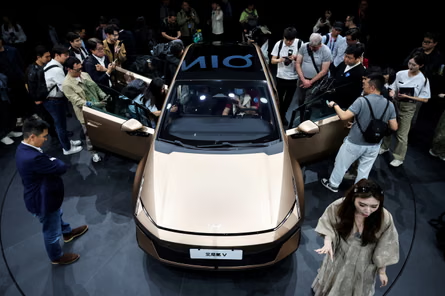
At the world’s biggest car fair, which opened in Beijing on Friday, there were hundreds of manufacturers, more than 1,000 vehicles, hundreds of thousands of enthusiasts – and hardly anyone behind a wheel.
China’s car companies have cornered the domestic electric vehicle market, and are increasingly visible on the global stage. Now they’re turning their attention to what they are betting is the future of mobility: autonomous driving.
At the Beijing Auto Fair, a huge industry event that covers 380,000 square metres on the outskirts of the capital, the country’s carmakers showed off a range of intelligent driving technologies.
In China’s cut-throat domestic market, nearly every big carmaker is investing heavily in the software and computing power needed to make “hands-free” driving a reality as they compete to offer additional perks and find new ways to generate revenue.
And Huawei, the telecommunications group, revealed this week that it would be investing up to 80bn yuan (£8.7bn) over the next five years to develop its autonomous driving software and computing power.
“The fact that almost every automaker has some version of intelligent driving makes it different to almost any market in the world,” said Tu Le, the managing director of Sino Auto Insights, a consultancy.
Le said that the Chinese market was so competitive that merely selling passenger vehicles domestically was no longer a viable way for Chinese companies to make money. Additional perks, such as leasing AI-powered software, are needed to boost revenues.
The EV maker Xpeng said its latest AI model allows drivers to give the car commands – such as, “park near the entrance to the shopping centre” – rather than a specific spot on a map.
An AI-powered operating system from Xiaomi, an appliance and phone maker, allows drivers to make restaurant reservations, compile notes while driving and place coffee orders. It can also detect when drivers seem stressed or agitated and adjust the lighting and music for their arrival at home.
Domestic car sales in China have fallen sharply in recent months. The number of passenger vehicles sold in China dropped by 17% in the first three months of this year as the government phased out a subsidy programme. BYD, the leader of China’s EV industry and the company seen as a bellwether for the sector, has reported seven consecutive months of declining sales.
China’s exports, meanwhile, soared by more than 60% in the first quarter.
China’s largest car exporter, Chery, has recently set its sights on the UK market. Since launching in the UK in August it has become on of the country’s fastest-growing car brands, with 13,500 cars sold between September and March.
On Friday, the company announced a goal for 10m global annual sales by 2030, up from 5m in 2025. Farrell Hsu, the UK country director for Chery, said: “This exceptional growth underlines Chery UK’s position as a key contributor to the overall business growth by 2030.”
The focus on overseas sales was evident at the fair as the carmaker Geely announced plans to deploy thousands of driverless taxis globally next year through its ride-hailing arm, Caocao. Chinese companies are looking to compete with US robotaxi firms such as Waymo, which have proven successful in San Francisco and Los Angeles.
Robotaxis have already been rolled out in several Chinese cities, but their widescale adoption has been limited by regulatory barriers as much as technical ones.
Last week the government concluded a public consultation on a proposed new set of safety standards for autonomous cars. There are no nationwide guidelines, and Beijing has been cautious about allowing unfettered access for driverless cars on its roads.
Last month several of Baidu’s Apollo Go robotaxis stalled in the middle of the road in Wuhan, leaving riders stranded for hours.
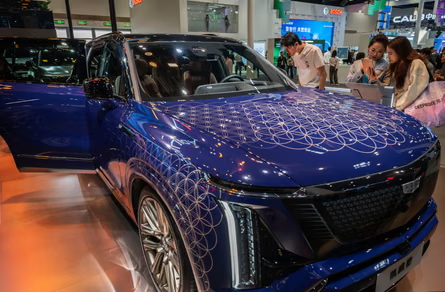
Nevertheless, Chinese robotaxis are expected on the streets of London this year as Lyft and Uber have announced partnerships with Baidu to use its self-driving software.
Faced with tariffs in big markets, such as theUS and the EU, Chinese carmakers are focusing on smaller markets, such as the UK and Canada, to shift units.
One industry professional said the UK was appealing for Chinese companies because it was seen as being “culturally agnostic” about allowing Chinese EVs on its roads – while other countries have blocked them on national security grounds.
Chinese companies are expected to account for one in every 10 new cars sold in Britain in 2025.
In February, Chery launched its fourth brand in the UK. Hsu said the company was “actively considering options for production and R&D facilities in the UK”.