


‘Ultras” – hardcore football fans renowned for their stunning stadium displays and gang-like loyalty – were once a subculture confined to Italian stadiums. But since the late 1960s the movement has spread through global football terraces and become a more elevated cultural obsession.
Books on the subject include my own Ultra and James Montague’s 1312 (the numbers stand for ACAB, an abbreviation of “all cops are bastards”). Netflix has not only commissioned one film, Ultras, about a Neapolitan gang, but also three longer series: Puerta 7 (based in Argentina), Furioza and The Hooligan (both set in Poland).
Now comes Ragnhild Ekner’s documentary Ultras, a 90-minute journey through Sweden, Indonesia, Poland, Argentina, England, Egypt and Morocco. Her film goes a long way to addressing the roots of ultra-mania. Many of the lingering shots are of thousands of people marching, singing and celebrating in unison. In an early voiceover, Ekner calls it “an uprising against loneliness”.
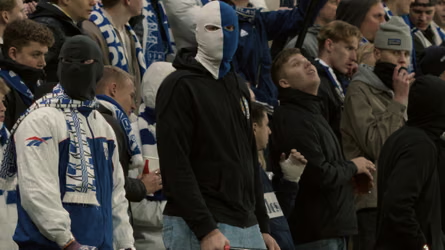
In many ways, ultra-dom provides precisely what contemporary society lacks: collectivism in a period of atomisation; danger and adrenaline in a society that seems strangely bloodless; old-fashioned masculinity and muscle in a period of soft skills, and belonging in an era of rootlessness. “It’s where I feel at home”, says one ultra in Ekner’s film; “Inside, we’re a family”, says another, “and we take care of each other.”
Some might be repulsed by a number of these concepts, but many, including women, aren’t. One female ultra, describing her own barra brava (the South American term for an ultra gang), says: “You can’t come in [to the terraces] with a ring, or with lipstick or with make-up,” as if that veto were liberating. Ekner’s film is good at unpicking the contradictions: there are terraces where women are excluded (in north Africa) and others (in Indonesia) where young, veiled women are centre stage.
The attraction of ultras also arises, one assumes, because modern football itself is so rootless. Teams now have negligible connection to their own city or suburb. Players and owners are from far-flung countries. Shirt advertising is in foreign languages for TV viewers abroad. Ultras are the only vociferous link to the soil in which the club germinated. It’s only they who give the sanitised, cinematic experience of modern football a sense of passion and even meaning.
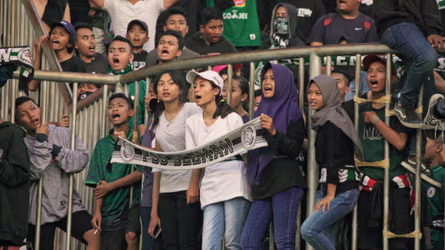
Another element of their appeal is that they’re outlaws and insurgents in an era of conformity and repression. Ultras played an important role in the Arab spring in Egypt and throughout the global movement they claim to champion the excluded and dispossessed: “If you cannot speak”, their rhetoric goes, “the stadium will speak for you.”
In our secular age, being an ultra also offers an induction into spiritual concepts. It’s a religion for the irreligious. The ultra lexicon – “faith”, “presence”, “devotion” – is nearly identical to ecclesiastical diction and, as in church, the ultra “congregation” hopes to influence fate through fidelity and ritual.
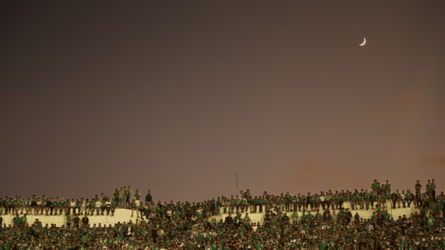
Being an ultra even introduces that ancient concept at the heart of many religions. One ultra who survived Egypt’s 2012 Port Said massacre (in which 72 Al-Ahly fans died, partly as revenge for their role in the Arab spring), says: “That’s when I understood one can sacrifice oneself for a higher cause.”
As well as mock-religion, there’s also mock-medievalism. There’s an element of historical reenactment to the ultras as they play “steal the flag”, sprinting across the pitch to rip off and burn the rival ultras’ herald (that “hand-painted piece of cloth worth more than gold”). Etiquette says that if a group’s herald is stolen, it should immediately disband and so “it needs to be protected by any means necessary”.
That, naturally, implies also by violence. “Subcultures have always been violent,” says one interviewee. “The violence can be aesthetic, verbal, or real, physical violence.” But Ekner openly sidesteps all negativity, saying that her film “isn’t a critical review, it’s a tribute”. In doing so, she perhaps misses the main reason ultras remain fascinating: their overlap with criminality. Because beneath all the carnival atmosphere of pyrotechnics and terrace-wide artwork (using 25km of thread and 150 litres of paint), and behind all the beer, spliff and fisticuffs, ultra gangs have frequently become criminal ones.
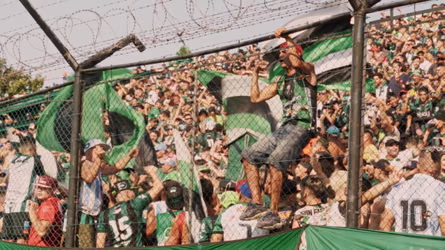
In Italy, some ultra bosses are proper mobsters, making five figure sums per month not only from ticket-touting, merchandise, burger vans and parking concessions, but also from wholesale drug-trafficking. Across Europe, terraces have been cauldrons of political experimentation, with ultras serving as the lighter fuel for the rise of the far-right.
Ultras are mind-bogglingly contradictory, being both charitable and criminal, unifying and divisive, revolutionary and reactionary. It’s a movement that reflects, like a wonky fairground mirror, the society and sport in which it exists. To avoid those contradictions is to miss the true essence of being an ultra: you gain much – belonging, roots and tribal loyalty – but at the cost of reintroducing those familiar negatives: a need to shame, scapegoating, omertà, muscle and derision for difference and diversity. Ultras show us not only what we’ve lost along the way, but also the cost of getting it back.