
惯性聚合 高效追踪和阅读你感兴趣的博客、新闻、科技资讯
阅读原文 在惯性聚合中打开

推荐订阅源

Threat Intelligence Blog | Flashpoint
量子位
M
MIT News - Artificial intelligence
Y
Y Combinator Blog
钛媒体:引领未来商业与生活新知
钛媒体:引领未来商业与生活新知
Google DeepMind News
Hugging Face - Blog
Hugging Face - Blog
博客园_首页
雷峰网
雷峰网
I
InfoQ
罗磊的独立博客
博客园 - 聂微东
酷 壳 – CoolShell
酷 壳 – CoolShell
大猫的无限游戏
大猫的无限游戏
D
Docker
H
Hackread – Cybersecurity News, Data Breaches, AI and More
腾讯CDC
博客园 - 三生石上(FineUI控件)
The GitHub Blog
The GitHub Blog
K
Kaspersky official blog
P
Privacy & Cybersecurity Law Blog
S
SegmentFault 最新的问题
T
Threat Research - Cisco Blogs
H
Help Net Security
小众软件
小众软件
Cyber Security Advisories - MS-ISAC
C
CERT Recently Published Vulnerability Notes
WordPress大学
WordPress大学
T
Tenable Blog
T
The Blog of Author Tim Ferriss
C
Cisco Blogs
Simon Willison's Weblog
博客园 - Franky
A
Arctic Wolf
T
Threatpost
Scott Helme
Scott Helme
C
Cybersecurity and Infrastructure Security Agency CISA
D
Darknet – Hacking Tools, Hacker News & Cyber Security
T
The Exploit Database - CXSecurity.com
G
GRAHAM CLULEY
Security Latest
Security Latest
Spread Privacy
Spread Privacy
L
LINUX DO - 热门话题
V
Vulnerabilities – Threatpost
P
Privacy International News Feed
S
Schneier on Security
Latest news
Latest news
cs.CL updates on arXiv.org
C
Cyber Attacks, Cyber Crime and Cyber Security
C
CXSECURITY Database RSS Feed - CXSecurity.com

The Guardian

New Zealand’s North Island braces for Cyclone Vaianu with thousands ordered to evacuate Artemis II splashdown – in pictures Swalwell denies allegations of sexual assault as calls grow for him to withdraw from California governor race Trump news at a glance: Epstein survivors have words for Melania Trump after surprise statement Multiple people face charges, including murder, in California fireworks blast Rory McIlroy surges into six-shot Masters lead with stunning second-round flourish Roberto De Zerbi targets ‘Ange-ball’ revival to save Spurs from relegation Bath hit back to reach semi-final after stunning Northampton in 11-try epic Australia crash out of BJK Cup after Britain secure upset with doubles win Zebras, wealth and power: Hungary’s election tests Orbán’s grip on power ‘TikTok effect’ brings sellout crowds and younger fans to Grand National meeting King signs up David Beckham to his Chelsea flower show team The war over Omagh’s gold: the £21bn mine plan tearing a community apart Britain’s shadow workforce is paid as little as 65p an hour. Who cares for the carers? Tim Dowling: my wife is on a quest to restore my thinning hair SUVs are making Britain’s potholes worse, say scientists Blind date: ‘She claimed she was usually shy. I wouldn’t have guessed’ I’m a sauna person now: the Becky Barnicoat cartoon ‘I got everything I dreamed of – when I had no ability to handle it’: Lena Dunham on toxic fame, broken friendships and her ‘lost decade’ Six great reads: the man who let snakes bite him, masked heavy metal and the brutal reality for foreign students in the UK Meera Sodha’s recipe for noodles with rose beancurd, spring greens and egg Cuba’s doctors were a lifeline for the world. Now the Caribbean is shamefully complicit in the US drive to expel them An environmental disaster in Moldova has Russia’s fingerprints all over it ‘This is as important as your teeth’: are you skipping this key part of mouth hygiene? Man arrested after four die trying to cross Channel in small boat Ukraine war briefing: doubts linger in Kyiv over Moscow’s promise to uphold Orthodox Easter ceasefire Ichiro Suzuki statue unveiling goes awry as bronze bat snaps during ceremony Arrest of national war hero Ben Roberts-Smith cuts deeply to core of Australian psyche European football: Real Madrid held at home by Girona to extend winless run ‘You come back different’: how rugby players change after motherhood Human rights groups decry US plan for Guantánamo camp for Cuban migrants Potential US host cities for 2031 Women’s World Cup games mull withdrawal over Fifa concerns Arne Slot insists he is ‘aligned’ with Liverpool board and fans as squad is rebuilt Kamala Harris ‘thinking about’ running for president again in 2028 JD Vance warns Iran against trying to ‘play’ the US in peace talks West Ham double up twice to thrash Wolves and put Spurs in relegation zone Trump administration releases new renderings of so-called ‘Arc de Trump’ Bafta apologises for events surrounding John Davidson’s Tourette’s outburst Cocktail of the week: Bar Shrimp’s la rosita – recipe New drug may extend survival in aggressive ovarian cancer, trial shows One dead and 27 injured after bus with British passengers crashes in Canary Islands OpenAI CEO Sam Altman’s home targeted with molotov cocktail Alarm as acting CDC director delays report showing Covid vaccine benefits Argentina just ripped up its pioneering glacier law. What does this mean for millions of people’s drinking water? ‘Illegal’ forest service overhaul risks causing ‘chaos’ across US public lands, union claims Prince Harry sued for defamation by charity he co-founded Anthropic’s new AI tool has implications for us all – whether we can use it or not Concerns raised about motorbike tourist trail after death of British teenager in Vietnam The Guardian view on Trump’s civilisational threats: the words that fuel war must be condemned The Guardian view on dystopias for our times: the American nightmare Weather tracker: Cyclone Maila batters Solomon Islands with 115mph winds Doctors’ leader claims new reduced pay offer killed chances of ending strikes in England Netanyahu-ism has achieved nothing for Israelis – and come at a monstrously high price Deborah Levy: ‘CS Lewis’s White Witch terrified me – but I wanted to meet her’ How I Shop with Michelle Ogundehin: ‘We grownups have enough stuff already’ ‘Butter Birkin’: popcorn plastic It bag in demand by Devil Wears Prada fans Trump’s war and Melania’s Epstein statement, with US editor Betsy Reed – The Latest Orbán and Magyar trade accusations in last days of Hungary election campaign Reckonwrong: How Long Has It Been? review | Safi Bugel's experimental album of the month Martin Rowson on Middle East peace talks – cartoon Fears of UK and EU flight cancellations as airports warn of jet fuel shortages Peers vote to ban pornography depicting sex acts between stepfamily members Week in wildlife: an ostrich on the lam, a tortoise crossing a road and surfing seals ‘There’s no shortage of terrifying technology’: how AI became TV drama’s new go-to villain Texas court overturns sentence for man on death row for nearly 50 years Power up! Could force be the secret to supercharging your fitness? ‘Irresponsible failure’: Google, Meta, Snap and Microsoft slam EU over child sexual abuse law lapse Blank canvas: what to wear with white trousers Critics assemble! Here’s my list of the greatest superhero movies of all time Amazon to finally launch Leo satellite internet in ‘mid-2026’, says CEO Pete Hegseth’s holy war: the militant Christian theology animating the US attack on Iran Toxic putdowns, brutal zingers ... and an unexpected love story – inside the joyful climax to brilliant sitcom Hacks Add to playlist: the beautifully dazed, countrified indie-rock of Tracey Nelson and the week’s best new tracks ‘I’m worried there’s too much of me,’ says a birch: inside the interspecies council giving nature a voice Dolce & Gabbana says co-founder Stefano Gabbana has quit as chair Why is anyone surprised by the US and Israel’s latest war? It’s only what the world allowed them to do in Gaza Super Mario what?! The seven best obscure Mario games Holly Humberstone: Cruel World review – Taylor Swift fave trades gothic melancholy for pop glow-up Thrash review – cursed shark thriller sinks like a stone on Netflix ‘The biggest, baddest, saltiest chick you would ever see’: why no one sang the blues like Big Mama Thornton Go Gentle by Maria Semple review – a joyfully clever New York romcom ‘Tranquil, natural and barely a tourist in sight’: readers’ favourite hidden gems in Spain Benjamina Ebuehi’s sweet and salty chocolate chip cookies recipe ‘I’m not a commercial director – I’m not even a professional film-maker’: Jim Jarmusch on the seven-year journey to make his new film Malcolm in the Middle: Life’s Still Unfair review – the TV magic they’ve created here is absolutely miraculous The Miniature Wife review – Matthew Macfadyen is wasted in this pointless comedy From soups and greens to roots, how to survive the ‘hungry gap’ From fat transplants to LED mittens: how the fear of ‘old lady hands’ mobilised the beauty industry Anna Wintour’s Vogue cover is more than a cameo – it’s a power play ‘They’re gonna make me cry’: I competed at a speed puzzling championship You be the judge: should my girlfriend stop mixing gold and silver jewellery? Maritime and port workers: how is the Middle East conflict affecting you? How games capture the awe and terror of cosmic isolation Why does alcohol make us both happy and miserable – and what else does it do to our minds and bodies? I never text back – and it’s ruining my relationships The pet I’ll never forget: Beau, the labrador who saved my life Life Is Strange: Reunion review – a decade-long story comes to an impassioned close Why is gaming becoming so expensive? The answer is found in AI Sign up for the First Edition newsletter: our free daily news email Sign up for the Feast newsletter: our free Guardian food email
‘Reparations take many forms’: what the UN’s landmark vote on enslavement means for restorative justice
Nesrine Mali · 2026-04-22 · via The Guardian

Just under a month ago, a landmark vote was passed. The United Nations voted to describe the transatlantic chattel slave trade as the “gravest crime against humanity” and called for reparations as “a concrete step towards remedying historical wrongs”. This was the culmination of a long journey and decades of work. But it is by no means the end.

I spoke to Ebony Riddell Bamber, director of the Scott Trust’s Legacies of Enslavement programme, about what the vote means, and the Guardian’s role in the global effort.

A win obscured by technicalities
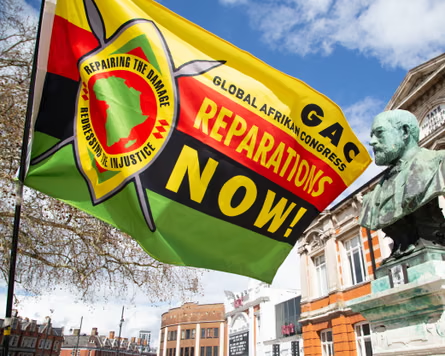
A man holds a flag calling for reparations in Windrush square.
A ‘fringe issue’ no more … calls for reparations in London’s Windrush Square. Photograph: Sopa Images/LightRocket/Getty Images

Ebony Riddell Bamber has just returned from the United Nations Permanent Forum on People of African Descent, held in Geneva, which included discussions on what reparations entail in practice. The response to the vote among the community, Ebony said, was broadly positive. For something that, for a long time, was a “fringe issue,” it was an achievement to see the slave trade recognised for the crime it was, and compensation for its consequences to be called for – consequences that continue to reverberate in terms of economic dispossession, displacement and cultural erasure.

To the casual observer, there was much to be infuriated about with how the vote played out: while 123 countries voted in favour of the resolution, there were 52 abstentions, including from many European countries and two of the nations most responsible for the trafficking of millions of Africans across the Atlantic – the US and the UK. But Ebony told me this was, in fact, a glass-half-full result. In the past these countries would “probably have voted against it”. The technical reasons for the abstentions did not negate the seriousness of the charge. The UK chargé d’affaires to the UN said that, while the UK recognised the suffering that had been inflicted on millions, “no single set of atrocities should be regarded as more or less significant than another”. It was also interesting, Ebony observed, that international law was invoked as a reason for not endorsing reparations. The fact that the slave trade was not “illegal at the time”, according to the UK and other countries who argued the same point of law, meant that no crime was committed, and therefore compensation could not be recognised by domestic justice systems.


Time is running out for excuses
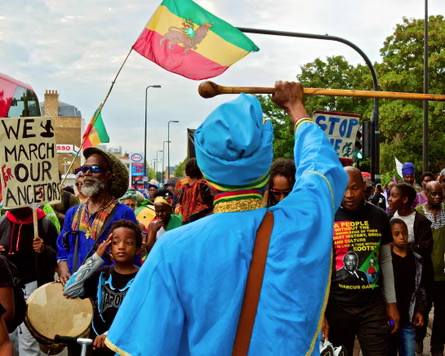
An image of protesters marching from Brixton to Westminster during the Afrikan Emancipation Day Reparations March in 2019
A growing diasporic movement … hundreds march on Westminster in London during the Afrikan Emancipation Day Reparations March in 2019. Photograph: Paul Iwala/Alamy

These justifications can be viewed as cop-outs or as anxieties about this vote not being merely symbolic. The west is “nervous”, wrote the Caribbean analyst Kenneth Mohammed, that “once it officially recognises that this atrocity was foundational and still alive in its consequences, the old script becomes harder to sustain. Then questions follow. About debt. About underdevelopment. About museum collections. About trade structures. About who was compensated and who never was.” That nervousness is a part of a wider moment of backlash against the progress and growth of racial justice movements, and the exploitation of that by rightwing populist parties. In the UK, the Reform party jumped on the vote results, declaring that if it ever forms a government it would deny new visas to anyone from a country seeking reparations from Britain.

Still, that old script is being rewritten by a growing “global diasporic movement”, Ebony said, given momentum by the Caribbean Community’s (Caricom) Ten-Point Plan for Reparatory Justice in 2014, but now includes African countries as well. The UN vote was proposed by Ghana’s president John Dramani Mahama, and the framework for it was drafted by Zimbabwean writer Panashe Chigumadzi.


The Guardian’s role in restorative justice
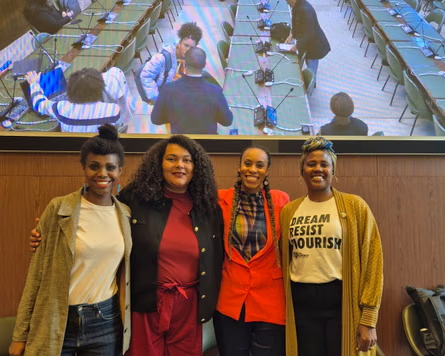
Four women stand together in front of a large screen at the UN Permanent Forum for People of African Descent. Left to right: Liliane Umubyeyi and Hélène Himmer from African Futures Lab; Manuela Thamani from Observatório da Branquitude (Whiteness Observatory) and Ebony Riddell Bamber from Scott Trust Legacies of Enslavement.
Truth-telling … Liliane Umubyeyi and Hélène Himmer from African Futures Lab, Manuela Thamani from Observatório da Branquitude (Whiteness Observatory) and Ebony Riddell Bamber (far right) at the UN Permanent Forum for People of African Descent. Photograph: Observatório da Branquitude

It has been three years since the launch of the Legacies of Enslavement programme, backed by the Guardian’s owner, the Scott Trust. The restorative justice programme was launched in response to the discovery that the newspaper’s 19th-century founders were connected to transatlantic enslavement. It includes community-led repair, truth-telling and raising awareness of Britain’s involvement in slavery, as well as aiming to increase the scope and ambition of the Guardian’s journalism, especially in covering underreported regions (an effort The Long Wave is a part of). I asked Ebony about her reflections on the work done so far, and how it is part of the wider, historical effort that culminated in the UN vote.

“One of the biggest things that struck me doing this work is that we never ask or reflect on what reparations for transatlantic enslavement could be. Many people we have had the privilege to engage with are being asked this question for the first time,” she said. And so the series is receiving “very precious information that has huge value” on what people’s “liberatory vision is”. One is simply the desire for there “to be a level playing field to have a better life,” Ebony added. “One of the legacies of enslavement is that that playing field does not exist.” In Jamaica, the preoccupation has been “very much education and training for young people. In the US Sea Islands, it is about land and property retention.”

Ebony also mentioned the climate emergency across the Caribbean, and the desire for communities vulnerable to it to be supported and to build resilience in such conditions. And then there is “preserving culture, heritage, history, connecting with the knowledge and food ways of our ancestors, decolonising curricula”. As Ebony listed these desires, it struck me that visions of liberation frequently return to recognising and rebalancing a state of western hegemony built on enslaved labour, not only in economic terms, but also in terms of culture and dignity.

The Guardian’s role in this lies in its ability to marshal not just funds and journalism, but also “convening power”, bringing together international organisations, academics, and local communities to ameliorate the fundamental imbalances brought about by colossal historical exploitation and enrichment. Reparations, Ebony told me, “take many different forms”.


An unstoppable momentum

An aerial view of a mural with the words “End Racism Now”, painted on Main Street in Fort Worth, Texas.
Art for action … a mural painted on Main Street in Fort Worth, Texas, as part of the Black Lives Matter movement. Photograph: Tom Pennington/Getty Images

That is an enormous task for all concerned, but Ebony said the effort to recognise the legacies of enslavement and the importance and means of reparative justice is “moving in the right direction” and building “momentum”, standing on the shoulders of those who laboured for years in far more hostile climates. “That doesn’t mean there isn’t a lot of work to be done,” she added, and challenges of pushback remain, but “there’s not the ability to block or shut down the discussion any more”. She observes that one of the learnings from the team’s work over the past three years is that there is a desire to be “in community both globally and locally”. “Wanting to reconnect across the diaspora,” she said, underpins all of the work, a fact that is demonstrated in the sort of growing collaboration of African and Caribbean countries that culminated in the UN vote. “There is momentum in working in lockstep. We are in a different place globally, but there is power in that collaborative force.”