


It’s not every comedy that dares to feature a character trying to strangle herself with her own hijab. Yet the BBC’s Proper Ladies has caused a storm on social media thanks to its chaotic energy and sharply observed teenage dynamics, drawing comparisons to shows such as Derry Girls and Some Girls. “We saw our first fan edit and it had 100,000 likes,” says writer Sabrina Ali. “It feels like we made it.”
Set in a faith school, Proper Ladies is a 10-minute short that follows four schoolgirls in detention, where friendships, rivalries and acts of rebellion unfold. Absurd, quick-witted and fast, it leans into the heightened logic of teenage life – where the smallest things escalate quickly and everything feels urgent. In one scene, a student delivers a dramatic monologue about setting off the fire alarm to conceal the fact that she used the staff toilets to defecate.
Created by Ali and based on her award-winning stage play Dugsi Dayz, it’s an attempt to make TV that’s “messy, chaotic, and funny”. It follows Salma, a model student and prefect played by first-time actor Samira Tahlil, who tries, and mostly fails, to keep order among her misbehaving peers – whose antics include slipping laxatives into their teacher’s (Lisa McGrillis). Detention and trips to see the headteacher (Mark Silcox) follow, resulting in Salma spotting that he wears a toupee, and inadvertently informing the whole school.
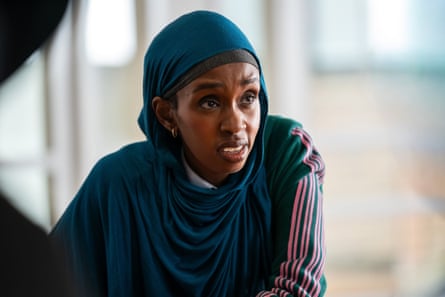
Ali plays the character of Munira, who runs an underground energy drink business from inside the school. She’s joined by Yasmin, played by Ebada Hassan (Brides), a fashion-focused “it girl”, and Hani, played by Kosar Ali (Muna, Rocks), an aloof, emo-leaning student who secretly writes Harry Styles fan fiction.
“So many girls I knew were into fan fiction,” says Kosar, reflecting on the script, which the cast say draws heavily on lived experience of school life. “It was a real form of escapism. And every teenage girl goes through some kind of emo phase.”
Together, the four form a tight-knit ensemble built around recognisable teenage archetypes, filtered through the contained world of a secondary school. The pilot is in development with the potential to become a full series, following a four-year journey from stage to screen.
Dugsi Dayz, which premiered in October 2022, established Ali as a writer working with Somali British stories on stage. She began adapting the material for television later that year, with backing from executive producers including Michaela Coel. Ali had met Coel at a press night where she shared the idea for the play, and later developed her early draft in Coel’s River Library, a writing sanctuary for women of colour in her home. “Having her backing feels full circle,” she says. “It’s given me the confidence to develop my writing.”
Ali says the shift from theatre to television didn’t change the show’s perspective. “What I didn’t want to lose was seeing the world through the girls’ lens,” she says. “Not being guided through it. Just peeking into their lives.”
An open casting callout, circulated across Instagram and TikTok, invited applicants with little to no acting experience, drawing in young people who might not otherwise have considered the industry. For many, it was their first audition. “Most of the time, people don’t feel like there’s access, so they don’t even pursue it,” Ali says. To combat this, she felt it was important to make the process “more open and less intimidating”.
Ali hopes that her comedic approach reshapes how Black and Muslim characters are often positioned in British television. “Sometimes, when characters look like us, there’s an expectation to disarm audiences,” she says. “Especially with Muslim characters. It becomes: ‘Show us why you deserve to be here.’ I didn’t want that.”
Instead, she argues, comedy allows for recognition without instruction. “As soon as you laugh at a character, you recognise something human in them.”
Alongside growing attention, however, the cast have also faced a wave of racist and Islamophobic abuse online since the short aired. Some have stepped back from social media as a result.
“If us simply existing causes this level of abuse, it shows how rarely people like us are seen on British television,” Ali says. “But it also shows why shows like this need to exist.”
Besides, she adds: “For every hateful message, there’s been an outpouring of love. And those messages matter more than anything.”