


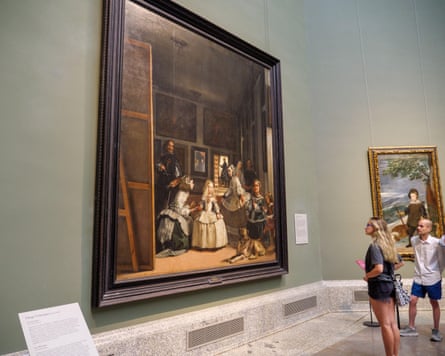
No trip to the Prado these days is complete without a visit to room 12 of the Madrid museum, where Diego Velázquez, a five-year-old princess and a sleepy mastiff stare down from the enormous canvas of Las Meninas.
Two hundred years ago, however, the must-see exhibit at the newly established museum was not Las Meninas, but a gigantic allegorical work that sought to remind Spaniards of their heroic resistance to the Napoleonic occupation and their loyalty to King Ferdinand VII.
Painted by José Aparicio in 1818, El año del hambre de Madrid (The Year of the Famine in Madrid), shows a group of emaciated, dying madrileños nobly refusing the bread offered to them by French soldiers. By choosing death over the occupiers’ aid – even as their children perish and they are reduced to gnawing on cabbage stalks – they demonstrate a perfect, if terminal, patriotism.
Although the painting was the main draw for visitors in the first decades of the Prado’s existence, it eventually fell from political and aesthetic favour and was banished from the museum. Today, after more than 150 years of itinerant exile that has included sojourns in a government ministry, the senate and another Madrid museum, The Year of the Famine in Madrid has come home.
The canvas has been chosen as the inaugural work in a new series of exhibitions called A Work, a Story, which aims to help visitors consider paintings in a wider context. The idea, in the words of the Prado’s director, Miguel Falomir, is “to encourage the viewer to look at a work which, aside from its aesthetic merits, helps us to reflect on aspects of art history that often go unnoticed”.
In the case of The Year of the Famine in Madrid, visitors are invited to consider the painting’s propagandistic intent, its social and political context, its relationship with the Prado over the years, and the way in which Francisco Goya’s depictions of civilian suffering have since come to eclipse Aparicio’s canvas. By the end of the 19th century, it had become a punchline and a byword for bad taste.
“The importance this picture had was massive, and so was the scale of its fall,” said Celia Guilarte Calderón de la Barca, one of the show’s curators. “There’s no middle ground here; it’s from one extreme to another.”
The painting’s history, she added, was “completely bound” up with Spain’s changing political and artistic currents.
Aparicio, who was the court painter to Ferdinand, envisaged The Year of the Famine in Madrid as a means to cement the recently restored king in people’s hearts – hence the message that appears on one of the pillars in the background: “Nada sin Fernando” (“Nothing without Ferdinand”).
Its nakedly patriotic sentiment, combined with its tribute to the resilience of the people of Madrid, proved an instant hit. The fact it was given pride of place in the Royal Museum of Painting and Sculpture, founded by Ferdinand and later to become the Prado, didn’t hurt either.
“Aparicio’s knack – and he was very strategic and intelligent in that sense – was to associate it with a collective trauma of the entire city of Madrid, where the painting was to be housed,” said Carlos G Navarro, the show’s other curator.
“When you look back over the records from those early years, you see that people were coming to the museum not to see the Raphael paintings that were hanging there, nor to see Las Meninas, but to see The Year of the Famine,” said Navarro.
But by the late 1860s, Ferdinand’s absolutist reign had been over for three decades, Spain was on its way to proclaiming its short-lived first republic, and the director of the now-nationalised Prado, the painter Antonio Gisbert Pérez, was no fan of Aparicio’s work.
In contrast to The Year of the Famine in Madrid, Gisbert’s best-known painting is The Execution of Torrijos and His Companions on the Beach at Málaga, which honours the bravery of the general who led his men in the fight against Ferdinand’s tyrannical rule.
“As the years pass, [Aparicio’s] painting loses its meaning and begins to become a joke, a tasteless joke – as does anyone who prefers that painting to any of the others in the museum’s collection,” said Navarro. Proof of how far the reputation of Aparicio’s work had tumbled came in an 1879 book that suggested it could be used as a taste test. “According to the book, the first clue to identifying a tacky person was that they liked going to the Prado to admire Aparicio’s painting,” added Navarro.
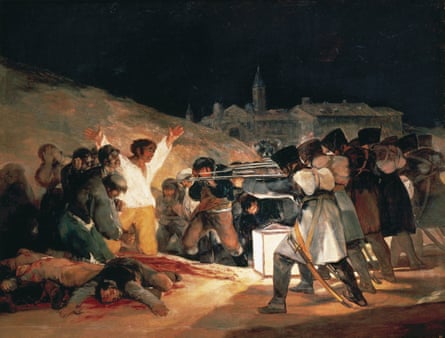
The painting’s long exile began in 1874. A century and a half later, Goya’s works – drawn from his experiences witnessing the cruelties of the French occupation – have become the most celebrated artistic testimonies of that era.
But it was not always thus. “Back then, The Year of the Famine in Madrid was one of the most modern paintings,” said Navarro. “It represented a greater modernity than Goya, who, in his time, was seen as an artist who followed vernacular traditions.”
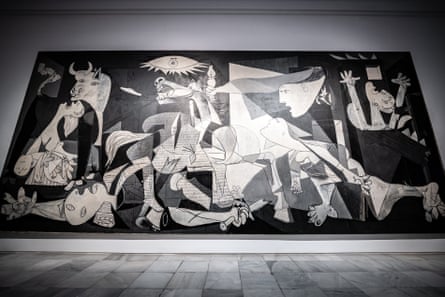
The curators say the new initiative is not intended to boost Aparicio’s fame nor to right some old wrong. The hope is that it will make people think about how taste, politics and context shift over time. The Year of the Famine in Madrid forms part of a long line of Spanish political and conflict painting that runs from Goya’s The Third of May 1808, through Aparicio to Gisbert’s The Execution of Torrijos, all the way to Picasso’s Guernica.
Even if Aparicio never found the lasting renown that Picasso achieved with his howl against war, The Year of the Famine in Madrid remains a fascinating case study.
“This is a work that went from being at the pinnacle of art history to being relegated to its less important corridors,” said Navarro. “It perfectly exemplifies the journeys of taste and how our idea of taste, which we think is canonical and immutable, actually changes with each generation that looks at paintings.”