










In his new book, Saved, Gianluigi Buffon talks about feeling crushed by nerves even at the peak of his playing career. The day before the 2006 World Cup final Buffon and Gennaro Gattuso walked past the French squad after training and were immediately sent into a tailspin by their opponents’ intimidating size and athleticism.
“We don’t stand a chance,” Gattuso joked, not actually joking. Buffon spent most of the night smoking in the hotel corridor with half the Italy team. At breakfast nobody could speak. They turned up at the stadium already feeling exhausted.
Luckily Buffon found his own way to cope. Before kick-off he stripped naked and sat in the dressing room talking to his goalie gloves. “I started a discussion with them. It was as if that inseparable instrument of my work could give something back to me. A part of me thinks that spirits or energies lurk in those objects and that they can affect games.”
Buffon went out feeling calm, made some brilliant saves, and was in goal when Italy won the penalty shootout and a fourth World Cup.
Reading this now it is hard not to wonder if Mikel Arteta needs to start talking to his iconic three-quarter-length gardening coat a bit more, or staging a naked one-to-one with his lucky black merino rollneck. What spirits, what energies lurk in the inner seams of those grey polyester slacks, stained with grass, sweat, hair gel, fear?
With four weeks still to run it is striking how a Premier League season previously dismissed as room temperature fare has boiled down not just to a gripping finish, but more to a kind of widescreen psychodrama. There is an acceptance that the endgame at the top and the bottom will be decided by how three London clubs, Arsenal, Tottenham and West Ham, cope with extreme pressure.
This feels like something new. Tight finishes are common enough. But the outcome has never been so closely tied up in notions of bottling and mental fragility, sport staged as a theatre of pain, torture porn: blanched and quivering Arsenal fans, the haunted eyes of Xavi Simons, Arteta chained to an industrial sink hacksawing off his own arm in return for a late equaliser at Selhurst Park.
There are two notable things about this. First, its arbitrary nature. Had Yoane Wissa not addressed his late chance at the Emirates with all the cold precision of a man playing in a set of fishing waders, a gritty 1-0 win would have become a potentially fatal moment of choke.
Manchester City, meanwhile, made the sensible choice to drop their points in January not April, thereby assuming the role of fearless buccaneers of the chase. Pep is wearing pleated slacks. Rayan Cherki is basically playing football with a Calippo in one hand. If City lose the league by a point now this will be a heroic, ballsy point. By the same token Wolves and Burnley haven’t collapsed or frozen. They just lost. Early on. A lot. Before it became a referendum on character.

The more urgent point is how bizarrely unmapped the process of managing this pressure seems to be. In an industry where every unit of play is broken down and parcelled out, where every physical aspect is logged and controlled, from nutrition to data-modelled tactics, dealing with the mental stuff still seems largely unhinged and random.
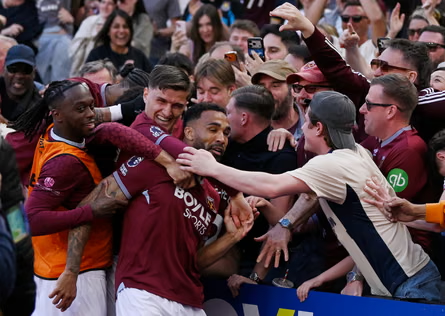
After the Newcastle game on Saturday Declan Rice spoke about how pressure is “just noise and you have to block it out”. After his late winner against Everton, Callum Wilson disagreed. He’s not blocking out the noise. He’s channelling it. The crowd are West Ham’s 12th man and “we’re going to need them”. Which one is it? And why, when it comes to the mental aspect, does everyone here seem to be scrabbling around looking for their own ad hoc piece of voodoo.
Pressure in football has often been addressed by intangible means. Brian Clough used to get his players to bundle into the goal net in training, or run en masse through the stinging nettles.
José Mourinho’s response to pressure was to create random alternate drama, to fill the space with siege-based distraction. Gareth Southgate went full control, breaking down every part of the penalty shootout, entering the sports psychology, chimp-brain zone. At Manchester United, Matt Busby based his paternalistic empowerment style on being as different as possible from his own manager at Liverpool, George Kay, who was notorious for spending entire games holding his head in his hands and moaning aloud.
The nature of pressure itself has changed profoundly in the last few years. Human beings have never at any stage in their history had to cope with being assailed continually by the brain-shouts of eight billion fellow souls. This is now an inescapable noise, the hum of the internet hive mind, the rolling 24-hour cycle, hungry for its heat, its flesh.
In this context the current season has become entirely hostage to the banter-sphere, a meme-war without end, an endless rolling wall of gloat and taunt. The combined effect on players still seems hugely underinvestigated, a subject for future doctoral theses once the title-race riots of 2027 have devastated the earth. So why hasn’t professional sport grasped this yet?
Even a manager as meticulous and process-driven as Arteta has been reduced to a series of gimmicky best-guesses. At times Arteta has decided it is his job to bring the vibes, to create a super-laid-back atmosphere. Arsenal have tried to curate having a good time, to work really, really hard at being the most relaxed guys in the building.
Little wonder this can feel stagey and awkward, the least-controlled part of the Arsenal project. Get on the fun boat. Be who we are.
Guardiola has played his hand well, helped by experience, having better players, and by being the chasing team. Roberto De Zerbi has decided to be nice at Spurs. “My work is not so much on the pitch, they are good guys, I feel sorry for them. I can be a big brother.’ Nuno Espírito Santo has also played it well at West Ham, going from brutally honest (“Concern becomes anxiety, becomes silence. That anxiety passes to the players”) to a kind of positive reinforcement, talking now in glowing terms about energy and togetherness.
The more urgent question is why there is no more formal playbook here; how a sport as sharp-edged and science-heavy as football is hostage to the best guesses of its managers in trying to process pressure. Perhaps this is to hope for too much. Humans are endlessly complex beings. Personality is not fixed. The chemistry of teams shifts all the time. It is a huge part of the sport’s ongoing fascination that this is not a machine simulation, that the human element continues to intrude. But managing it, or at least having a more structured methodology, also feels like the next great leap forward.
The next few games will be interesting in this regard. City play their next game on 4 May. Arsenal will be six points clear if they beat Fulham on Saturday evening, a team that has taken points off them in three of their last five meetings. They might have been better off chasing for a while, given Arteta’s new tick-em-off, nothing to lose approach. West Ham versus Arsenal at the London Stadium on 10 May promises to provide one of the great nerve-offs of recent times. Either way it seems right that Arteta is going to stick to his process on the pitch, whatever the messaging off it.
There is a theory that Arsenal will at some point experience The Freeing Up, a bursting of the dam, pressure transformed into joy juice, flying without wings, football without fear. Is this a good idea? The tactical straitjacket is at least a form of support. The team has come this far in acquisitive mode, gatherers not hunters, storing up its pile of nuts through the winter. The entire energy of the project is based on these fine margins, including the energy around it.