





The Lebanese journalist killed in an Israeli attack on Wednesday had previously spoken of receiving a threat via an unidentified Israeli phone number that she would be killed if she did not leave southern Lebanon, where she had long been based and worked.
Amal Khalil, 43, who worked for al-Akhbar newspaper and had described herself as supporting the resistance against Israel “whether communist or Islamist”, was killed in a sustained attack by Israeli forces in which a colleague was also wounded.
Rescuers attempting to dig her out of the rubble of a building were also targeted and prevented from providing life-saving assistance.
Khalil was the ninth journalist killed in Lebanon this year. Last month three journalists were killed in a double-tap attack.
Meanwhile, an investigation by the Israeli newspaper Haaretz has found that Israeli soldiers in southern Lebanon have been involved in widespread looting.
Lebanon’s prime minister, Nawaf Salam, described the targeting of the journalists and the obstruction of relief efforts as war crimes. International media rights organisations expressed outrage over the latest of scores of attacks on journalists in Gaza and Lebanon.
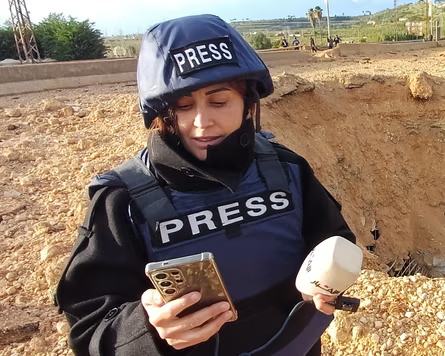
As further details of the killing emerged on Thursday, it became clear that the group Khalil was with came under sustained attack over several hours and that Israeli forces were apparently aware of their identities.
According to her employer and the Lebanese health ministry, Khalil was working in the area of the village of al-Tiri when the vehicle she was travelling in was hit by an Israeli airstrike, killing two people and wounding her and her colleague Zeinab Faraj, a freelance photographer.
Khalil and Faraj took cover in a house in al-Tiri, which was hit by another Israeli airstrike. Rescue workers reached the scene and recovered Faraj but Khalil was trapped under the rubble for hours, and Israeli forces fired on those attempting to free her.
The Union of Journalists in Lebanon said that when medics attempted to rescue her, Israeli forces prevented access to the site and used stun grenades. Khalil’s body was eventually retrieved shortly before midnight, at least six hours after the strike.
Israel denied that it targeted journalists or that it had prevented rescue teams from reaching the area, and said the incident was under review. Previous “reviews” have rarely if ever attached any blame to Israeli forces, who typically attempt to suggest killed journalists are members of armed groups.
The IDF said it identified two vehicles that had “departed from a military structure used by Hezbollah”, without providing evidence for the claim. It said one of the vehicles approached Israeli troops in a manner that was an “immediate threat” after crossing a “forward defence line”, violating a ceasefire.
In 2024, Khalil told local media she had received an Israeli death threat warning her to leave the south and threatening to destroy her home and decapitate her.
Khalil said she had “received a message from an Israeli enemy” urging her to leave the south. “I have informed the relevant authorities about this, as the enemy has recently used this tactic with many others there,” she said.
According to Khalil, the warning – allegedly sent from an Israeli phone number – included details of her recent movements and said: “We know where you are and we will reach you when the time comes.” It was not clear who had sent the message.
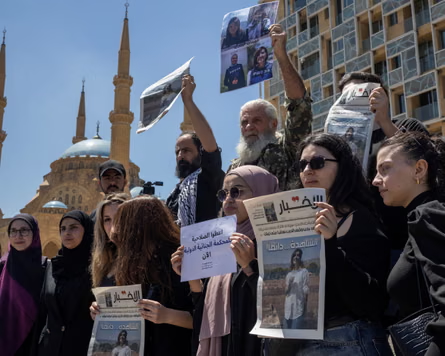
Reporters without Borders condemned the latest Israeli killing of a journalist. Clayton Weimer, its executive director, said the IDF received messages from his organisation as well as from journalists, asking that it allow ambulances to get to Khalil.
“The Red Cross signalled they were unable to get through because of ongoing Israeli bombardment. So that is callous disregard, on top of what appears to be a deliberate and targeted killing of a journalist,” Weimer said.
The Committee to Protect Journalists also condemned the attack. “The repeated strikes on the same location, the targeting of an area where journalists were sheltering, and the obstruction of medical and humanitarian access constitute a grave breach of international humanitarian law,” said its regional director Sara Qudah. “CPJ holds Israeli forces responsible for the endangerment of Amal Khalil’s life and the injuries Zeinab Faraj sustained after the targeted strike on their location.”
In a later interview with Al Jazeera, Qudah said: “The Israeli military’s obstruction of medical crews from rescuing wounded civilians is a brutal and recurring crime we have already witnessed in Gaza and now again in Lebanon.”
Outrage over Khalil’s death came amid claims by Haaretz of widespread looting by Israeli soldiers during the invasion of southern Lebanon. Soldiers interviewed for the piece described the looting of “motorcycles, televisions, paintings, sofas and rugs on a wide scale”, with sources claiming officers were aware and had failed to stop it.
The IDF told the paper that it took disciplinary and criminal measures when necessary and that Israeli military police conducted inspections “at the northern border crossing as forces exit combat”.