






“Just keep delaying,” Darren England tells the referee, Chris Kavanagh, at West Ham on Sunday afternoon. The title is on the line, possibly relegation too, and as replay after replay queues up on the tape machine, who could blame a humble video assistant for wanting to savour the moment?
To survey it from all the relevant angles, consider all contingencies. To feel the sensation of all that awesome power at his fingertips. They’re calling it the most important VAR review in Premier League history. Stuart Attwell, you’ll never sing that.
“Do you want to see it at full speed?” the replay operator asks him. Of course he does. You may as well ask a man whether he fancies an extra spoonful of grated parmesan on his carbonara. And so they watch Pablo’s foul on David Raya again. And again. And again. “Go back to the second angle you showed me,” England urges. “Give us a split screen. That one, and then the first angle.”
In fact only two minutes and 35 seconds elapse between the ball crossing the Arsenal goalline and England pushing the large red button on his desk and sending Kavanagh to the replay screen for a final review. But it’s possible to cram a lot of action into those 155 seconds, if you know what you’re doing. Kavanagh goes to the screen and – not wanting to miss out on the fun – watches 17 replays of the incident, while England sensually murmurs into his ear exactly what he should be looking at. Eventually, with what appears to be a certain reluctance, the climax. Foul. No goal.
One thing you may not know about the Premier League’s VAR team at Stockley Park is that they watch the game in silence. Ostensibly this is a concentration aid, minimising distractions and dispassionately protecting them from the influence of crowd noise. But when you think about it, it means the officials in the control room are watching an entirely different kind of game to virtually everyone else on the planet.
Not only that, but this weird, sanitised football-scented product is about as far removed from the actual job of in-person refereeing as it is possible to imagine. The art of refereeing a football match is above all the art of context: judging the ebb and flow, sensing where tempers are beginning to fray, managing potential flashpoints before they occur, handling the mood of the players and the crowd.
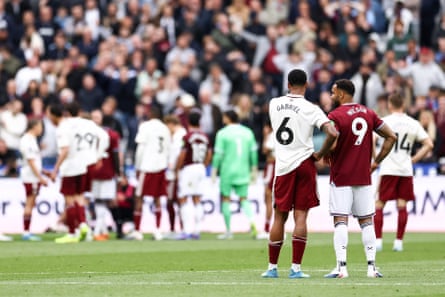
Perhaps this context inevitably generates its own human biases. But then refereeing has always been an inherently subjective business. Football is a sport that has always run on tacit consensus as much as the strict letter of its 17 brief laws. Not every throw-in will be taken from the precise spot the ball crossed the line. Not every shirt-pull will be penalised. Not every yellow-card foul in the second minute will earn a yellow card. This is the unspoken compact that has governed the sport since its earliest days, at virtually all levels.
The point here is not to argue that West Ham’s late equaliser on Sunday should have been allowed, or that the VAR team acted beyond their authority, or that a quick decision is preferable to a correct one. On the contrary, those four minutes of waiting on Sunday were perhaps some of the most dramatic minutes of this season’s campaign: infinitely more watchable than anything Wolves, for example, have produced with an actual football.
In a way, this is the problem. Everyone here did the job they were paid to do. West Ham pushed the laws to the limit in an attempt to score, Arsenal pushed the laws to the limit in an attempt to stop them, the officials followed the established protocols, the broadcasters milked the occasion for everything it was worth, the amateur pundits on the sidelines fumed and emoted in all the most predictable ways. And this was the upshot: the basic category farce of some men in a room watching a patently obvious thing on a screen, over and over again, until the constituent elements had long been stripped of any meaning, a blur of colours and shapes and flying limbs scrutinised to the point of absurdity.
A couple of days later, on Match Officials Mic’d Up, Howard Webb was beaming with pride at how his brave lads had courageously seized the moment. “It takes a bit of time,” he admitted, “because they’re going through a process diligently. Because they really respect the game.” To listen to Webb, the chief of Professional Game Match Officials, is to be left with the impression that his team of champions – men with names such as Simon and Michael – are the everyday heroes of the game, Stockley Park’s unsung codebreakers.
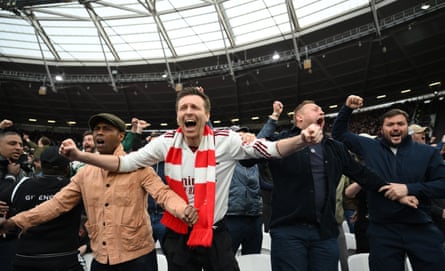
This was always going to be the major problem with parcelling off refereeing into some grandiose, quasi-governmental realm. Bodies devoted to officiating will never seriously argue for less officiating. The solution will always be more legislation and not less, more technology and not less, more explanation, more decisions, more work for more hands. And above all a belief in the sanctity of refereeing as an end in itself, rather than, you know, the annoying but necessary minimum layer of bureaucracy required for this multibillion-pound sporting product to function.
According to a Football Supporters’ Association survey, 76% of Premier League fans want VAR scrapped, while only 3% believe it has made football better. (VAR is, of course, not used in the EFL.) And yet at this summer’s World Cup VAR will not be curtailed but extended, this time to cover second yellow cards and corner kicks. The Premier League is expected to opt out of the latter move for fear of angering broadcasters.
Why have the game’s authorities moved in a direction that so few of its fans appear to want? On some level, there is a sense that the vitriol and abuse generated by controversial decisions are largely priced in, that because fans are ultimately irrational actors there is little point in trying to placate them. Far better, surely, to lurch wholesale in the pursuit of as many correct decisions as possible, whatever that means, and by whatever means.
Almost a decade after the introduction of VAR, it has disfigured the game to the point where its abolition would be dangerously disruptive. We no longer really know what a handball is, or the acceptable quantum of contact in the penalty area, or when an assistant should flag a potential offside and when not. The muscle memory of these decisions – for decades enforced by custom and precedent – has largely been delegated to technology.
But of course there are harder commercial forces at work. Endless interruptions have formalised the mid-match stoppage, softening the ground for the in-play advertisement breaks that will be introduced at the World Cup this summer. Beyond this there is the fact that VAR simply generates too much spume and passion, too much sweet secondary content, too many television debates and seething newspaper columns, too much Webb standing sternly in a studio, like a gameshow host about to hand out £25,000 to a nurse from Solihull. Why would football kill a golden goose like this?
Take the average interminable VAR stoppage, whether at the London Stadium on Sunday or any other ground on any other weekend. You’re frustrated, you’re exasperated, you’re angry, you’re screaming, but above all you’re still watching. The minutes are ticking, the pitchside adverts are still rolling, the social engagement is off the charts, and from a crude bottom-line perspective, does anything else really matter? “Just keep delaying,” England tells Kavanagh, secure in the knowledge that he has the audience in the palm of his hand.