








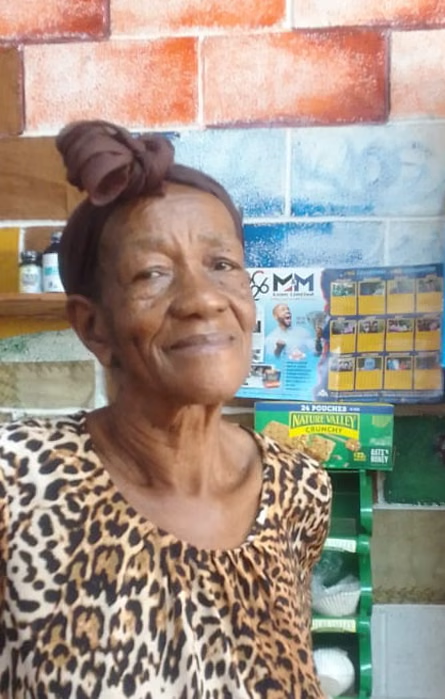
Novlyn Ebanks, 73, had been due to receive the eye surgery she needed free of charge at St Joseph’s hospital in Kingston.
But after Jamaica’s unilateral decision in March to end the nearly 30-year agreement with Cuba to provide doctors, she was no longer able to schedule the procedure. The hospital’s ophthalmology centre was mainly staffed by Cuban doctors, many of whom had already left Jamaica.
“I’m really disturbed and concerned,” said Ebanks, who will now have to seek private treatment at a cost that, she said, could reach 350,000 Jamaican dollars (about £1,600).
In recent months, many people across Latin America and the Caribbean have suddenly found themselves without healthcare, as nearly a dozen countries acquiesce to pressure from the US to end medical agreements with the Cuban government.
The US claims that the programme amounts to “forced labour” for doctors, who have most of their salaries withheld by the Cuban government.
Cuba acknowledges the retention but denies any human rights violations, saying the allegation is merely a pretext for the White House’s efforts to economically strangle the island and force regime change, which include the now months-long blockade of oil shipments.
Meanwhile, doctors, NGOs and researchers agree that the people who will be most affected by the sudden withdrawal of doctors – typically deployed to remote and historically underserved healthcare areas – will be the region’s poorest communities.
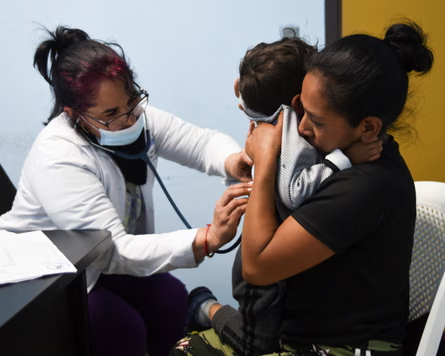
“We did not get sufficient time to come up with or put in place a contingency,” said Damion Gordon, a lecturer at the University of the West Indies in Jamaica. “It just happened suddenly, which created a sudden gap … and a crisis for those communities,” he added.
US pressure to end the partnerships has included cancelling the visas of government officials – and even their family members – who have had any connection to the programme.
Since Donald Trump began his second term, the governments of Jamaica, Guatemala, Guyana, Honduras, St Vincent and the Grenadines, the Bahamas, Antigua and Barbuda, and Paraguay have ended the medical agreements, either immediately or gradually.
The lone point of resistance has been Mexico, where the president, Claudia Sheinbaum, has refused to end the programme, saying that the about 3,000 Cuban doctors are of “great help” as they work in remote areas where there is a shortage of personnel.
“People in rural conditions are the ones who will suffer,” said John Kirk, professor emeritus of Latin American studies at Dalhousie University in Canada.
The programme emerged in 1960, when a medical brigade was sent to Chile to help treat victims of an earthquake. Since then, more than 600,000 Cuban doctors, nurses and health technicians have been deployed to more than 160 countries.
Cuba does not release precise data, but estimates suggest there are now more than 20,000 doctors across about 50 countries, with specialisms ranging from obstetrics and paediatrics to surgery and oncology.
The largest deployment was in Venezuela, which began in 2004 and at its peak involved nearly 30,000 doctors. Now, with the US calling the shots since the capture of Nicolás Maduro, there have been reports of doctors leaving the country, although the mission has not officially ended and more than 10,000 Cuban health professionals are still believed to be on the ground.
It was with the Venezuelan mission, known as “oil for doctors”, that the programme became one of Cuba’s main sources of revenue and a crucial buffer against the decades-long US economic embargo.
“Now, Trump is determined to cut that off in his attempt to bring about regime change,” said Kirk, who estimates the programme generates about $5bn a year for Cuba.
The money comes mainly from retaining about 80% of salaries, which the US says amounts to “21st-century slavery”.
Reports by the UN and the Inter-American Commission on Human Rights have also gathered testimonies from former participants who say they worked under coercion, and the organisations have described the programme as a form of modern slavery.
“I interviewed 270 Cuban doctors, nurses and technicians; none of them said they had been forced to work,” said Kirk.
“It’s not slave labour,” said the Cuban doctor Yanili Magdariaga Menéndez, 41, who spent five years in Venezuela in the early 2010s.
“I joined the programme because I realised that, in Cuba, I couldn’t give my family what I wanted to,” said Menéndez, who moved from the roughly $40 a month she earned on the island to about $1,000 abroad, even after the government’s deductions.
Although she said she did not consider the share “entirely fair”, she added that she also “understood Cuba depends on it and uses it to fund free education and healthcare”. After Venezuela, she moved to Brazil, where the programme once had more than 11,000 professionals, but was ended in 2018 after being attacked by the then far-right, Trump-allied president, Jair Bolsonaro.
Helen Yaffe, a senior lecturer at the University of Glasgow and a host of the podcast Cuba Analysis, said the US allegation of human rights violations was “a pretext” and “absolute rubbish”.
“How can they claim to care about human rights while blocking oil shipments to Cuba, which means that premature babies in incubators are left at risk during power cuts?” she said.
Although the US is reportedly offering countries that agree to stop employing Cuban doctors support for “infrastructure modernisation”, Yaffe said Washington was “not replacing medics or even proposing to train domestic substitutes”.
Although they did not respond to specific questions, a US state department spokesperson said: “We condemn forced labour and human trafficking involved in the Cuban regime’s labour export programme, especially its foreign medical missions. Cuba’s state-sponsored scheme deprives ordinary Cubans of medical care, and medical professionals of their human rights and fundamental freedoms. We urge other countries to treat Cuban doctors fairly as individuals and not as commodities to be traded by the regime.”
The government of Cuba did not respond to requests for comment.
In Guatemala, where the government has announced the “gradual withdrawal” of about 400 Cuban doctors by the end of the year, NGOs such as the Emergency Project already know they will have to fill the gap, which will disproportionately affect Indigenous communities.
“To abandon a programme like that is to strip healthcare access from some of the most disenfranchised and underserved populations in our part of the world,” said the emergency physician Darren Cuthbert, the executive director of the NGO, noting that many countries in the region are still recovering from Trump’s decision to dismantle the US Agency for International Development (USAID).
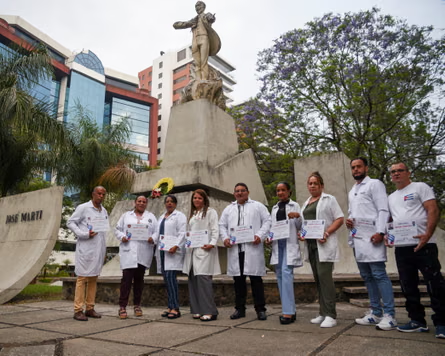
In Jamaica, where a group of people held a march in the capital in gratitude to Cuban doctors, the health minister, Christopher Tufton, admitted their departure had created “gaps”.
“Some of those gaps are challenging to fill because of the specialisation and the fact that we don’t have a local equivalent. So we have started by doubling up on the shifts … by local [doctors] to fill the void, particularly in eye care and oncology,” he said.
But Tufton said he saw the moment as an opportunity to force the country to address its shortage of domestic medical staff, including through an ad campaign to encourage Jamaican doctors abroad to return.
“I think we’re better off moving in that direction, where we can create less dependence [on foreign doctors] … We value what the Cubans have done and the relationship we have had. We do hope to see that kind of re-engagement under different circumstances,” he said.
While still working out how she will pay for the eye surgery, Novlyn Ebanks already misses the Cuban doctors, whom she described as “very patient, humble and understanding”.
“These are the people that we really need to have around us to take care of us,” she said.