









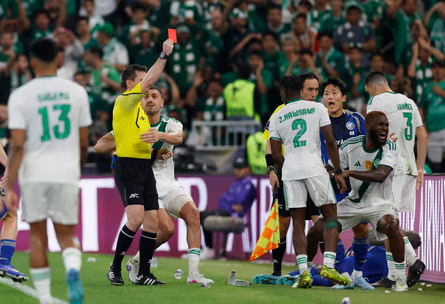
As far as head-butts in major finals go, it wasn’t quite Zinedine Zidane in 2006, but Zakaria Hawsawi’s lunge forwards in Saturday’s AFC Champions League Elite final connected with Tete Yengi’s jaw and dropped the stunned Australian, almost a foot taller, to the ground.
With the score 0-0 between Saudi Arabia’s Al-Ahli and Machida Zelvia of Japan midway through the second half, it all took place on the touchline of the King Abdullah Sports City Stadium in Jeddah, right in front of the referee and the shocked Al-Ahli fans who feared their team’s chances of a second successive continental title had gone.
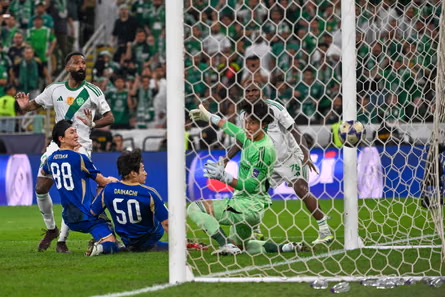
Hawsawi was rightly sent off, but it did not matter. A Riyad Mahrez cross in extra time caused problems and striker Firas al-Buraikan did his chances of starting for Saudi Arabia against Uruguay at the World Cup on 15 June no harm at all, pouncing at the far post to give Al-Ahli a 1-0 win in front of 60,000 home fans. Hawsawi, a talented but impetuous full-back, cannot say the same and the new Saudi Arabia coach, Georgios Donis, will not have been impressed with his moment of madness.
Until the sending off, Machida offered little going forward. The narrative around the game was more interesting than most of what happened in the 120 minutes. These were two contrasting clubs. The champions against a debutant, with Machida never having won the Japanese title, their first season in the top tier of the J League was 2024. The coach, Go Kuroda, who was a high school teacher before taking the job in 2023, has developed a style not usually associated with free-flowing teams from the country. Their rise has been fuelled by a direct and physical playing style that has earned them some unfair criticism of being “unJapanese”.
They deserve praise for making it so far with a squad that is not as star-studded as Al-Ahli’s, who benefit from the backing of Saudi Arabia’s Public Investment Fund. The home team had Mahrez and Édouard Mendy, past winners of the European version, as well as big-money signings such as Ivan Toney, Galeno and Franck Kessié. Machida have Yengi, on loan from Livingston, bottom in the Scottish Premiership.
It was the second successive final between clubs from two countries on opposite sides of Asia and with opposite philosophies, after Al-Ahli’s 2-0 win over Kawasaki Frontale a year ago. The home team started with nine foreigners, Machida hadthree. In Al-Ahli’s semi-final win over Vissel Kobe, that ratio was 10 to 1. Saudi Arabia have the club title again, but the media in Japan have pointed to their national team being on a different level as proof of a healthier football ecosystem.
If Al-Ahli had had to play in Japan, the outcome could have been very different. That would have been the case for much of the Champions League’s history, but for the past two seasons the Asian Football Confederation (AFC) has decided that the knockout stages from the quarter-finals onwards are held in Jeddah.
That both years the tournament has been won by a team from the same Red Sea port may not be a coincidence. This format means Al-Ahli did not play an away game in the knockout stage. It is unfair, damages the tournament’s integrity and is quite boring. Organisers have never really explained why the old system, with two-legged ties played home and away, needed to be scrapped.
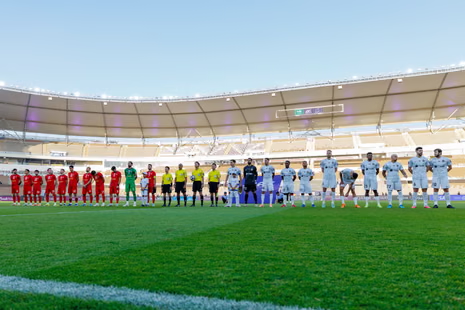
It has other consequences Crowds when Saudi teams play are big – Jeddah is a genuine football hotbed with the two clubs, Al-Ahli and Al-Ittihad, blessed by large and passionate support. For the semi-final between Machida and Shabab Al-Ahli from Dubai, however, only 395 people showed up.
This is not unique to Saudi Arabia and there would probably be a similar outcome elsewhere in Asia, which is why neutral venues are a bad idea. To have such a crowd at such a late stage in a continental tournament was, as one AFC official admitted, embarrassing. More, they said, should be done to attract larger audiences, but conceded that even if a few thousand did show up the format would still be a fundamental problem.
It is not just the knockout stages. Only 12 of the AFC’s 47 member nations were allowed to enter a team (two more will get a playoff spot next time), leaving three-quarters of the continent out in the cold. The group stage is messy with two pots of 12 and teams playing only eight games. The war in the Middle East complicated things further, causing the postponement of games in West Asia with last-16 ties moved from March to April.
At least the Iranian champions, Tractor SC, made it to Saudi Arabia, but that was a rare positive story from a Champions League that few outside Jeddah will remember fondly.