








In the second week of March, the nature vlogger Ilie Cojocari went out to film the arrival of spring on the Nistru (Dniester) river, 70 metres away from his home in Naslavcea, a village bordering Ukraine on the northernmost point of Moldova. But as he approached the river he could smell the stench of oil rising up from the water and see dark spots floating on its surface. Something was wrong.
Two days earlier, Russia had attacked Ukraine’s Novodnistrovsk hydropower complex 15 miles upriver. Cojocari had been kept awake all night by the sound of shelling. “No one slept in the [Moldovan] district of Ocniţa that night,” he told me.
There was no official information from either the Ukrainian or Moldovan governments on the oil spill into the river when Cojocari went filming along its banks. But soon after posting his footage, he received calls from the Chișinău ministry of the environment asking him to confirm that the footage was real.
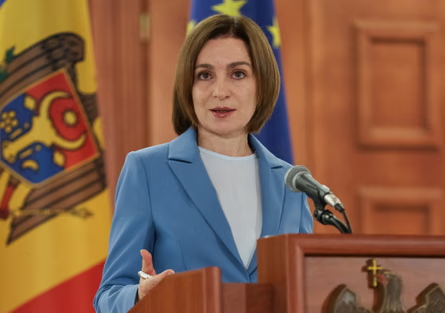
The next day, the ministry publicly announced that the water in Naslavcea was being tested and that officials had asked Ukraine about the origin of the spill. On 16 March, nine days after Russia attacked Ukraine’s hydropower complex, Moldova declared an environmental alert, the president Maia Sandu laid the blame squarely on Moscow.
A crisis centre was set up to monitor the spill and remove the pollutant. Oil traps and barrages made from textiles and absorbent materials were erected, and authorities provided people with alternative water supplies. But for many local residents, this felt like more than just a contaminated water issue.
Moldova has had war on its doorstep for four years. During this time, more than 2 million refugees have passed through a country of 3 million. Some 140,000 Ukrainians have settled within its borders. Russian drones have violated Moldova’s airspace and Vladimir Putin’s attacks on Ukrainian energy infrastructure have caused power outages. At its peak, inflation rose to 35% in 2022 and is currently around 5%. On 31 January, Moldova had to declare a state of energy emergency after Russia attacked the Isaccea–Vulcănești power line in Ukraine, reducing the capacity of the capital Chișinău, to produce electricity.
Rising from the Carpathian mountains near the Ukrainian-Polish border and flowing into the Black Sea, the Nistru provides 80% of Moldova’s drinking water. The spillage of tonnes of petrol into this body of water is therefore a national crisis. Oil slicks have been detected all the way to Dubǎsari, which more than 200 km from Naslavcea whereCojocari initially spotted pools of polluted water.
Fortunately Moldova’s European allies were able to step in and offer support. Moldova is a candidate country for EU membership and Brussels triggered an emergency aid facility. Romania and Poland sent help to prevent the petrol from streaming downwards towards Chișinău, which is home to a third of the population and almost entirely dependent on the Nistru for water. Other countries followed suit.
Although catastrophe seems to have been halted for now, we are now acutely aware of just how vulnerable our water supply is to attacks from Russia and the chaos caused by its war on Ukraine. Yet an information war between Moldova’s pro-European and pro-Russian factions has given rise to conflicting interpretations.
In the aftermath of the Nistru disaster, Moldova’s minister of the environment, Gheorghe Hajder, released a number of on-the-ground videos in which he spoke directly to the public, Volodymyr Zelenskyy style. This heightened many people’s fears that the war was spilling over. The water shortage was just the latest, and most devastating, confirmation of it.
Bălți, the second largest city, with a population of about 120,000, was most affected by the leak. Army and police forces there were mobilised to help provide water tanks, which helped people like Irina, a 39-year-old mother of three, to deal with the shortage.
Irina told me that she queued at a nearby well with her husband twice a day: in the morning, before the children woke up, and in the evening, after work. This allowed the family to cook and wash, and drink water. “If I had 20 people before me, then 50 queued after me,” she recalled.
School lessons went online during the water crisis, which meant that Irina had to take days off work to stay at home with her children, aged seven and 13. But even at home it wasn’t easy to make sure that the children had access to clean water. In the shop where Irina works as a cashier, shelves that usually stock large bottles of water were emptied in hours.
When I contacted Larisa Novac, a member of the Moldovan parliament from the ruling pro-European Action and Solidarity party (PAS), she said: “This is an unprecedented situation. This is an attack on Moldova’s security”.
Vladimir Zgavordei, a mayor of three villages in the northern Florești district, which was also affected by the spill, told me that in areas without wells he had organised firefighter trucks to provide people with water tanks to water their farm animals.
But the entire food chain may be affected, ecologists have warned, along with fish, wild ducks, cormorants and swans. Thus far Moldovan authorities have not registered any impact on wildlife. This has not stopped speculation, however. After people posted pictures of dead birds on the river, the ministry said laboratory tests showed they were victims of avian flu or other natural causes.
By 18 March the barrages erected along the river had stabilised the oil in the water at safe levels in the most affected districts. It was another 48 hours before authorities allowed people to use tap water from the Nistru.
Even if the immediate crisis has eased, Moldova finds itself fighting on two fronts: to find alternative sources of water and to rid the river of pollutants, while struggling for the hearts and minds of those who refuse to believe that Russia was responsible for the leak.
On 25 March, Hajder went to the Novodnistrovsk hydro plant to check on the situation. “No more oil stains have been noticed,” at the source, the minister said in a video, “but we continue to monitor the situation because [further down] on the Nistru river there are still oil stains.” One comment beneath the video written by someone perhaps sympathetic to Russia’s propaganda said: “Show us where they bombed the hydro plant as well, or is it a secret?”
When I spoke to Cojocari, he told me he had removed two of his videos because of online hatred from pro-Russians denying that Russia caused the oil spill by attacking Ukraine’s energy infrastructure. “I’m not a political person. I am quiet. I write poetry,” he explained. “I got involved in this without wanting to.”
While Moldova’s pro-European government holds Moscow responsible for the spill, pro-Russian propagandists claim the crisis was an accident caused by a Ukrainian truck on the Otaci-Moghilau (Mohyliv) bridge and had nothing to do with the war. Cojocari says this is implausible. “I went to check the bridge and there was no oil slick there. Plus the bridge is lower down the Nistru River than Naslavcea, so I wouldn’t have seen the petrol stains in the case of an accident lower down,” Cojocari said.
The denials and allegations of conspiracy bring to mind an environmental disaster from four decades ago . It may seem like an exaggeration, but Russia’s bombing of the Novodnistrovsk hydropower complex has given Moldova its most serious environmental crisis since Chernobyl in 1986. Then, as now, Ukrainian and Moldovan authorities were slow to declare a calamity.
Russia’s war has unleashed a string of environmental disasters in Ukraine. The destruction of the Kakhovka dam led to extensive flooding along the Dnieper River in 2023; thousands of tonnes of oil have spilled into the Black Sea; and the war’s pollution of water, soil and air has caused long term harm to biodiversity as well leading to human deaths. These harms are now understandably but worryingly taking a back seat to Ukraine’s attempts to defend itself against Russian aggression.
The Nistru oil spill has shown Moldova how exposed it is, and how fragile a society can become without access to clean drinking water. The war next door, combined with the climate crisis, give us little reason to think there won’t be another ecological disaster like this. The only way to avoid is to start taking environmental security seriously. It has to be treated it as a critical national, regional and international priority.
-
Paula Erizanu is a Moldovan journalist and writer based in Chișinău
-
Do you have an opinion on the issues raised in this article? If you would like to submit a response of up to 300 words by email to be considered for publication in our letters section, please click here.