

惯性聚合 高效追踪和阅读你感兴趣的博客、新闻、科技资讯
阅读原文 在惯性聚合中打开

推荐订阅源

酷 壳 – CoolShell
酷 壳 – CoolShell
H
Hacker News: Front Page
P
Palo Alto Networks Blog
T
ThreatConnect
Apple Machine Learning Research
博客园_首页
T
True Tiger Recordings
P
Privacy & Cybersecurity Law Blog
B
Blog
IT之家
IT之家
Last Week in AI
Last Week in AI
F
Full Disclosure
Hacker News: Ask HN
Hacker News: Ask HN
C
Comments on: Blog
Microsoft Azure Blog
C
Cybersecurity and Infrastructure Security Agency CISA
Microsoft Security Blog
博客园 - 【当耐特】
N
News and Events Feed by Topic
NISL@THU
NISL@THU
腾讯CDC
雷峰网
雷峰网
Security Latest
Security Latest
李成银的技术随笔
M
Microsoft Research Blog - Microsoft Research
L
LangChain Blog
L
Lohrmann on Cybersecurity
cs.CL updates on arXiv.org
C
Check Point Blog
Y
Y Combinator Blog
Recent Announcements
博客园 - Franky
N
News | PayPal Newsroom
V
V2EX
A
About on SuperTechFans
The Register - Security
月光博客
月光博客
奇客Solidot–传递最新科技情报
奇客Solidot–传递最新科技情报
Google Online Security Blog
MyScale Blog
MyScale Blog
Cisco Talos Blog
Cisco Talos Blog
Vercel News
Vercel News
WordPress大学
WordPress大学
C
Cyber Attacks, Cyber Crime and Cyber Security
The Hacker News
The Hacker News
IntelliJ IDEA : IntelliJ IDEA – the Leading IDE for Professional Development in Java and Kotlin | The JetBrains Blog
爱范儿
爱范儿
A
Arctic Wolf
L
LINUX DO - 最新话题
freeCodeCamp Programming Tutorials: Python, JavaScript, Git & More

The Guardian

Tentacles, pointy teeth and the T-rex of the sea: the Natural History Museum on beasts that once ruled the oceans Have no doubt: the campaign to sack Misan Harriman is part of an assault on black figures in public life | Afua Hirsch Rachel Roddy’s recipe for ricotta and breadcrumb balls in tomato, chilli and basil sauce | A kitchen in Rome ‘We feel let down’: sustainable chefs in UK mourn end of Michelin green star Toxic chemicals in pet flea treatments harming wildlife, UK study warns Thursday news quiz: Eurovision winners, Tesla swimmers and Strictly zingers ‘Give every item a long life’: Vinted boss on how the site is moving beyond fashion AI will help make a Nobel prize-winning discovery within a year, says Anthropic co-founder Care review – this searing portrayal of dementia raises urgent questions for us all Wiggy stardust! The mind-blowing hair artist who astonished Rihanna and Cate Blanchett How often should you go to the toilet? How can you get the better of wind? Experts’ tips for a healthier gut ‘The devil’s child’: the rise and fall of the only female yakuza Sánchez is loved everywhere – but not so much in Spain, say Andalusia’s voters. Can he pull off another comeback? | María Ramírez While rightwing Australia scapegoats immigrants, the country directly benefits from our skills and labour | Zoya Patel UN backs historic climate crisis ruling, despite US attempts to stop resolution Ukraine war briefing: Fresh threat of attack from Belarus front, warns Zelenskyy Trump news at a glance: US indicts Raúl Castro, ratcheting up Cuba tensions Papua New Guinea warns against fishing in New Ireland after mystery deaths of marine life Trump claims he will speak to Taiwan’s president, departing from decades-long diplomatic norms The Ebola and hantavirus outbreaks warn us we must be better prepared if we are to prevent the next pandemic | Helen Clark ‘If she didn’t have us, she would be toast’: a NZ mother’s fight to free her daughter from ICE detention Trump envoy says it’s time for US to ‘put its footprint back on Greenland’, during visit to arctic territory Voters across parties believe UK net migration is rising despite sharp drop Nvidia’s revenue blows past Wall Street expectations as AI boom accelerates ‘We will not go back to Jim Crow’: thousand of Mississippians rally for voting rights SpaceX discloses finances for first time in plan for $1.75tn stock market debut Tielemans starts party as Aston Villa outclass Freiburg to claim Europa League glory Alice Capsey shines as opener to give England lead in T20 series against New Zealand Tennessee man jailed over Charlie Kirk post wins $835,000 settlement Murder inquiry launched after fatal assault on London bus driver Sinkhole shuts down runway at New York LaGuardia airport Aaron Rodgers says 2026 will be his final NFL season: ‘This is it’ Canada faces calls for investigation into death of woman after plasma donation UK struggles to reassure Ukraine after easing new sanctions on Russian oil UK radio station apologises for accidentally announcing king’s death San Francisco turns to AI to save whales from ship strikes as deaths soar DRC cancel World Cup training camp and fan event due to Ebola outbreak Israeli security minister stirs diplomatic outrage with flotilla activist abuse video Guardiola leaves Manchester City as one of the game’s greats – and someone who knows its dark heart | Barney Ronay The Guardian view on Britain and Europe: international upheaval demands new terms of debate The Guardian view on tackling Ebola: pathogens aren’t the only things that kill Meghan Markle’s anniversary candle: who wouldn’t want to pay $64 to celebrate someone else’s marriage? Norwegian court blocks extradition to Greece of migrant rights activist ‘If you keep looking we will kill you’: death stalks those searching for Mexico’s disappeared US indicts former Cuban president Raúl Castro as it seeks to oust regime Are Xi and Putin still ‘best friends’? - The Latest Freiburg v Aston Villa: Europa League final – live Russian jet causes ‘dangerous’ near collision after flying close to RAF spy plane England v New Zealand: first women’s T20 cricket international – live I didn’t think it was possible to love Kylie Minogue any more – her new Netflix series changed that Bolivia rocked by protests as US warns of ‘coup d’état’ UK strikes £3.7bn trade deal with six Gulf states Tesla Cybertruck pulled from Texas lake after attempting ‘wade mode’ How Arteta overcame setbacks, crises and boos to defy the doubters at Arsenal Giro d’Italia: Narváez storms past Mas for third win as Eulálio keeps pink jersey Jeff Bezos defends Amazon’s controversial $40m Melania film as ‘a good business decision’ James Murdoch to acquire half of Vox Media in deal reportedly worth $300m Immunotherapy could be used to treat depression, early trial suggests Open plan is not the answer: design professionals on the dos and don’ts of small space living Plastic food and drink packaging ‘world’s most common coastal litter’ January 6 police officers sue Trump over $1.8bn fund, alleging ‘presidential corruption’ Fan-friendly pricing at this World Cup? Some cities are showing that it’s possible US and Israel ‘hoped to install Ahmadinejad as Iran’s leader’ Pedro Almodóvar says film-makers have a ‘moral duty’ to speak out against the far right Bournemouth race to upgrade Vitality Stadium before first season in Europe US puts pressure on Palestinian leaders to withdraw bid for UN vice-presidency role ‘He sacrificed his life’: security guard killed in San Diego mosque attack hailed as hero ‘Real talk’ or wreaking havoc? The questions WNBA coaches should ask before calling out their teams ‘You’re expected to learn quick’: three draft picks on stepping up to the NFL Google DeepMind in talks with UK unions amid staff concern over AI use by US and Israel ‘Messy, chaotic, funny’: inside the hilarious comedy about teen Muslim schoolgirls Southampton hit out at ‘largest penalty ever’ for spying on opponents Same but different: how Xi and China welcomed Trump and Putin Lithuanian leaders rushed to bunkers as drone violates country’s airspace ‘Brits are not as groovy as us – but they’re less square than Europeans’: how drum’n’bass united Brazil and the UK Dog yoga and the Ministry of Hound: Goodwoof festival – in pictures Jess Cartner-Morley on fashion: Posh Grandpa is fashion’s new main character Eva v Goliath: the 20-year-old climate activist taking on Trump and the fossil fuel industry More than £52m reserved for social housing at risk after collapse of investment firms Arsenal to reward Mikel Arteta with huge pay rise and put Kroupi among transfer targets Tennis players plan ‘work-to-rule’ French Open media protest over prize money Fantastic visions and cosmic rhythms: how Whistler is making me see – and hear – differently Vaccine to tackle Ebola outbreak will take six to nine months, says WHO The lesson from John Travolta’s dramatic new look: always dress for the job you want ‘The flavour crisis’: an exposé on the origins of broken Britain George Soros group pledges $300m to US economic security and civil liberties How to turn leftover cooked new potatoes into a spicy Indian snack – recipe Forced disappearances and torture: Ecuador’s war on drugs is brutal – and backed by US troops Tom and Jerry: Forbidden Compass review – furry foes out of their depth in candy-coated Chinese adventure ‘He’s one of us’: Liverpool fans say goodbye to Andy Robertson Tell us: have you emigrated because of rising anti-migrant sentiment? Back on top: the season-by-season story of Arsenal’s return to title glory Totó la Momposina, vocalist and Colombian music legend, dies aged 85 We can’t talk about press freedom without talking about misogyny Art Cure by Daisy Fancourt review – is culture the best medicine? An Epstein ‘reading room’ is showing 3.5m printed-out files. Why does it feel like a troll? ICE-watch group decries ‘intimidation tactics’ as federal agents raid activists’ homes: ‘We’re not gonna stop’ ‘I don’t worry about a robot takeover’: AI expert Michael Wooldridge on big tech’s real dangers (and occasional blessings) Manchester City succession sheds light on Enzo Maresca’s Chelsea departure Uefa vows to take hard line on multi-club ownership in Women’s Champions League
Zebras, wealth and power: Hungary’s election tests Orbán’s grip on power
2026-04-11 · via The Guardian

The drone footage showed a sprawling residence in northern Hungary, complete with manicured gardens, a swimming pool and an underground garage. But it was what came next that captured much of the country’s imagination: zebras darting across the countryside.

The property caught on camera belongs to the father of the country’s prime minister, Viktor Orbán, offering a glimpse of the staggering wealth amassed by his inner circle, even as most in Hungary have become poorer. References to the zebras – which came from a neighbouring property belonging to Orbán’s best friend and Hungary’s richest man, Lőrinc Mészáros – soon began turning up across the country; plush toys were sold at protests, people posted videos of their own treks to spot the animals, and photos of zebras were plastered over government billboards.

“They became a symbol of the limitless corruption of the whole system,” said Ákos Hadházy, a Hungarian independent MP who last autumn organised a series of “safari tours” to the area in protest.

Those protests were just one part of a swelling opposition movement that has left Orbán facing the prospect of being ousted after 16 years in power.

The scope of this movement is set to be laid bare on Sunday, as Hungarians cast their votes in an election widely seen as the most consequential since the country’s transition to democracy in 1990.
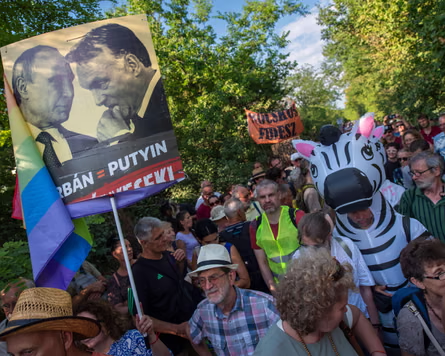
Protesters at Orbán’s estate at Hatvanpuszta.
Protesters at Orbán’s estate at Hatvanpuszta, which has become a symbol of alleged corruption and the wealth amassed by his inner circle. Photograph: Imago/Alamy Stock Photo/Alamy Live News.

Most polls suggest Orbán and his Fidesz party – who have transformed Hungary into a “petri dish for illiberalism” – could lose power, in a result that could rattle global far-right movements and reshape Hungary’s antagonistic relationship with the EU. But opposition supporters fear the polls are underestimating support for Fidesz, or that Orbán will find a way to retain power even if he loses the election.

“Hungary stands at a historic crossroads once again,” said Anita Orbán of the opposition Tisza party, the political force that has shaken up the race and now leads in most polls. “This moment carries powerful echoes of the past.”

The election comes 23 years to the day after Hungarians voted overwhelmingly to join the European Union. “Now, on 12 April, once again, voters are not simply choosing between parties, but deciding the direction, identity, and future of Hungary,” Anita Orbán, no relation to the prime minister, said on social media. “In many ways, this election is a referendum on whether Hungary returns to European values.”

It was a hint of how much has changed in Hungary since Orbán took power in 2010. What followed was, in the words of Zoltán Kész, a former member of the Fidesz party, nothing less than a “coup in slow motion,” albeit one that eschewed tanks for lawyers and clientelism.

The rightwing populist government had used its time in office to steadily whittle away at the checks and balances that constrained its power: rewriting election laws to its own benefit, manoeuvring to put loyalists in control of an estimated 80% of the country’s media, and retooling the country’s judiciary.

“We’ve come to the point in Hungary when we obviously can no longer talk about a real democracy,” said Kész. “It’s really a state capture that has been going on in Hungary with all the institutions that are supposedly independent. Whether it’s the courts or public services, they’ve been captured by one party, basically.”

On the streets and across dining room tables, Hungarians readily shared how this has played out in practice, from the university professor who has lost his job after speaking out against the government, to the music venues shut down after hosting artists who backed the opposition, and journalists whose newsrooms became government mouthpieces overnight after changes in ownership.

When Hungary’s economy was growing, many paid little attention to what was happening, said Kész. But as inflation soared after Russia’s full-scale invasion of Ukraine and economic stagnation set in, rumblings began over the growing disconnect between ordinary Hungarians and its ruling class.

It was against this backdrop that Péter Magyar, a former member of Fidesz’s inner circle, began speaking out. As he accused Orbán’s party of branding itself as a defender of Hungarians while siphoning off state funds, corruption rocketed to the top of voters’ concerns and Magyar’s hastily formed party climbed to the top of the polls.

Péter Magyar holds aloft a Hungarian flag during a march.
Péter Magyar holds aloft a Hungarian flag during a march as support for his campaign gathers pace. Photograph: Bernadett Szabó/Reuters

Magyar’s lead has held as the government attempted to ban Pride events and mulled hardening its longstanding clampdown on independent media and NGOs.

What Magyar is up against is visible across Hungary: the omnipresent billboards, generated with AI and paid for by the government, depicting him as a danger to the country and a stooge of both the EU and the Ukrainian president Volodymyr Zelenskyy.

The result is a campaign that has pitted fear against hope, as one Hungarian news outlet noted this week. Orbán – whose government did not respond to a request for an interview – has sought to convince voters that Hungary’s biggest risk lies in the war in Ukraine, casting himself as the only leader capable of keeping peace. Magyar, in contrast, has focused on domestic issues, promising to crack down on corruption, funnel funds towards long-neglected public services and repair the country’s strained relationship with the EU.

A two-minute video released in January made clear the outsized role that the election in a country of less than 10m people, which produces 1.1% of the EU’s GDP, would play on the world stage.

Nearly a dozen rightwing leaders, from Italy’s Giorgia Meloni and Matteo Salvini to France’s Marine Le Pen, endorsed Orbán, praising the path he had blazed in Hungary. “Europe needs Viktor Orbán,” Germany’s Alice Weidel, a co-leader of the far-right Alternative für Deutschland (AfD), tells viewers in the video.
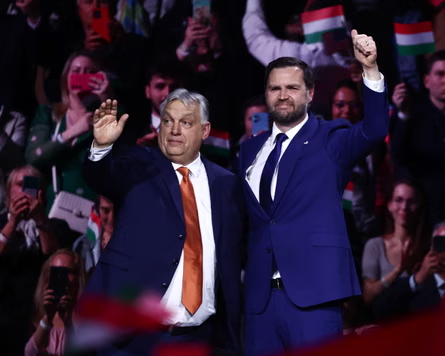
Vicktor Orbán and JD Vance on a stage at a rally in Budapest.
Viktor Orbán and JD Vance in Budapest. The US vice-president was in Hungary to support the prime minister. Photograph: Jakub Porzycki/NurPhoto/Shutterstock

The extent of Orbán’s reach was laid bare this week as JD Vance landed in Budapest with his wife, Usha. As he campaigned with Orbán, the US vice-president parroted much of Fidesz’s campaign strategy, railing against the EU and taking shots at Ukraine. On Friday, Donald Trump posted : “I AM WITH HIM ALL THE WAY!”.

“I think the symbol of Orbán losing should not be underestimated,” said Daniel Freund, a German Green MEP who has long sounded the alarm on democratic backsliding in Hungary. “He is the absolute poster boy of this whole movement of the illiberal, anti-European, extreme right. He is the icon and the example that others follow.”

Vance’s visit was the culmination of years of precise targeting by Orbán, said Dalibor Roháč, a senior fellow at the American Enterprise Institute. After Orbán’s allies cast him as a model for Trump and others, the Hungarian government is alleged to have spent millions of euros on US lobbyists, tasking them with peddling this narrative in Washington.

Their efforts soon paid off, with people such as Kevin Roberts, the head of the US Heritage Foundation thinktank that produced Project 2025, describing Hungary as the model for conservative statecraft, “Orbán kept investing in these relationships and bringing people over,” said Roháč.
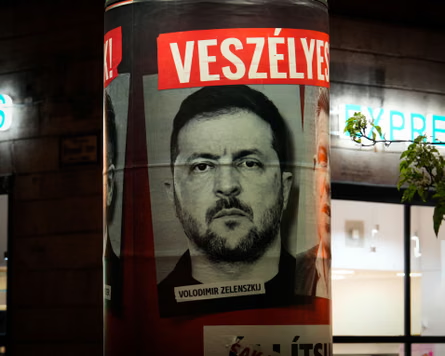
A pro-Orbán election poster showing Volodymyr Zelenskyy.
A poster in Budapest portrays Volodymyr Zelenskyy as a danger to Hungary. Photograph: Jaap Arriens/NurPhoto/Shutterstock

Budapest has swiftly become a hub of thinktanks and conferences aimed at amplifying the idea of Hungary, in the words of one local journalist, as a “Christian conservative Disneyland” where the global far right feels at home.

The global veneration has continued even as the country plunged in press freedom rankings, faced accusations of no longer being a full democracy, and became the most corrupt country in the EU.

As Orbán’s government cozied up to Vladimir Putin, growing more dependent on its crude oil, Budapest acted as a node between Washington and Moscow and offered Maga a jumping-off point to export Christian nationalist and far-right ideology to the rest of Europe.

Vance’s visit was a demonstration of this. While it made headlines around the world, there’s been no indication that it boosted Orbán’s position.

Peter Magyar with supporters during an election campaign rally in Miskolc.
Peter Magyar takes a picture with supporters during an election campaign rally in Miskolc. Photograph: Márton Mónus/Reuters

Instead, momentum seemed to be growing for Magyar. On Thursday evening, his supporters packed the central streets of Györ in north-west Hungary. Images of Hungarian flags prompted comparisons to a March rally in the same town, at which Orbán lashed out at demonstrators who booed him, accusing them of being pro-Ukrainian.

The confidence belies a note of uncertainty that has run through the campaign, as it is anyone’s guess as to whether the opposition surge would be enough to dislodge Fidesz. While the polls suggest a Tisza win, undecided voters and Hungarians abroad could still sway the result, as could the already-swirling claims of vote-buying and gerrymandering.

In the small city of Kecskemét, about 50 miles south of Budapest, many said the campaign had done little to endear them to Magyar. “There’s a level of palpable anxiety among people,” said Katalin, 81, citing fears that Hungary would be drawn into the war in Ukraine. “I don’t think that the Ukrainian people want a war, but their leader might.”

Zsuzsi in Kecskemét.
Zsuzsi, 83, in Kecskemét fears Hungary would be drawn into the war in Ukraine if the opposition wins. Photograph: Zsuzsa Darab/The Guardian

It was a thought that made Zsuzci, 83, shake with fear. “At this point, we can only pray,” she said. “I’m praying to preserve a Christian Hungary. We’ll get dragged into the war in Ukraine if Péter Magyar wins and he’ll also let in the migrants – he does exactly what the European Union tells him to do.”

Regardless of the outcome, it’s clear that Sunday’s vote marks the beginning of a wider reckoning with Hungary’s foray into illiberalism, said Kész. “Under normal circumstances, you lose an election, so what? You go in opposition, you come back in four years. That is a normal democracy, but this is not normal.”

During Fidesz’s 16 years in power, the party stacked the state, media and judiciary with loyalists, suggesting that Orbán’s system could survive him even if he loses.

“Even under the ideal circumstances, change will not happen overnight,” he said. “If you look at the state of the education system, if you look at the state of healthcare, courts, public services, and you name it – these need to be built up again from scratch. There’s a lot of work to be done by a new government.”