


Gustav Mahler hated it. Its publisher was convinced it would be a commercial disaster. Critics complained it was mostly just “noise” and predicted that it would quickly be forgotten. But more than 125 years since Tosca’s premiere in January 1900, Giacomo Puccini’s fifth opera remains one of the most bankable in the business.
We love a hard-won success story in classical music. Think of the tales of woe that still swirl around Beethoven’s life and works, with their implied happy ending in our own Beethoven centrism. Or there’s Wagner’s Tannhäuser being booed off the stage in 1861, before finding its way into the operatic pantheon. Or the riot supposedly provoked by Stravinsky’s Rite of Spring at its 1913 premiere, before everyone calmed down and the score was acclaimed a masterpiece.
in the case of Tosca, it’s hard to imagine today how a work so packed with tuneful hits – some of the best-known numbers in opera, no less – could have left one early critic grumbling that “song is lacking”. But Mahler’s own catty dismissal of the new opera as “papal pageantry with continual chiming of bells” is revealing. The problem in 1900 was precisely that Puccini wove the “real-world” sounds of bells and screams, cannonfire and religious chant straight into his score. It was a groundbreaking example of an immersive soundscape. But for some of Puccini’s contemporaries, those soundeffects were radically out of place in an operatic work of art.
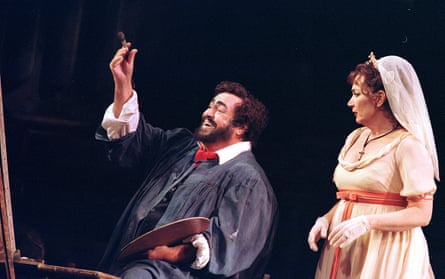
This is where Tosca parts ways with classical music’s other initially reviled treasures: the opera is still treated with suspicion. In the 1950s, leading US musicologist Joseph Kerman dismissed Tosca as a “shabby little shocker”. More recently, in 2010 the eminent opera critic Rupert Christiansen described it as a “tawdry but irresistible melodrama”. Put bluntly, Tosca’s most intractable problem in certain quarters is its popularity: that overwhelming melodic appeal, combined with a sexanddeath nail-biter of a plot.
“It’s also a study of evil,” US director Ted Huffman suggests, “which we find really entertaining in a horrible way.” Huffman is speaking to me between rehearsals for his new production of Tosca at Glyndebourne in East Sussex. The summer festival has been running since 1934, but this will be the first time it stages the opera. “I associate this piece only with the largest theatres,” says Huffman. “It’s interesting to do Tosca on this scale, which is much more intimate than opera houses like the Royal Opera House [in London] or the Met [New York], where Tosca is a staple.” Glyndebourne’s smaller stage and auditorium mean that “people will experience it as a slightly different piece,” he says – one full of “little conversations and asides and minuscule plot points that are very important, actually”. Crucially, the size of Glyndebourne’s theatre means “you don’t have to telegraph those details to the audience in a big way”.
Yet for well over a century, productions have reproduced the same details on the grandest possible scale. As specified by Puccini and his librettists, Tosca is set in three real places in Rome in 1800: the Sant’Andrea della Valle church, the Palazzo Farnese and the Castel Sant’Angelo. Productions these days rarely follow historical stage directions literally – who in the Netflix age wants a return to painted flats, slow-mo processions and hyper-stylised gestures? Yet the vast majority of Toscas are still set in a monumentally realistic Rome populated by priests in cassocks, a hero working on an oil painting, and a heroine who wears red, places candelabras on either side of the villain’s corpse and leaps at the end (as per the gags about sopranos and trampolines) from the battlements of the Castel Sant’Angelo.
As Huffman stresses, Tosca is “a piece about state violence and resistance and heroism”. Such themes could hardly be more relevant today. So where are the bold reimaginings of Tosca – the equivalents of Jonathan Miller’s iconic 1950s, Little Italy-set Rigoletto or Claus Guth’s radical displacement of La Bohème into space? Huffman has risen to prominence as an intrepid director specialising in new opera. On Tosca, however, he is cautious, agreeing that the work seems “more rooted in its setting than most”. You can change the time and place, he says, but Puccini’s “little narrative details” remain vital.
Opera critic Tim Ashley observes that “Rome, Catholicism and the queasy symbiosis between church and state are so embedded in Tosca that most directors shy away from rethinking it”. The Te Deum that closes act one (an authentic religious chant accompanying the villain’s erotic fantasy about the heroine) or the volley of bells in the prelude to act three – all tuned according to Puccini’s location research – are certainly symptoms of the composer’s commitment to a new, realist aesthetic. No wonder directors have filmed on-location productions of a work that so directly pre-empts the values of modern cinema and TV.
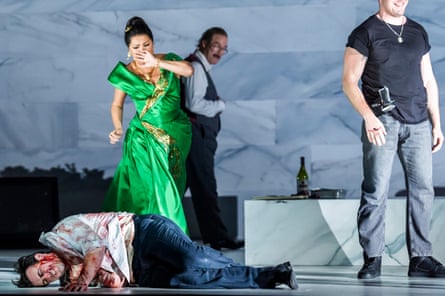
Among the gazillions of productions that keep Tosca on stage across the world, Ashley can name only two major ones that have deviated from the norm: Barrie Kosky’s “opéra noir” treatment for Dutch National Opera (think minimalist chic and a sushi-making villain – though Tosca still wears red) and Martin Kušej’s staging for Vienna’s Theater an der Wien. Forget Rome – this is a post-apocalyptic wasteland of grimy caravans, limbless torsos and industrial quantities of snow.
Back at Glyndebourne, Huffman’s production is inspired, he tells me, by 1940s neorealist Italian film. “Not in a literal way,” he’s quick to add, but as an exploration of realism, which “comes back at certain times when we need to assess what has gone wrong politically in our world”. In the meantime, he giggles, “People keep asking me whether there are two candelabras at the end of act two. Spoiler: there aren’t. I’m sorry.”