


In The Simpsons, Bart is always 10, Lisa eight and Maggie a baby. In Peanuts, Charlie Brown and Lucy van Pelt are perpetual children. In Garfield, age shall not weary the eponymous lasagne-loving cat, nor the years condemn.
But Garry Trudeau’s Doonesbury cartoons are different, with characters ageing, evolving, having children and occasionally even dying. Still active after 56 years, Trudeau’s sprawling narrative – woven through the four-panel confines of a comic strip – invites comparison with Charles Dickens.
“If you want to understand Victorian England, reading a handful of Dickens novels can get you there,” said Joshua Kendall, author of the first major biography of Trudeau. “In the same way about the late 20th and early 21st century, Trudeau has got all these different characters and they’re growing and changing. If you want to see how America evolved from 1970 to 2026 you could do worse than just go through a few Doonesbury collections.”
Published on Tuesday, Trudeau & Doonesbury: The Cartoonist Who Turned the News into Art is the story of the first comic strip artist to win a Pulitzer prize for editorial cartooning, drawing on original interviews and thousands of archival documents. For Kendall, a 66-year-old Boston-based biographer and a Yale alumnus who walked the same campus a decade after Trudeau, the project was deeply personal.
Speaking by phone, he reflected: “I’m a baby boomer at the very end of the baby boom. For my generation Garry was like a mentor and Doonesbury was like a survival guide of how to get through yuppiedom in the 80s and various stages.
“Every biography is kind of an autobiography and, even though I stuck to the evidence, it was a way to think about my own life too and that was very appealing. I had also gone to a fancy prep school and just some of the issues that he was dealing with as a young man were ones that I was struggling with. It was fascinating to see how he managed to cope and develop.”
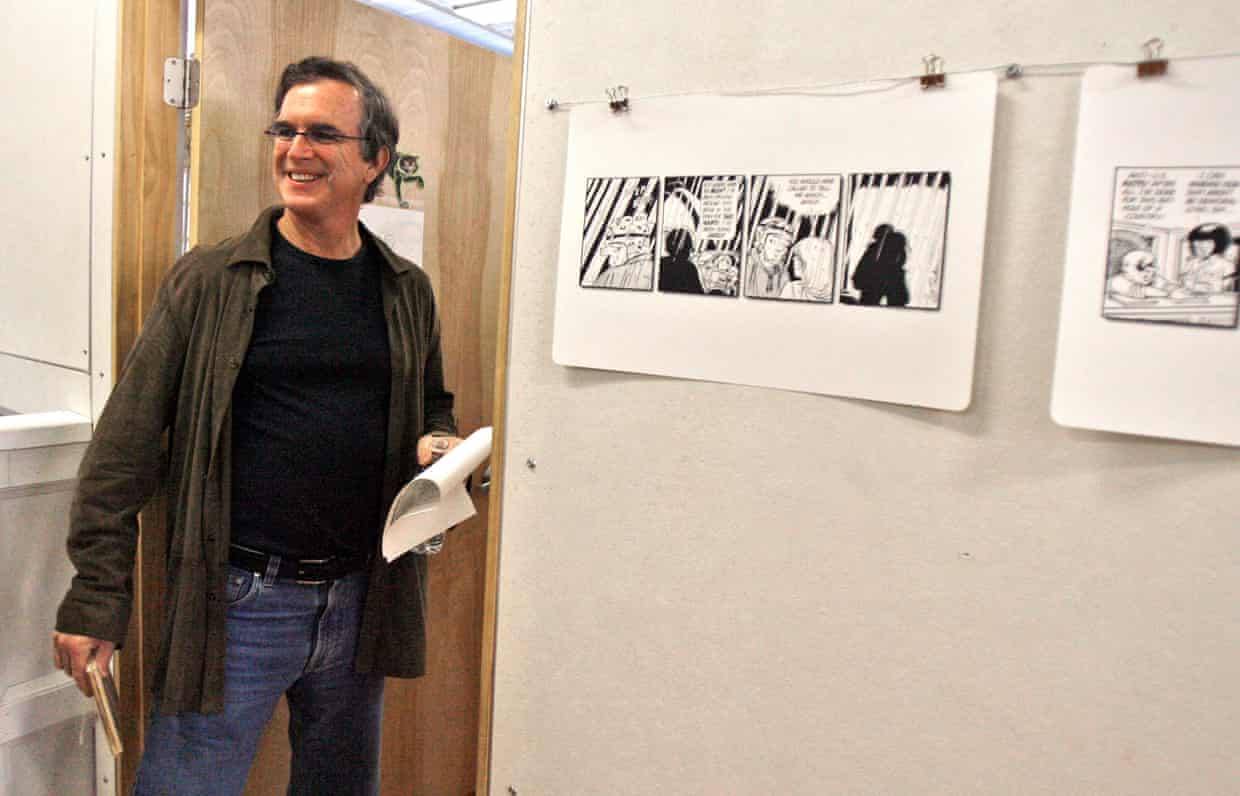
Writing the life of Trudeau, however, meant chasing an elusive target. Despite his massive cultural footprint, the satirical cartoonist is reclusive and has given only a handful of interviews over the past six decades. Kendall recounts a story from the late 1970s when Trudeau locked himself in a bathroom for four hours to avoid being interviewed by a Baltimore Sun newspaper reporter.
“I tried to bring his voice into the story but he has this reputation of being the JD Salinger of cartoonists,” Kendall explains, noting a contrast with Jane Pauley, Trudeau’s wife and a TV journalist, who wrote a memoir about being diagnosed with bipolar disorder.
Kendall spent two years interviewing Trudeau’s friends and colleagues, establishing his credibility. “They passed on and said: ‘OK, Kendall is trustworthy’. He started responding by email and I would ask him about something and he would clarify and his emails were often incredibly witty and terrific. Then he did agree to sit down for some interviews.”
Yet the book remains strictly unauthorised, a condition that Kendall prefers as it allowed him to follow the evidence without requiring the subject’s approval. When they finally met, Kendall found that the man mirrored his creation: “He is like a Doonesbury strip. He is witty and a quick thinker.”
He has sent the book to Trudeau, who has promised to read it. “There are all these stories about biographers and their subjects, and overall we have a pretty good relationship, but it is a relationship that, even in the best of circumstances, pockets of tension that are inherent because the biographer’s goals are not the same as the subject’s.”
Kendall traced Trudeau’s life back to its origins – a childhood marked by both immense privilege and a quiet, defining trauma. Trudeau grew up in Saranac Lake, New York, essentially a company town established by his family, who founded a prominent tuberculosis sanatorium (early patients included Robert Louis Stevenson). “It was like his family was the town.”
But when Trudeau was 10 years old, his mother left the family. Kendall says: “In the 1950s there were divorces and divorces were kind of shameful and there weren’t as many as today, but it was rare was for a mother to leave and that shook him up.”
This sudden abandonment was compounded when his parents sent him away to a fiercely competitive prep school. “The prep schools in the early 60s were all male. They were super competitive and, like the British public schools, there was a lot of sexual abuse and sadism, a lot of Lord of the Flies kind of stuff.”
Deeply depressed and feeling disconnected from the intact family life he had once loved, Trudeau found a lifeline in an extraordinary art teacher. He threw himself into independent art projects, drawing cartoons for the school paper and even painting the walls of a local psychiatric hospital.
Kendall explains: “He found that if he could express himself through art – he felt better and felt more alive and I feel like that’s the engine that has been going for the last 65 years. The way he feels alive is to observe the world and then to give his spin on it. He is obsessed with it in terms of he’s been doing it for all these years and for him it’s like breathing now, doing that artwork.”
That engine roared to life during Trudeau’s formative years at Yale University. Digging into the archives at Yale’s Beinecke Library, Kendall was astonished by the sheer volume of material – more than 10,000 documents, including unseen original notebooks and correspondence.
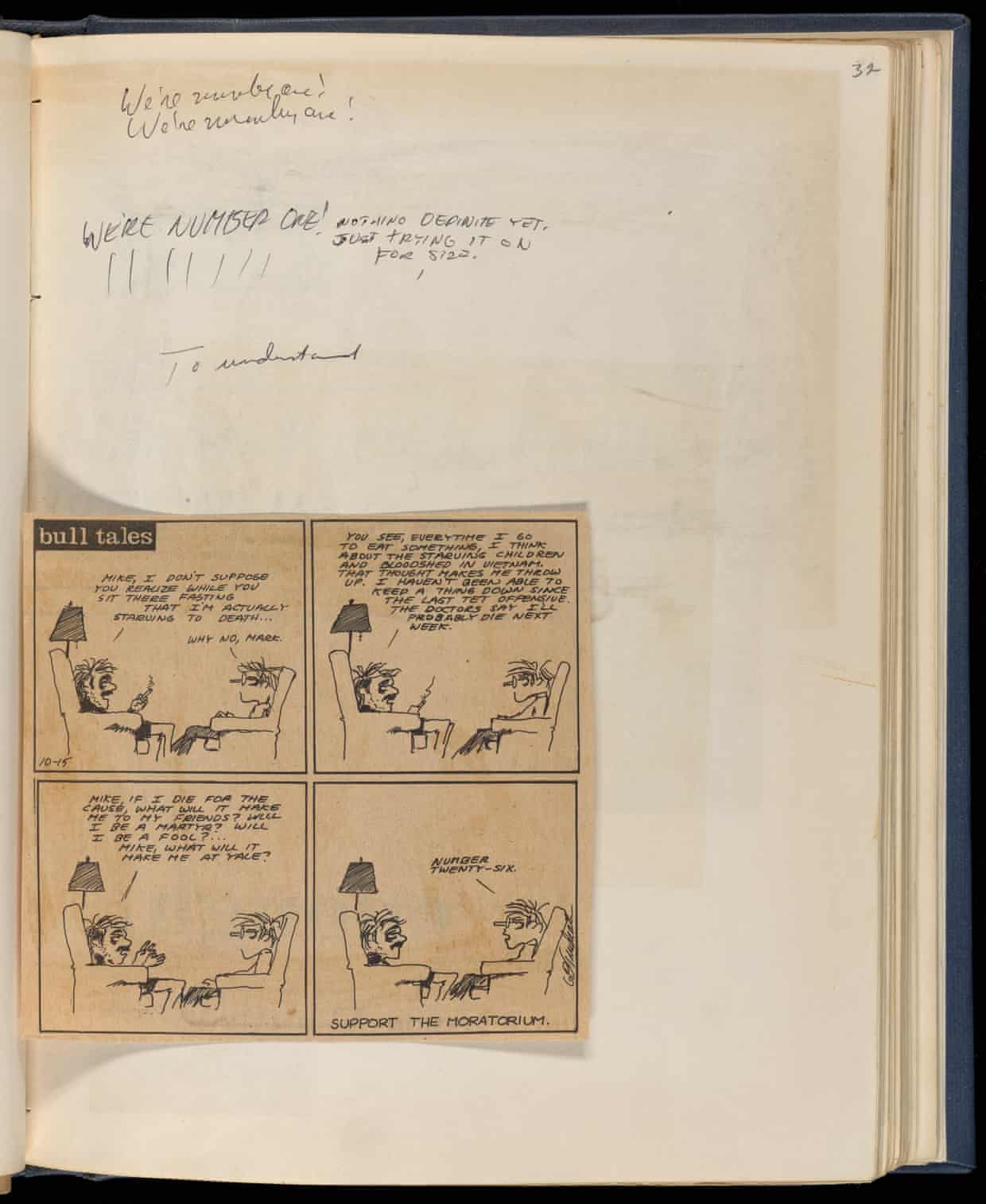
But Kendall was also taken aback by the university’s deeply entrenched sexism during the late 1960s. A female Yale professor chairing the co-education committee had to sneak up the back staircase of a private Yale club just to attend her own meetings, while academic buildings lacked women’s bathrooms.
Coming from an all-male prep school, Trudeau arrived at Yale with his own archaic views about women, and his earliest comic strips displayed sexism. However, his worldview was rapidly upended when he began dating a woman hailing from three generations of feminists. “She gave him an education, a crash course,” Kendall notes. “He quickly developed and got it.”
This awakening birthed the character Joanie Caucus, a middle-aged woman who leaves her husband to go to law school, cementing Trudeau as a mainstream advocate for feminism in the 1970s.
This capacity for personal and artistic evolution is, for Kendall, Trudeau’s most defining and admirable trait. “I feel like in this culture right now, there are a lot of people, particularly men, who kind of get stuck in adolescent mode. The one thing about Garry that moves me is his development and growth.”
This extended to his depiction of war. In his early 20s, Trudeau drew strips featuring the character B.D. (named after the Yale quarterback Brian Dowling) going to Vietnam merely to avoid writing a college term paper. Decades later, during the Iraq war, an older, wiser Trudeau depicted B.D. losing a leg and suffering from PTSD – a storyline handled with depth and care.
Trudeau also demonstrated a sensitive understanding of race and religion, mainstreaming Jewish characters like the radical student leader Mark Slackmeyer, and capturing the nuanced generational divides between assimilationist parents and their radicalised children.
By the mid-1970s Doonesbury was appearing in 450 newspapers and had a total of 60 million readers. Kendall argues that Trudeau should not be viewed merely as a joke-teller but a groundbreaking frontline reporter. On his book’s dust jacket, Henry Louis Gates Jr, a historian, calls Trudeau “one of our nation’s greatest journalists”.
Trudeau became a member of the White House press corps and followed President Gerald Ford to China. Dan Rather, a CBS News anchor who covered the Nixon administration, told Kendall that he was stunned by the thoroughness of Trudeau’s reporting on the Watergate scandal.
Trudeau covered the bank robbery and kidnapping trial of the heiress Patty Hearst, where one of Hearst’s co-defendants passed him a note via a bailiff confirming that “even revolutionaries like chocolate chip cookies”, and the star-studded recording of the charity single We Are the World.
Kendall comments: “There’s a sense that Garry is reporting on the 70s and the 80s. Journalism is the first stab at history and Garry is on the ground taking in what’s happening, not only in politics but also in society with things like the Aids crisis or abortion. He takes on these hot button issues and tries to capture where the country is.”
As he did so, Trudeau pioneered a form of satirical news that paved the way for the likes of The Daily Show and The Colbert Report on the Comedy Central network. Long before Stephen Colbert was blurring the lines of fact and fiction, Trudeau was drawing characters sitting on a park bench casually chatting with a cartoon Henry Kissinger.

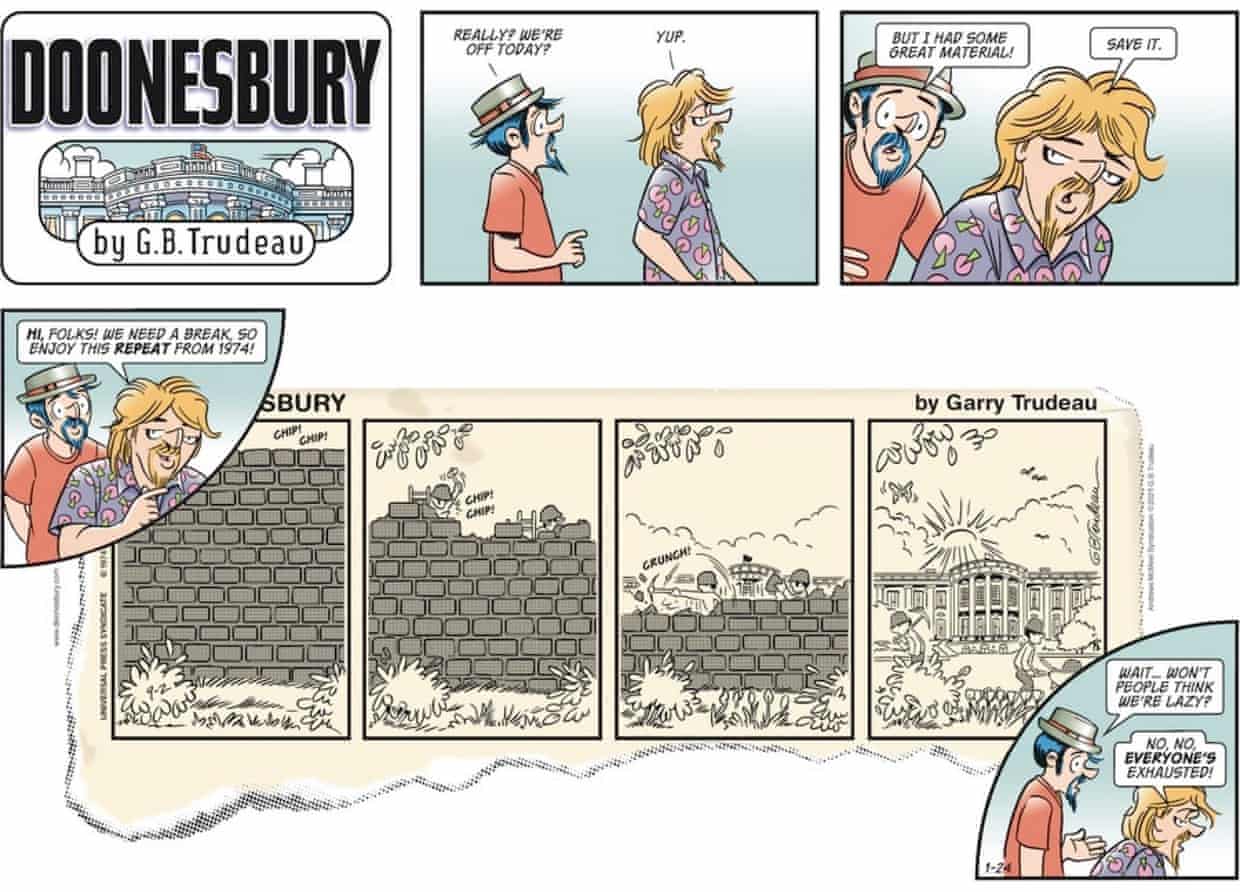
Yet the political landscape Trudeau navigated in his early career was vastly different from today’s bitterly polarised environment. Trudeau mercilessly lampooned the Nixon administration during Watergate, most memorably by depicting a stone wall slowly enclosing the White House. Yet the Nixon operatives respected the game.
“He and the Nixon people got along well in that they understood that he was a liberal, a young kid, and he was gonna criticise them. But it was like: ‘OK, we’ll take off the gloves and we’ll do it, we’ll fire back.’ It was a sense that’s the way the world works, people have different positions and let’s try to be as clever as Garry: we need to up our game. It was accepted by both parties that there would be these critics and that’s their job and they would laugh along. That’s changed.”
Even early political targets including Newt Gingrich wrote to Trudeau in 1984 expressing admiration, calling Doonesbury his favorite cartoon. But not everyone was amused; singer Frank Sinatra referred to Trudeau as a “cancer” after the strip highlighted the singer’s alleged mob ties.
Currently, Trudeau is only producing fresh Sunday strips – with the dailies existing as “Doonesbury Classic” reruns – and about a third of his new output focuses entirely on Donald Trump.
Trudeau has been tracking Trump since 1987, recognising him early on as an outrageous, narcissistic character, frequently placing him in adventures with the Doonesbury gang. Kendall says: “Trump is a very colourful character. Trump’s hair and various body parts are fun for the cartoonist. I guess he wants to talk about the effect of Trumpism on the Doonesbury gang and how it’s affecting the baby boomers, not just American politics, but American culture as well.”
Kendall believes that satirists such as Trudeau inherently view themselves as healers. Coming from three generations of doctors, Trudeau uses his pen to “bring out the better angels of our nature”, Kendall suggests. “Satire is a normal human impulse and that’s also a source of concern because it seems like the Trump administration is trying to threaten satirists and that is very worrisome because satire is part of life.”
Trudeau remains a steadfast observer, holding up a mirror to a nation that is arguably in a very dark place. “America has been in better places in the last 30 years and that’s also been reflected in the strip,” Kendall says. “But he’s a journalist so he’s going to tell the story of where the country is, wherever that happens to be.”
This is a tough moment for baby boomers who won struggles for feminism and civil rights in the 1960s only to see many of those gains stalled or reversed by Trump, the Republican party and a rightwing supreme court. Can Trudeau remain optimistic about America? His biographer thinks so.
“I end the book where he says, you’ve got to have hope, I live with hope. He has a sense that this is a dark time but we will get through it, that every era is time limited – but push through.”
-
Trudeau & Doonesbury: A Biography by Joshua Kendall (Abrams, £26). To support the Guardian, order your copy at guardianbookshop.com. Delivery charges may apply.