






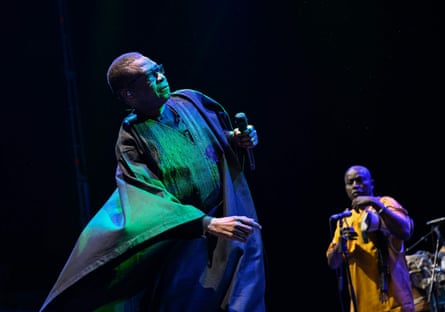
“The Grand Ball of Bamako,” as organisers tagged the Saturday evening soiree at the Hotel de l’Amitié in the Malian capital, was meant to provide one of the west African country’s biggest headlines last weekend.
Many sponsors including Orange Mali, the local subsidiary of the French telecoms company, had bankrolled the show, which organisers hoped would demonstrate Mali’s capacity to put on big cultural events in the teeth of a security crisis raging on multiple fronts. On the eve of the concert, a convoy of over half a dozen cars picked up the main attraction, GrammyAward-winning Senegalese singer Youssou N’Dour, from the Modibo Keita international airport.
In the end though, N’Dour, one of the continent’s most famous voices, did not get to perform. Halfway into the concert, guests stood up from the tables draped in white and left the venue, after news reached organisers that the ruling junta had imposed a 72-hour citywide curfew. “We have been faced with a situation beyond our control,” the main organiser Abdoulaye Guitteye said on stage. “We really did our best, we tried.”
The curfew was announced in response to a coordinated attack on multiple Malian cities and towns by an unlikely alliance of jihadists and separatists. In Bamako, people had woken up at dawn on Saturday to the sounds of gunfire as the Azawad Liberation Front (FLA) and al-Qaida-linked group JNIM targeted the same airport N’Dour had come in through. Sources claim the junta granted special permission for the airport to briefly reopen later on so he could fly back to his base in Dakar.
In the high-security garrison town of Kati, only 9 miles outside Bamako, a fierce fight broke out between insurgents and security forces at the residence of defence minister Sadio Camara. Then a suicide bomber drove an explosives-laden car into the property, killing Camara along with several relatives.
Since 2012, Mali has faced a profound security crisis fuelled in particular by violence from groups affiliated with al-Qaida and the Islamic State, as well as local criminal gangs and pro-independence groups. JNIM imposed a punishing fuel blockade of Bamako last year, but it had eased in the period leading up to Saturday’s attacks.
Camara was a key junta figure and Russian speaker seen as the mastermind behind the junta’s pivot to Russia, specifically its deal with mercenary group Wagner – which later morphed into the Kremlin-controlled Africa Corps – to provide regime protection and counterinsurgency support. Along with its neighbours Burkina Faso and Niger, Mali had expelled French and American forces following the coup that brought its junta to power.
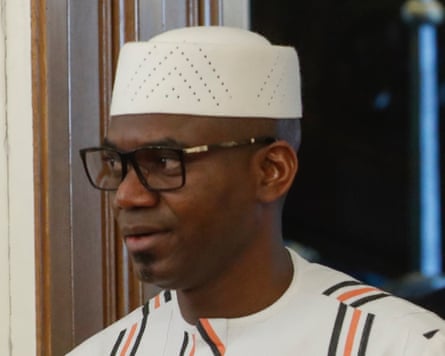
Conspiracy theories have been spreading freely: some claim the jihadists had sources near Camara who helped them breach his heavily guarded compound. “The military themselves say there had to be accomplices,” a Bamako-based consultant who did not want to give their name told the Guardian.
Simultaneous attacks took place on cities and towns around the country, including Gao, Mopti, Sévaré and Bourem. In the former separatist stronghold of Kidal near the border with southern Algeria, the Malian military and Africa Corps were overwhelmed by the militants. Algerian authorities reportedly helped the troops negotiate an exit from the city.
The attacks – the largest assault on the country in nearly 15 years – were a fresh escalation of a conflict that began in 2012 when men from the Tuareg ethnic minority who had felt sidelined since Mali’s independence from France in 1960 launched an offensive aided by weapons from the fall of the Gaddafi regime in Libya. Extremists in the north then hijacked the uprising and scaled it up to such an extent that interventions by the French military and a UN peacekeeping force failed to bring the situation under control.
The conflict also triggered three successful coups, including the one in May 2021 that installed Assimi Goïta as head of state. A few years later he pulled Mali out of the Economic Community of West African States (Ecowas) alongside his fellow junta leaders in Burkina Faso and Niger.
Goïta was neither seen nor heard from at the weekend, prompting speculation that the rebels had outsmarted the Turkish private military contractors protecting him, or that he had been deposed by his fellow putschists in the junta.
On Tuesday afternoon, Goïta proved the rumours wrong, resurfacing in a photo of him meeting the Russian ambassador that was posted by the Malian presidency to X. Goita later addressed the nation, saying the “enemy’s deadly plan has been thwarted”.
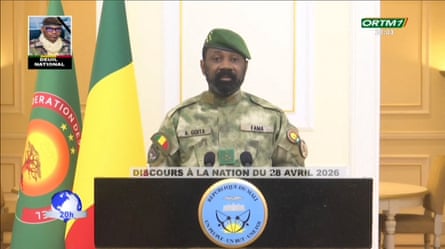
“These attacks are not isolated incidents, but are part of a vast destabilisation plan conceived and carried out by terrorist groups and external and internal sponsors who provide them with intelligence and logistical support,” he said, toeing the same narrative as Moscow’s defence ministry, which claimed without evidence to have thwarted a coup backed by western forces.
Authorities in Bamako and Moscow have confirmed that there were civilian and military losses, but have not given casualty figures. The military also said it had killed more than 200 terrorists.
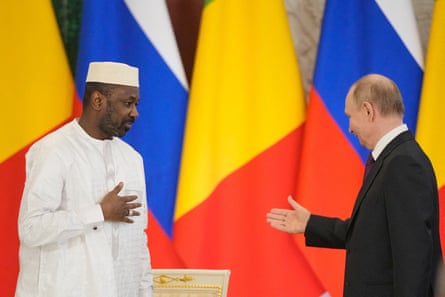
Analysts say the Russians will now focus on safeguarding the capital and the presidency. The Bamako-based consultant doubts the militants can take Bamako due to superior military numbers but knows the threat is ever-present. The jihadists and separatists “know the mountains and the trails” better than the army, and travel on motorcycles, he said. “They are in control. They have prepared for this.”
As people go about their daily lives, the city has remained on high alert. “Even this morning, the children went to school but there’s panic and many people are staying at home,” said the consultant, who lives in a suburb on the outskirts of Bamako and has not left his house since Saturday.
On social media, videos are circulating from the jihadists telling people in Bambara, the most widely spoken language in the country, not to leave the capital. One video with an upbeat musical soundtrack appears to show a militant spray-painting over the government’s signage in downtown Kidal while flashing a peace sign at the camera. The Guardian could not independently verify the footage.
Throughout the day on Saturday, the concert’s organisers resisted calls to cancel the event in light of the fast-moving security situation in part because the venue, a few blocks from the French embassy, is seen as one of the safest places in the capital.
The attempt to keep the show on the road reflected a desire among many people living in Bamako to try to lead as normal and spirited a life as possible. This attitude is encouraged by the junta, which has long sought to project an image of stability.
In December, even as the fuel blockade upended daily life for millions of ordinary people, a biennale was held in the ancient city of Timbuktu. And last weekend couples went ahead with weddings across Bamako despite the violence.
A woman from Bamako who attended the Timbuktu festival said this week:
“This is what I tell people: ‘Either we decide to live, or we decide to remain terrorised’ … what a lot of people have also written on their [social media] pages is: ‘We won’t give in, we have to resist, we have to keep living.’”