


The local people know there is something going on when the internet and phone signal drops dead, they say. If the heavy bombers are flying low, the teachers will pause their school assembly until the thunderous din has passed. The parish council has been briefed on the intricacies of sonic booms. Car insurance is more expensive here as the Americans “can’t drive” and sometimes find themselves on the wrong side of the road. The base became less open to its neighbours after 9/11. But everyone knows there are secrets held beyond the barbed wire, not least that this is where the nukes are stored.
RAF Lakenheath is the largest US air force (USAF) base in Europe, part of what is known as the “tri-base area” of Suffolk, a stretch of 20 sq miles (52 sq km) of land leased to the US government around which a peculiar ecosystem has developed over the eight decades of the American presence.
Less than a 10-minute drive south-west of Lakenheath is RAF Mildenhall, which supports aerial refuelling and special operations. On the other side of Lakenheath Fen, to the north, is RAF Feltwell, a home for some of the 7,000 active duty personnel and 11,000 family members working across the three bases, although many Americans call the surrounding villages home too.
One of the most popular places to stay is the village of Lakenheath, population 10,000, of which just under half are US citizens.
The village is long and narrow, dominated by a busy main road, but it is not without its charms; tastefully designed new-builds complement the 19th-century cottages and a medieval church.
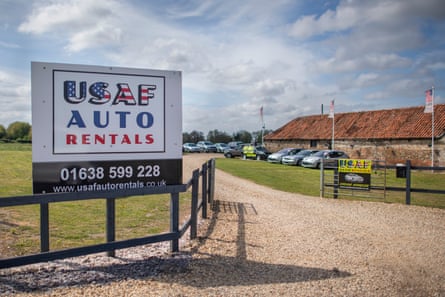
Its inner world could be lost on a driver whizzing by on the way to Newmarket were it not for the disproportionately large number of barbers, tattoo salons and car rental outlets. “A car for every American,” offers Fly Rentals at the southern edge of the village near the turn-off to the base.
Louise Marston, 41, owns CJ’s Sandwich Bar and Cafe, on the high street. While having a cup of tea with her aunt, Sarah Marston, 58, she described a community largely at peace with itself but not without its quirks and mysteries. “You can be on the phone and the signal will just go,” she said. “Only for a bit, but it comes and goes.”
“Even our internet,” said her aunt. “For all their technology [on the base] it does interfere with life, but it is one of those things.”
“You know if something is going on – when it all kicked off the signal was down,” added Anouska Isaacson, 45, with reference to the fighter jets and bombers that flew from the base to attack Iran in recent weeks.

Isaacson, who makes the sandwiches at CJ’s, has lived in Lakenheath all her life. She is bullish about the benefits the base brings. There were some concerns aired about where a new primary school had been built as the children bore the full brunt of the noise, but locals here were used to it, she said.
She said: “People say: ‘How do you put up with that racket?’ You don’t take no mind to it. We get a lot of plane spotters but they just need to learn how to park; they are a little irritating. But it brings in people here.”
The boon to the local economy trumped the myriad of little inconveniences. “Car insurance is more locally,” Marston noted. “Every crash I have had has involved an American. They can’t really drive, bless them. But then I couldn’t drive when I went to their country.”
Then there are the nuclear weapons. This area in East Anglia was first chosen as the site for heavy bombers during the second world war due to the relative ease with which they could reach Berlin. The US took operational command of the bases in 1948.
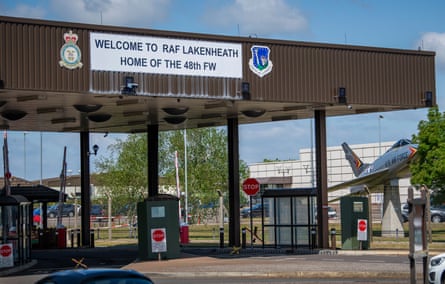
It was largely understood, but never confirmed, that nuclear warheads were on site for the duration of the cold war. In 2008, it was suggested that more than 100 of them had been removed due to security deficiencies. The publication three years ago of plans to build a dome that could protect B61-12 thermonuclear gravity bombs at Lakenheath, followed by the discovery of various flights of planes specialising in nuclear transport last year, convinced many that the nukes had returned, if they ever left.
“They have been there for donkey’s years,” said Isaacson. “Not bothered.”
Not everyone feels the same. Once a month, for the last three years, an organisation called Lakenheath Alliance for Peace has been protesting outside the base. The demonstrations are the result of two women involved in the 1980s Greenham Common peace camp alerting Sue Wright, a retired headteacher and the chair of the Campaign for Nuclear Disarmament in nearby Norwich, to the developments at Lakenheath. The base today hosts the fifth-generation nuclear-capable F35A stealth jets.
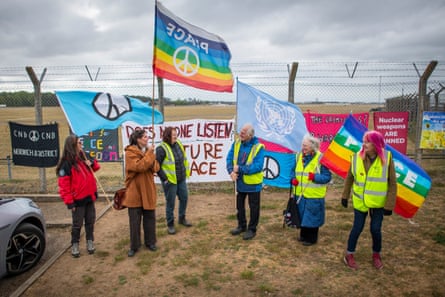
Isaacson said she had little time for the demonstrators. At a recent protest, Suffolk constabulary arrested 13 people, all of whom lived outside the county. “They disrupted everybody’s day,” Isaacson said of the protesters. “They bussed them in – they weren’t from here.”
Standing at the base’s barbed wire perimeter fence, Wright, along with fellow protesters from Ely, a town just under half an hour’s drive west, said this was not entirely true. She was encouraged by those entering and leaving the base by car who had tooted their horn in apparent support. It was further claimed that a couple of residents of Lakenheath had joined them, but had been concerned about repercussions should they make themselves known.
Bianca Mularoni, 31, from Ely, said she found the sound of the planes overhead – as well as her knowledge that many had likely been on the way to Iran to take part in an “illegal war” – deeply unsettling. “It is so eerie,” she said. “They are sometimes so loud that you can’t hear yourself speak.”
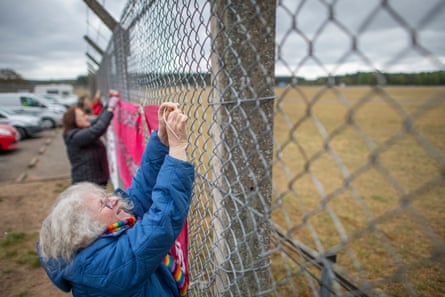
Such arguments are not entirely lost on the residents of Lakenheath. There was a confrontation last spring when personnel at the base took part in a drill in the case of a nuclear spill. Nearby households have not ever been briefed on what they should do in such an event.
Gerald Kelly, a councillor, has suggested a siren system would be a good first step. But his bigger concern, he said, was the general lack of transparency from the Ministry of Defence when the parish council raised issues.
“There’s a fairly solid collection of locals who believe the nuclear warheads never went away anyway, so we just live with it,” said Kelly. “But generally, in terms of how we get on at a council level, the issue is not with the USAF, with whom we get on wonderfully. But as soon as the Ministry of Defence gets involved, the shutters come down.”
It’s not an unhappy community, but Lakenheath remains a place of secrets.