



惯性聚合 高效追踪和阅读你感兴趣的博客、新闻、科技资讯
阅读原文 在惯性聚合中打开

推荐订阅源

WordPress大学
WordPress大学
大猫的无限游戏
大猫的无限游戏
B
Blog
阮一峰的网络日志
阮一峰的网络日志
IT之家
IT之家
Hugging Face - Blog
Hugging Face - Blog
博客园 - 【当耐特】
Jina AI
Jina AI
博客园 - 聂微东
T
The Blog of Author Tim Ferriss
宝玉的分享
宝玉的分享
L
LangChain Blog
M
MIT News - Artificial intelligence
Blog — PlanetScale
Blog — PlanetScale
腾讯CDC
酷 壳 – CoolShell
酷 壳 – CoolShell
Y
Y Combinator Blog
F
Fortinet All Blogs
H
Help Net Security
B
Blog RSS Feed
J
Java Code Geeks
Cyber Security Advisories - MS-ISAC
Apple Machine Learning Research
S
SegmentFault 最新的问题

The Guardian

New Zealand’s North Island braces for Cyclone Vaianu with thousands ordered to evacuate Artemis II splashdown – in pictures Swalwell denies allegations of sexual assault as calls grow for him to withdraw from California governor race Trump news at a glance: Epstein survivors have words for Melania Trump after surprise statement Multiple people face charges, including murder, in California fireworks blast Rory McIlroy surges into six-shot Masters lead with stunning second-round flourish Roberto De Zerbi targets ‘Ange-ball’ revival to save Spurs from relegation Bath hit back to reach semi-final after stunning Northampton in 11-try epic Australia crash out of BJK Cup after Britain secure upset with doubles win Zebras, wealth and power: Hungary’s election tests Orbán’s grip on power ‘TikTok effect’ brings sellout crowds and younger fans to Grand National meeting King signs up David Beckham to his Chelsea flower show team The war over Omagh’s gold: the £21bn mine plan tearing a community apart Britain’s shadow workforce is paid as little as 65p an hour. Who cares for the carers? Tim Dowling: my wife is on a quest to restore my thinning hair SUVs are making Britain’s potholes worse, say scientists Blind date: ‘She claimed she was usually shy. I wouldn’t have guessed’ I’m a sauna person now: the Becky Barnicoat cartoon ‘I got everything I dreamed of – when I had no ability to handle it’: Lena Dunham on toxic fame, broken friendships and her ‘lost decade’ Six great reads: the man who let snakes bite him, masked heavy metal and the brutal reality for foreign students in the UK Meera Sodha’s recipe for noodles with rose beancurd, spring greens and egg Cuba’s doctors were a lifeline for the world. Now the Caribbean is shamefully complicit in the US drive to expel them An environmental disaster in Moldova has Russia’s fingerprints all over it ‘This is as important as your teeth’: are you skipping this key part of mouth hygiene? Man arrested after four die trying to cross Channel in small boat Ukraine war briefing: doubts linger in Kyiv over Moscow’s promise to uphold Orthodox Easter ceasefire Ichiro Suzuki statue unveiling goes awry as bronze bat snaps during ceremony Arrest of national war hero Ben Roberts-Smith cuts deeply to core of Australian psyche European football: Real Madrid held at home by Girona to extend winless run ‘You come back different’: how rugby players change after motherhood
AI will help make a Nobel prize-winning discovery within ...
Robert Booth · 2026-05-21 · via The Guardian

An AI system will work with humans to make a Nobel prize-winning discovery within 12 months and tradespeople will be helped by bipedal robots in two years, according to the co-founder of Anthropic.

Jack Clark described a “vertiginous sense of progress” in the technology and made a series of predictions, including that companies run solely by AIs would be generating millions of dollars in revenue within 18 months, and that by the end of 2028, AI systems would be able to design their own successors.

In a lecture at Oxford University on Wednesday, he also said there remained plausible scenarios in which the technology had “a non-zero chance of killing everyone on the planet” and that it was “important to clearly state that that risk hasn’t gone away”. Anthropic’s most popular model is called Claude, but it recently launched a version called Mythos that proved alarmingly capable at exploiting cybersecurity weaknesses.

Clark told students it would be better if humans could slow the development of the technology “to give ourselves more time as a species” to deal with the implications of its powers. But he said this wouldn’t happen, in the breakneck development “by a variety of actors and a variety of countries, locked in a competition with one another, where commercial and geopolitical rivalries are often drowning out the larger existential-to-the-species aspects of the technology being built”. This was “not ideal”, he said.
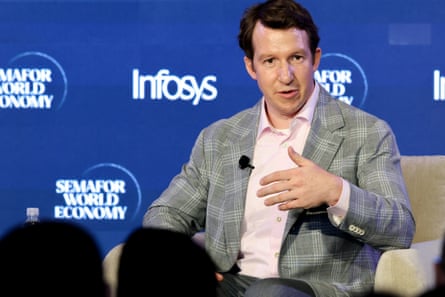
Jack Clark speaks at a summit in Washington.
Jack Clark said he wanted to encourage humanity to prepare for a technology that would ‘soon be more capable than all of us collectively’. Photograph: Samuel Corum/Bloomberg/Getty Images

Clark is one of the most senior figures at Anthropic, which was established by AI researchers who quit the rival firm OpenAI over disagreements on safety. The $900bn (£670bn) company has been accused by Donald Trump’s White House and other AI accelerationists of “fear-mongering” to encourage regulation that could cement its competitive position.

Anthropic disputes this, and Clark said many people appeared to be in denial about AI’s progress. He said he wanted to encourage humanity to prepare for a technology that would “soon be more capable than all of us collectively”. Comparing the failure to prepare for AI to the failure to prepare for pandemics such as Covid, he said: “If we stand by and let synthetic intelligence multiply, then we’ll eventually be forced into reactivity.”

Critics of the frontier AI companies such as Anthropic, OpenAI and Google fear over-reliance on their few AI models – which have been backed by huge amounts of profit-seeking capital – could create a “single point of failure” in global systems.

Prof Edward Harcourt, the director of the Institute for Ethics in AI, which co-hosted Clark’s lecture, separately warned that the rise of AIs that did more and more things for humans risked creating “cognitive atrophy” which could weaken humans’ decision-making and powers of judgment. He advocated for alternative AI models that ask humans to do more of the thinking, sometimes called “Socratic” AI.

Clark said his most conservative prediction was that “vast swathes of the economy and society will go through profound changes” – which could include a machine economy decoupling from the human economy, robots gaining brains, science progressing without humans, and scientific equipment that people hadn’t conceived of but which worked. He admitted some of this sounded “crazy”.