








The Scottish, Welsh, and local English elections on Thursday 7 May are a huge test for all the main political parties – and may be existential for Keir Starmer as prime minister and Labour leader.
The elections, two years into a Labour government, will see more than 30 million people across England, Wales and Scotland vote in the devolved administrations, in six mayoral races, and for more than 4,500 councillors in city and county councils.
Polls predict a dire night for Labour, which is defending the majority of the councils. The party could face losses of more than 1,800 councillors, which would be almost three-quarters of the seats being defended. Significant losses are also expected for the Conservative party.
It is also a test for the Reform party leader, Nigel Farage, and the Green party leader, Zack Polanski, as to whether they can convert surging popularity into real power.
In Scotland and Wales, nationalist parties are expected to benefit – with the possibility of Plaid Cymru taking the Welsh Senedd for the first time, and the Scottish National Party consolidating its support after it was once predicted to lose to Labour.
1. Scotland
Although the incumbent Scottish National party is cruising towards a gravity-defying fifth term in office after Thursday’s Scottish parliament elections, the fine detail of the results and the subsequent makeup of the Holyrood chamber remains exceptionally unpredictable.
Reform UK, which has gained considerable momentum in Scotland over the past 18 months, is neck and neck for second place with Scottish Labour, whose rating have suffered from growing public dissatisfaction with the UK Labour government, despite its leader, Anas Sarwar, taking the career-defining decision to call for Starmer to stand aside in February.
With an unusually high proportion of voters still undecided, and turnout likely to be low, many constituency seats are in the balance, and the SNP is by no means guaranteed a majority. It could then turn to the Scottish Greens – who are anticipating a strong showing thanks in part to a Polanski bounce, although the Green Party of England and Wales is a separate entity – for support to create a pro-independence majority at Holyrood.
The SNP leader, John Swinney, has pledged to hold a vote seeking the powers to hold a second independence referendum on the first day of a new parliament – despite the fact that the UK government has consistently refused previous demands and he can offer no alternative route.
2. Wales
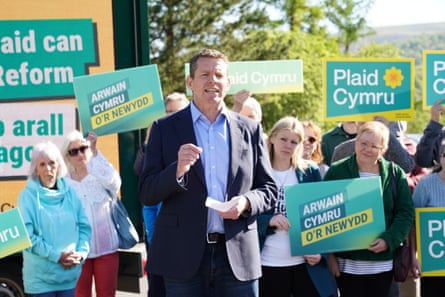
The leader of Plaid Cymru, Rhun ap Iorwerth, speaking in Pontypridd. Photograph: Zoe Head-Thomas/PA This week the Welsh parliament will grow from 60 to 96 members under a new, more proportional electoral system. Labour is likely to lose control of the Senedd for the first time since devolution in 1999, with Plaid Cymru’s Rhun ap Iorwerth expected to become the new first minister, putting Welsh independence firmly on the agenda.
Coalition arithmetic makes it highly unlikely Reform will be able to form a government, even if it wins the most seats. If the numbers allow, Plaid Cymru will form a minority government without entering formal coalition agreements with Labour or the Green party.
Labour’s predicted losses are so catastrophic that some polls put the party in fourth place, after the Greens. Several polls suggest Eluned Morgan, the Labour first minister, will lose her seat.
The Senedd’s new list system has razor-sharp margins, making predictions very difficult. As little as 0.06% of the vote could decide the last (sixth) seat in each constituency, according to the pollsters More in Common.
3. North-east England
Sunderland is the jewel in the crown, and is expected to deliver the most significant Labour loss to Reform – it has been under continuous Labour majority control since the council’s creation in 1974. It is a key target for Reform and one that Farage believes his party will win comfortably, after taking neighbouring Durham county council last year.
There will be a strong Reform challenge too in South Tyneside and Gateshead. And Labour may lose control of Hartlepool – which is likely to be an earlier result and may dominate some of Friday’s narrative. There is even an outside chance Reform could take Newcastle city council.
In Yorkshire, the prime targets for Reform are Barnsley – Labour since 1974 – and Wakefield.
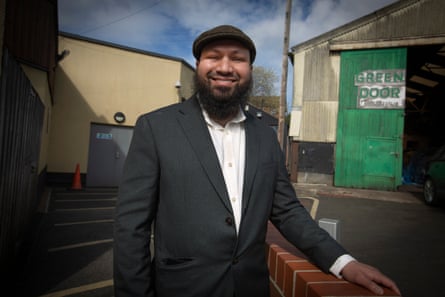
The Green party deputy leader, Mothin Ali. Photograph: Colin McPherson In cities such as Leeds and Newcastle, the Greens are expected to make gains. At Leeds city council the Labour vote could be eaten by different parties, particularly the Greens in diverse and more impoverished areas such as Harehills, where the Green party deputy leader, Mothin Ali, is a councillor. The Greens may also attract affluent progressives in places such as Roundhay. In the east of the city, Reform is likely to make gains.
4. North-west England
Manchester city council is one of the few that Labour can safely hold – though with a Green challenge, so the most interesting moment here will be if the mayor of Greater Manchester and would-be prime minister, Andy Burnham, uses any dent in Labour’s vote as an opportunity to call for Starmer to go.
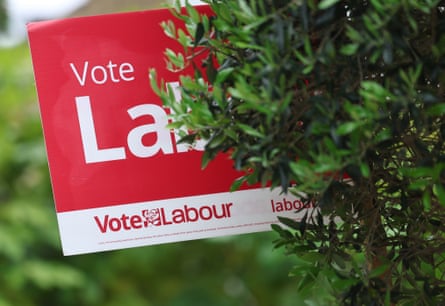
Labour looks set for a torrid night in the north-west. Photograph: Neil Hall/EPA Labour looks set for a torrid night in the north-west, with Reform hoping to take Tameside council in Greater Manchester. Even in Merseyside, where Labour dominates the councils, there are potential Reform gains in Sefton and St Helens. And there are also significant challenges to Labour from independent candidates, particularly in Blackburn, often associated with large Muslim communities that are disillusioned with Labour.
5. East of England
This is where the Tories will take their biggest battering, losing county councils that last went Tory during Boris Johnson’s “vaccine bounce”. Reform hopes to make considerable gains in Essex, Suffolk and Norfolk, taking three councils that have been Conservative since inception.
Losing Essex would be a particular blow for the Conservative leader, Kemi Badenoch, because it is the home of her Saffron Walden constituency.
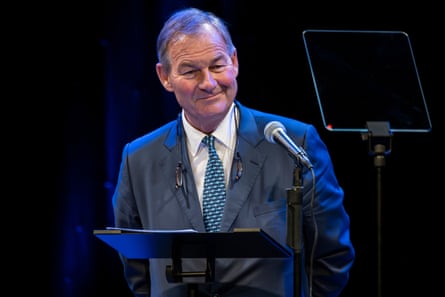
Rupert Lowe. Photograph: Jason Bye/The Guardian Ex-Reform Rupert Lowe’s Restore UK party is competing in nine Norfolk council seats, all within his Great Yarmouth constituency. If he sees gains, that could deny Reform a majority on that council.
One spot to watch in the south-east is Hastings, which could be the only council outside London where the Greens have a chance of taking control.
6. Midlands
The main event here is Birmingham city council, the scene of a long-running bin dispute, recently resolved but damaging enough to cause Labour to get hammered in this set of elections. The council is likely to go into no overall control – with Labour losing to independents, Reform, Greens and the Tories.
The most likely governing coalition may be with independents and Greens, but it is highly dependent on the final mix, which is very unpredictable.
Reform has double-digit polling leads in a slew of West Midlands councils: Cannock Chase, Dudley, Newcastle-under-Lyme, Nuneaton, Redditch, Tamworth and Walsall.
7. London
This is the true Labour heartland, where councils that could once weigh the Labour vote rather than count it now find themselves fighting to keep control against an insurgent Green party. Hackney is the Greens’ most likely victory, where they are also expected to take the mayoralty, but they could also make gains in Lambeth, Lewisham and Waltham Forest. Independents are also a significant presence in Newham and Redbridge.
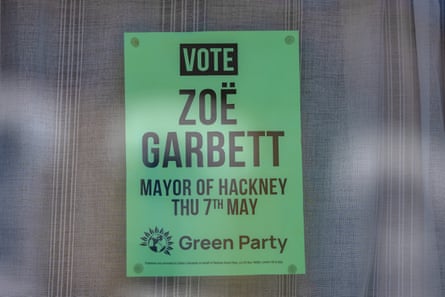
A Green party poster in the window of a property in Hackney. Photograph: Carl Court/Getty Images Labour will hope to keep hold of former Tory-controlled councils in Westminster, Barnet and Wandsworth, though any of those may be regained by the Conservatives.
Farage is targeting six councils in London including Havering, Barking and Dagenham and Croydon. The Croydon mayoralty, however, may be one bright spot for Labour – one of the few gains of the night it hopes to make.
8. Southern England
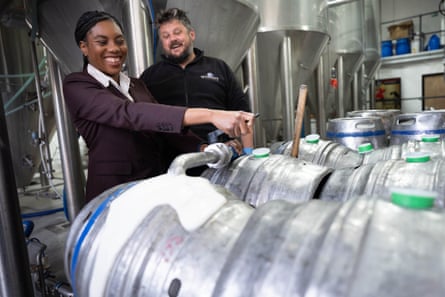
Kemi Badenoch on the campaign trail. Photograph: Stefan Rousseau/PA This is the spot to watch for how the night unfolds for the Liberal Democrats, especially the party’s dominance of the home counties. Its biggest hope is to take control of the two new East and West Surrey unitary councils.
The party is likely to keep the Conservatives out in Cheltenham, Eastleigh and Winchester, although any sign of Tory revival here would be positive for Badenoch’s party.


