


John Barnes: got. David Beckham: got. Ruud Gullit: got. Andrei Kanchelskis: got. Matthew Le Tissier: got. Alan Shearer: got.
Looking back through the football autographs I collected as a teenager in the early 1990s feels delightful and discomfiting. The Merlin sticker albums, Pro Set cards and Shoot annuals chronicle a youth spent travelling the country with my dad, watching Coventry City take on the great and the good of the top flight at the dawn of the Premier League. We would hunt for the visiting teams at local hotels before each game, aiming to bag a handful of signatures when the players went for their mid-morning walk, then sneak around the back of Highfield Road after the match – darting past security, through the executive suites, to the players’ exit – where we would complete our haul as the players boarded the team buses.
Tony Daley: got. Jason Dodd: got. Anders Limpar: got. Des Walker: got. Alf-Inge Haaland: got. Bruce Grobbelaar: got.
It’s 25 years since Coventry were a Premier League team. That’s more than half my life. No other team has returned after such a gap (a clutch of teams had far longer absences from the old First Division, but it’s hard to compare Coventry’s modern-day revival with theirs). The Sky Blues fell three divisions in the first 16 years and played “home” games at Northampton and Birmingham as a protracted stadium ownership saga almost killed the club. We, the fans, desperately held on but nearly gave up. And all the while, life rolled onwards relentlessly. I went to university and then moved to New Zealand, London, Australia and Cornwall; my dad became a pensioner; I had a child of my own; my autographs started to go mouldy in the loft.
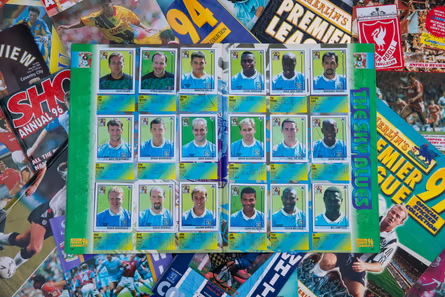
Dion Dublin: got. Darren Huckerby: got. Cobi Jones: got. Gary McAllister: got. Peter Ndlovu: got.
At their best, Coventry were a decent Premier League team who should have finished in the top 10, but somehow never did. We scalped the big boys on a regular basis (Arsenal away via a Micky Quinn hat-trick; Manchester United 3-2 thanks to Darren Huckerby’s solo special; Chelsea at home in the first game of the season two years running). We bagged our share of bangers (Stephen Froggatt against Everton in 1998) and curios (Dublin against Newcastle in 1997 at Shay Given’s expense). We even signed a Brazilian player, Isaias, in 1995 which felt positively exotic at the time. Watching Coventry from our touchline seats in the M&B Stand, I didn’t truly appreciate how lucky I was to be present for those salad days, and to be there with my dad.
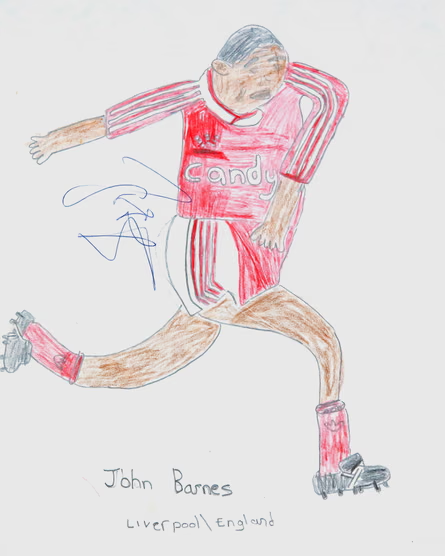
Eric Cantona: got (but badly smudged). Paul Gascoigne: need. Steve McManaman: got lots. Ali Dia: need.
The first rule of autograph memorabilia is: value lies in obscurity. As a boyhood fan I most wanted the superstars such as Cantona, whereas a seasoned collector like my dad, who has upwards of 30,000 autographs dating back to the first world war, cherishes signatures such as that of Lee Hildreth, whose only appearance for Coventry lasted just 60 seconds against Burnley in 2007 (did he even touch the ball?). The second rule of autograph memorabilia is: one is never enough. I recall finding the Spice Boys Liverpool team at the Hilton on the outskirts of Coventry in the mid-90s and asking Steve McManaman to sign a few books. When I pleaded for “just one more”, McManaman bellowed for the entire hotel to hear: “Are you having a laugh?” The third rule of autograph memorabilia, which I realised far too late, is: always use a marker pen, because Biro fades almost as fast as your youth.
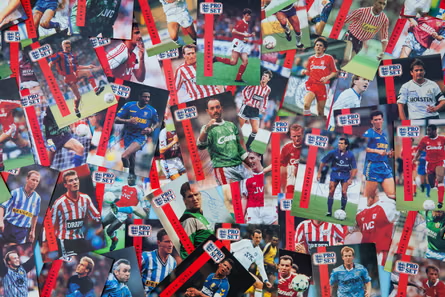
Ian Wright: got. Ian Woan: got. Ian Bishop: got. Ian Ormondroyd: got. Ian Rush: got. Ian Walker: got.
My dad’s interest in autographs began as a child in Bristol in the 1950s. After his father sold half his collection for the sake of a few beers, that interest turned into obsession. For decades, he travelled the UK and beyond, relentlessly building a collection that no one else could tear away from him. If you’ve kicked a ball professionally for Coventry – or for Liverpool, Manchester United, Arsenal or Chelsea – there’s a good chance my dad has got your autograph. The collection is so vast and so impressive, it belongs in a museum. Instead, it lives in plastic boxes and peach-coloured wardrobes, catalogued in such a perplexing way that only my dad could ever understand it.
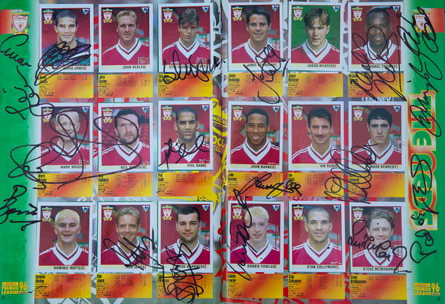
Robbie Fowler: got. Chris Kiwomya: got. Henning Berg: got. Tony Dorigo: got. Peter Schmeichel: got. Gary Speed: got.
One summer, presumably around 1995, my dad took me to a sticker swap shop to help me finish that year’s album. However, the event was cancelled, so he promptly drove me across the country to the Merlin offices, where he politely demanded that they give me all the shinies and player portraits I needed. I thought he was heroic. But soon my appetite for autographs was on the wane. In what must have been April 1996, my dad and I were trying to find where QPR were staying. We drove to the Holiday Inn behind Blockbuster Video. It was where the crap teams stayed. “Can you see them?” my dad asked. “No,” I lied. I didn’t have the heart to tell him I didn’t wish to wait two hours in a drab hotel lobby just to get Kevin Gallen.
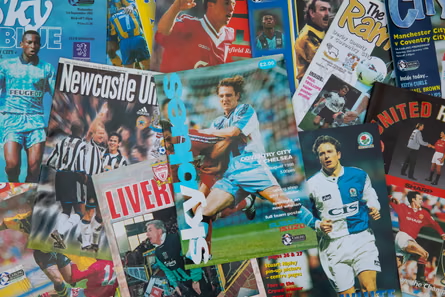
Richard Shaw: got. Paul Telfer: got. Gary Breen: got. John Hartson: got. Craig Bellamy: no thanks.
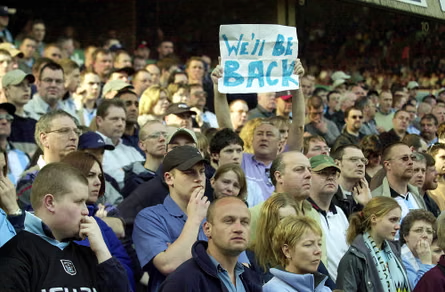
For many years the Sky Blues were the top flight’s great escape artists. Needing a win at Tottenham on the last day in 1997 to stay up, we triumphed 2-1 thanks to a thunderbolt from Paul Williams. Nirvana! I can still feel it now. On the journey home in my dad’s burgundy Renault Laguna, bathed in sunshine, listening to fans’ reactions on the radio, it seemed we were invincible. But by 2001 our time was up. I hold Bellamy single-handedly culpable for Coventry’s relegation. In my memory at least, he was an arrogant, petulant player who didn’t score from open play all season (in reality he scored six goals, two of which were penalties). We were relegated at Aston Villa, of all places, when we threw away a two-goal lead to lose 3-2. Wearing my Subaru-sponsored Coventry shirt – the last kit I ever bought – I wept in the stands. One fan held aloft a sign saying: “We’ll be back.” In truth, I wasn’t sure when I would be back. I was 18, soon to leave home and I knew my time as a season-ticket holder was over. It was the bookend to my childhood.
Gordon Strachan: got: Roland Nilsson got. Iain Dowie: got. Mark Robins: need. Frank Lampard: got.
Who could have envisaged, then, that Lampard, whose autograph I got when he was a West Ham youngster, would be the man to lead Coventry back to the top flight? Not one of our former players who tried in vain to turn our fortunes around, nor Mark Robins, who oversaw seven years of judicious progress and took us to within a penalty shootout of redemption. Under Lampard, City have bossed the Championship thanks to a midfield cast in his image and a sensational goalkeeper in Carl Rushworth who’ll one day star for England. We are overdue another crack at the top tier. Yet, I’m not sure if I really want us to go up. The Premier League looks stale and joyless compared with the division we left behind all those years ago, and there’s a risk we won’t be competitive this time around. Most of all, I worry that demand for tickets will be so high that my dad and I may not even get a chance to attend a top-flight fixture next season. Whatever happens, at least I can live off those precious memories we made together in the 90s – they’re more valuable to me than any autograph.