

惯性聚合 高效追踪和阅读你感兴趣的博客、新闻、科技资讯
阅读原文 在惯性聚合中打开

推荐订阅源

月光博客
月光博客
云风的 BLOG
云风的 BLOG
小众软件
小众软件
雷峰网
雷峰网
博客园 - 【当耐特】
V
V2EX
WordPress大学
WordPress大学
IT之家
IT之家
Last Week in AI
Last Week in AI
罗磊的独立博客
奇客Solidot–传递最新科技情报
奇客Solidot–传递最新科技情报
Apple Machine Learning Research
钛媒体:引领未来商业与生活新知
钛媒体:引领未来商业与生活新知
V
Visual Studio Blog
freeCodeCamp Programming Tutorials: Python, JavaScript, Git & More
有赞技术团队
有赞技术团队
The Cloudflare Blog
Jina AI
Jina AI
博客园 - 司徒正美
阮一峰的网络日志
阮一峰的网络日志
博客园 - 聂微东
大猫的无限游戏
大猫的无限游戏
博客园 - 三生石上(FineUI控件)
让小产品的独立变现更简单 - ezindie.com

The Guardian

New Zealand’s North Island braces for Cyclone Vaianu with thousands ordered to evacuate Artemis II splashdown – in pictures Swalwell denies allegations of sexual assault as calls grow for him to withdraw from California governor race Trump news at a glance: Epstein survivors have words for Melania Trump after surprise statement Multiple people face charges, including murder, in California fireworks blast Rory McIlroy surges into six-shot Masters lead with stunning second-round flourish Roberto De Zerbi targets ‘Ange-ball’ revival to save Spurs from relegation Bath hit back to reach semi-final after stunning Northampton in 11-try epic Australia crash out of BJK Cup after Britain secure upset with doubles win Zebras, wealth and power: Hungary’s election tests Orbán’s grip on power ‘TikTok effect’ brings sellout crowds and younger fans to Grand National meeting King signs up David Beckham to his Chelsea flower show team The war over Omagh’s gold: the £21bn mine plan tearing a community apart Britain’s shadow workforce is paid as little as 65p an hour. Who cares for the carers? Tim Dowling: my wife is on a quest to restore my thinning hair SUVs are making Britain’s potholes worse, say scientists Blind date: ‘She claimed she was usually shy. I wouldn’t have guessed’ I’m a sauna person now: the Becky Barnicoat cartoon ‘I got everything I dreamed of – when I had no ability to handle it’: Lena Dunham on toxic fame, broken friendships and her ‘lost decade’ Six great reads: the man who let snakes bite him, masked heavy metal and the brutal reality for foreign students in the UK Meera Sodha’s recipe for noodles with rose beancurd, spring greens and egg Cuba’s doctors were a lifeline for the world. Now the Caribbean is shamefully complicit in the US drive to expel them An environmental disaster in Moldova has Russia’s fingerprints all over it ‘This is as important as your teeth’: are you skipping this key part of mouth hygiene? Man arrested after four die trying to cross Channel in small boat Ukraine war briefing: doubts linger in Kyiv over Moscow’s promise to uphold Orthodox Easter ceasefire Ichiro Suzuki statue unveiling goes awry as bronze bat snaps during ceremony Arrest of national war hero Ben Roberts-Smith cuts deeply to core of Australian psyche European football: Real Madrid held at home by Girona to extend winless run ‘You come back different’: how rugby players change after motherhood
Germany urged to stop admiring Beijing and wake up to ‘Ch...
Lisa O’Carro · 2026-05-20 · via The Guardian

Germany must stop admiring China’s success in the EU or it will sleepwalk into the kind of deindustrialisation the US experienced 25 years ago, a leading Brussels thinktank has said.

With China’s surplus with Germany having doubled between 2024 and 2025 from $12bn (£9bn) to $25bn, creating a $94bn trade imbalance, the Centre for European Reform (CER) said Europe’s largest economy risked a repeat of what happened in the US in 2001 when a sudden surge in imports permanently hollowed out towns in the American midwest.

“China Shock 1.0” not only led to losses of up to 2.5m jobs but was also marked by a rise in suicides, divorce and drug use in US towns that lost industries to the Chinese, according to the CER report.

That fraying of the US social fabric, it said, was “an eerie warning shot for Germany’s car and machine-building cities like Wolfsburg and Stuttgart”, a reference to the homes of Volkswagen and Mercedes-Benz, two brands emblematic of German engineering and design success.

“Germany remains hesitant, even as China has already eaten much of German industry’s lunch and is preparing to start on dinner,” said the CER.

Entitled “China Shock 2.0: the cost of Germany’s complacency”, the thinktank report concluded: “Berlin cannot keep admiring the problem,” adding that the risk for Berlin was acute, yet the German political leaders had “struggled to see the problem clearly”.
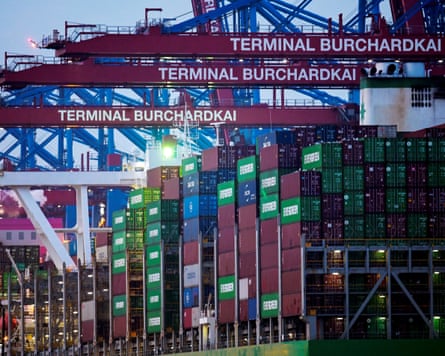
A Panama-flagged container ship is seen at the loading terminal “Burchardkai”, in the port of Hamburg, Germany
China’s surplus with Germany doubled between 2024 and 2025 from $12bn (£9bn) to $25bn. Photograph: Fabian Bimmer/Reuters

It comes amid a growing consensus that the Chinese export boom, which is underscored by Xi Jinping’s laser-focused five-year policy cycles, has triggered a second China shock that is putting industry and jobs at risk all over the world.

However, the CER said that in the EU, the shock was more consequential in Germany than any other country and was worsening.

Its report pointed out that Beijing was running a policy project, named “10,000 little giants”, that was specifically targeting Germany’s Mittelstand, the country’s ecosystem of middle-sized, innovative industrial suppliers and firms. Germany was described as “frantically searching for culprits” for its economic woes with high energy prices and bureaucracy dominating the political conversation, instead of China.

Germany’s failure to diagnose what was going on resembled the “phantom pain” of an amputee, the CER said, adding: “That missing limb is export demand, chopped off by China’s profound pressure on China’s industrial base.”

The root of the problem was ballooning Chinese exports around the world as imports into China declined, with the country reporting a record $1.2tn surplus in 2025.
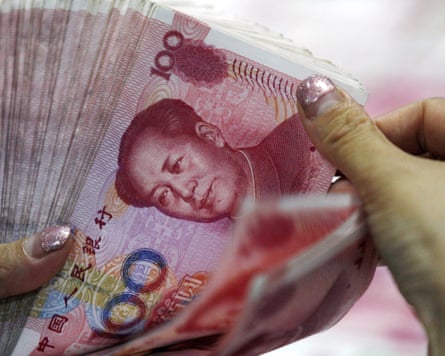
A bank clerk counts Chinese currency notes at a bank outlet in Huaibei in central China’s Anhui province
The CER blamed the economic imbalance on issues including the yuan being potentially undervalued against the euro by 40%. Photograph: AP

The CER blamed the economic imbalance on three issues: dampened domestic demand in China; an extremely unfavourable exchange rate, potentially undervaluing the yuan by 40% against the euro; and a Beijing policy that ruthlessly targeted Germany’s core industrial base.

The thinktank said political leaders needed to wake up: “Waiting for the shock to correct itself is not prudence, but a decision to let deindustrialisation run its course.”

It said the best option for Berlin was to go on the offensive “and support Paris in pushing the IMF and G7 to confront China’s currency undervaluation and one-sided trade model”.

Industrial leaders in Europe and China have told the Guardian of their fears that European industry was being cannibalised , while one leading German industrial said Europe might as well become “a province of China” such was the endemic damage.