






Israeli forces have been moving an agreed truce line in Gaza westwards over the six months since the ceasefire, expanding their zone of control and making the state of limbo ever more dangerous for Palestinians.
The “yellow line” agreed in the US-brokered ceasefire in October was supposed to be temporary pending further Israeli withdrawals, but the partially observed truce has stalled after its first phase amid disagreements over the disarming of Hamas, and continued Israeli bombardment of Gaza.
Since then, the yellow line has crept forward in several places, expanding the army-controlled area well beyond the 53% of Gaza territory implied in the original ceasefire maps. According to the research agency Forensic Architecture, by December Israel had taken 58% of the strip and continued to edge forwards.
The line is marked in some places by yellow concrete blocks, many of which were moved in December and January as the army took more territory, particularly in urban areas. All over Gaza, residents awoke to find the line had moved overnight and they were suddenly in a free-fire zone.
“The yellow line has advanced several times,” said Faiq al-Sakani, 37, in al-Tuffah. He said the line moved 100 metres in January, reaching al-Sanafour roundabout near the Salah al-Din road, the main route running north-south through the strip.
“During these advances, displaced people who had been staying near Salah al-Din Street were targeted,” he said. In recent days, he added, there had been a significant uptick in demolitions, excavations and new buildings by the army, along with constant heavy gunfire in the area.
The army has also extended a chain of earth berms – raised areas of land – along the line, dominating neighbourhoods and giving tank gunners and snipers a line of sight over large tracts of ruined Palestinian cities. More than 10 miles of berms have been erected already, according to Haaretz, mostly in the north, but bulldozers have started putting up new earthworks in Gaza City and Khan Younis.
Adding to the growing sense of permanence around the yellow line, the military has been building an expanding array of fortified outposts. Seven new concrete forts have been built in recent months, bringing the total across the strip to 32. All of the new construction has been along the yellow line.
As these physical markers have moved westwards, so too has an unmarked zone in which any Palestinian person or vehicle is considered a threat and a legitimate target.
Aid organisations working in Gaza said they were told by Israeli liaison officers that the edge of this zone was the “orange line” and they had to coordinate their operations with the military if they crossed it. But the orange line existed only on maps. It was never marked and its distance from the yellow line appears to vary from 200 to 500 metres, according to the Israeli army unit deployed there.
When the yellow line moves, many Palestinians find that rather than them crossing the orange line, the orange line has crossed them. The UN reported in March that it had been informed that the orange line had moved forward and 10 UN facilities were now on the wrong side of it, including emergency shelters for displaced people.
Ahmad Ibsais, a Palestinian-American legal scholar and commentator, argued that the real motive lurking behind the yellow line and all associated security arrangements was to drive out the Palestinian population. Writing on the website of Al-Shabaka, a thinktank, Ibsais described it as “a method of annexation deliberately designed to evade legal consequences”.
The Israel Defense Forces (IDF) have defended their actions along the yellow line by arguing that their soldiers have the right to protect themselves from perceived imminent threats in a tense environment.
“The IDF is working to visually mark the yellow line, in accordance with terrain conditions and the continuously updated operational assessment,” an Israeli military spokesperson said. “As part of these efforts, the IDF informs the local population in Gaza of the line’s location and works to mark it on the ground in order to reduce friction and prevent misunderstandings.
“The area adjacent to the yellow line is a sensitive and dangerous operational environment. Signs are posted in the area indicating that it is forbidden to approach it. It should be emphasised that the IDF does not operate against civilians and does not target civilians solely due to their proximity to the line.”
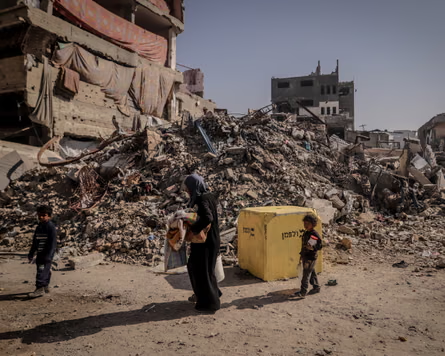
The claim that civilians have been killed when they were perceived as a threat to Israeli positions along the line has been rejected as a legal defence by the UN human rights commissioner, Volker Türk, who said this month: “Targeting civilians not taking direct part in hostilities is a war crime, regardless of their proximity to deployment lines.”
Of the more than 700 Palestinians killed by Israeli fire over the six months of the ceasefire, 269 were shot near the yellow line, according to UN data. Of these, more than 100 were children.
Duaa Taima, 29, who lives in an abandoned UN clinic in Jabaliya refugee camp 200 metres from the yellow line, said: “We live under continuous threat even after the ceasefire. There is continual random gunfire from the Israeli army and I hide with my children behind the cracked walls, searching for any kind of protection.”
When the ceasefire was initially declared, the demarcation line near Jabaliya and the neighbouring town of Beit Lahiya seemed distant, but Taima said in December it was much closer.
“That day was extremely difficult,” she said. “A large truck carrying the yellow concrete blocks arrived, accompanied by a crane to lift them, while Israeli military vehicles advanced, and heavy and direct gunfire began towards us.”
More recently, three connected berms have been erected along the yellow line by Beit Lahiya, forming a high barrier visible from miles around.
All along the yellow line, residents reported being afraid to leave their homes, under the constant watch of surveillance drones and the unpredictability of the Israeli security zone.
Rafiq Mustafa, 60, had thought his family home in Beit Lahiya was a safe distance from the yellow line until the yellow concrete markers appeared 200 metres away. “We would know the blocks were being moved by the sound of tank and bulldozer engines, accompanied by heavy and random gunfire,” Mustafa said. “We stayed inside the house, unable even to go up to the roof.”
He said: “Approaching the yellow line has become extremely dangerous. Anyone who gets near it, or even looks in its direction, is pursued by quadcopter drones, shot at, or arrested and interrogated by [Israeli-backed] militia groups.
“We only go out if it’s absolutely necessity now, and when we do, we go with extreme caution. We are afraid for ourselves and for our children. They no longer play in the streets.”