








The parliamentary inquiry into Peter Mandelson’s appointment as US ambassador has heard more than 77,000 words of evidence from five of the most senior officials and advisers in government. Yet, as MPs on the foreign affairs select committee meet this week to discuss next steps, there are concerns that key questions remain unanswered.
The committee’s investigation has been hampered by a lack of documentary evidence, amid concerns that the government is not adhering to the terms of a parliamentary motion that ordered the release of “all papers” relating to the appointment.
A source on the committee said MPs planned to meet on Tuesday, with options ranging from moving towards a preliminary set of conclusions to extending the inquiry to demand further answers from the Foreign Office.
Their deliberations come at a crucial moment for Keir Starmer. His decision to appoint Mandelson in December 2024 has cast a shadow over his premiership and led to repeated calls for his resignation. One of his potential rivals for the Labour leadership, Wes Streeting, who resigned as health secretary last week, also faces questions over his proximity to Mandelson. Streeting has previously said he was never a close friend of Mandelson.
There are concerns that any conclusions by the committee at this stage may be premature. The next tranche of Mandelson-related files to be released under the parliamentary motion, known as a humble address, are not expected until June.
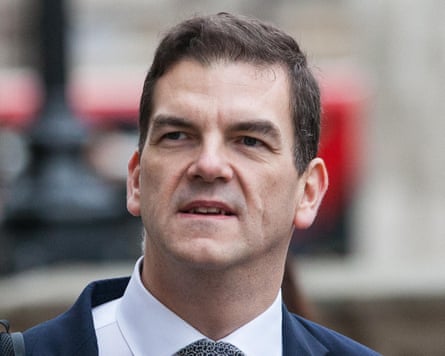
And there are a series of unanswered questions, in particular in relation to evidence given by Olly Robbins, a former permanent secretary at the Foreign Office, who granted Mandelson clearance and was later sacked by Starmer.
Oral briefings
The committee has so far focused on a decision taken by Robbins over a few hours in late January 2025.
Starmer had weeks earlier announced that Mandelson would be his pick for the top diplomatic role and Robbins and others have testified there was pressure from Downing Street to get the ambassador-designate out to Washington. Mandelson’s security vetting was presumed to be a formality.
Like almost everyone in the Foreign Office, even junior civil servants, Mandelson required “developed vetting” security clearance. The risk assessment was undertaken by UK Security Vetting (UKSV), an agency within the Cabinet Office, but the final decision rested with the Foreign Office.
After twice interviewing Mandelson and scrutinising his background, officials in UKSV completed their assessment on 28 January. A document summarising the agency’s findings and conclusions arrived at the Foreign Office via a “secure portal” the next day at 1.52pm.
UKSV assessed Mandelson to be a “high” overall concern and recommended clearance should be denied. But within hours, the Foreign Office had decided – against that advice – to grant Mandelson clearance, with mitigations.
One source of the foreign affairs select committee said the lack of transparency over Mandelson’s vetting had impeded MPs from interrogating the wisdom of Robbins’ decision. Committee members have not been told why UKSV regarded Mandelson as a national security risk or what mitigations were put in place.
It is unclear whether the next batch of documents due to be released by the humble address will contain the answers. On Friday the intelligence and security committee, a parliamentary group of MPs and peers that is reviewing the most sensitive Mandelson documents before their release under the humble address process, criticised the government for withholding Mandelson’s vetting file and applying redactions “far too broadly”.
Robbins, who as permanent secretary was the most senior civil servant in the Foreign Office, was ultimately responsible for granting Mandelson clearance. In his evidence, Robbins defended that decision but admitted to MPs that he did not read a UKSV document summarising Mandelson’s vetting file.
Instead of asking to see the document, which was said to be about 10 pages long, Robbins said he relied on an oral briefing on its contents provided by his security chief, Ian Collard, a career diplomat.
Collard did not give evidence but a letter submitted to the committee on his behalf by the foreign office revealed that he did not read the UKSV summary document either. Instead, he too relied on an oral briefing, from an unnamed official on his team.
The Foreign Office letter revealed the involvement of a third official: the department’s then chief operating officer, Corin Robertson. It said Collard discussed the UKSV’s findings with Robertson, who agreed that “the risks could be mitigated” and said Collard should take Mandelson’s case to Robbins for a “final decision”.
The committee is now considering whether to invite Robertson, who in August will take up a role as the UK’s ambassador to Japan, to give evidence.
Pressed over why he did not view the short UKSV summary document, Robbins said such files were highly sensitive and should remain in a “hermetically sealed box”.
It would require a “wholly exceptional circumstance” for him to review any such file, Robbins said. Emily Thornberry, the chair of the committee, asked Robbins: “This is a wholly exceptional circumstance, surely?” He responded: “No.”
The Guardian understands the document was marked “official – sensitive”, a routine classification for government documents and one that falls well short of “secret” or “top secret”, files to which access is highly restricted.
When Cat Little, the permanent secretary of the Cabinet Office, gave evidence to the same committee, she said “anyone within the security chain” can request to see such information “if they feel it is necessary.”
‘Borderline’ confusion
Another point of confusion arising from Robbins’ testimony was his widely reported claim that Mandelson’s case was less than straightforward.
Robbins told the committee that he was told that UKSV “considered Mandelson a borderline case” and was only “leaning towards” recommending that his clearance should be denied.
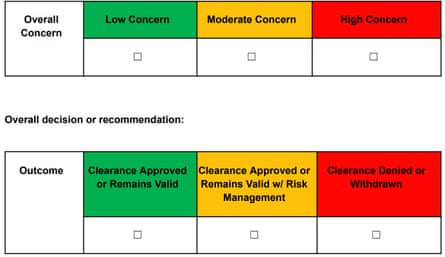
Members of the committee were confused by this claim. The agency’s conclusions were marked in two red boxes on the summary file, with ticks denoting Mandelson posed a “high” overall concern leading to a recommendation of “clearance denied”.
A template of the document, published by the Cabinet Office, suggests UKSV had an “amber” option of clearance approved with “risk management” but chose the more severe “clearance denied”.
MPs on the committee, who were reportedly briefed by the Cabinet Office about the summary document, repeatedly questioned Robbins on this point.
Since his testimony there have been no documents published that support the “borderline” claim. And no witnesses who have given evidence in the hearing – other than Collard – have used that word.
Starmer, who has seen the summary document, made no reference to the case being “borderline” when he updated the House of Commons about UKSV’s findings. Nor did Little, who has also seen the document, when she gave evidence to the committee.
Post-sacking
Despite having been adamant in his testimony that it would have been wrong for him to review Mandelson’s vetting file summary when he gave him clearance, Robbins told MPs he did ask to see the file seven months later.
Mandelson was withdrawn from the Washington embassy on 11 September 2025 after revelations about his relationship with the sex offender Jeffrey Epstein.
According to Robbins, it was around this time when queries were made on his behalf about whether he could see the document. The Cabinet Office did not think he should see it because he required a national security justification to do so, he told MPs.
Collard also asked to see the summary document around this time. Neither official has yet been asked to explain why they wanted to see Mandelson’s UKSV document after he’d lost his job.
The document was emailed to Collard’s team, according to Little, four days after Mandelson was sacked.
What happened next is one of the key mysteries the committee may now seek to resolve. The Foreign Office said that when Collard reviewed the document in mid-September 2025, the security chief took notes as an “aide memoire”.
He noted the tick boxes – “high concern” and “clearance denied”. But, the letter added: “He also noted that, as well as the tick boxes, UKSV stated in the final case assessment: ‘Overall, I believe that this is a very borderline case.’”
The committee may now seek clarification on this sentence. When Collard noted the reference to “a very borderline case”, was he referring to the official UKSV paperwork that he was viewing for the first time? If so, why have no other officials or ministers referenced a UKSV document of that kind when briefing parliament?
Alternatively, could it be that Collard, in September 2025, produced a record of something that he claims to have been told seven months earlier? So who exactly told Collard the case was “very borderline”, and when?
The Guardian asked those questions of the Foreign Office and Robbins. Neither provided any answers.