







The mounds of detritus pile up outside Finsbury Park station, like an offering to a vengeful deity. A deity gone rogue for the evening, demanding tribute specifically in the form of empty food cartons and abandoned Lime bikes. A deity that has finally decided to break the habit of 22 years.
They approach via the familiar sidestreets, Gillespie Road, Benwell Road, Hornsey Road, the little shortcut past The Plimsoll pub. The night is cool and calm and still, the air rumbling with adoration and freedom, the sensation of chains being broken. As they reach the stadium, perfect strangers grip each other by the shoulders, bound by shared memory, shared trauma, a shared hymnbook. What do you think of shit? Tottenham! Thank you. That’s all right! A firework is let off, and then another. People are FaceTiming their relatives. People are getting selfies with Ian Wright. The crowd is hundreds, and then thousands, a lawless melee that in classic Arteta-ball tradition features plenty of jostling but no free-kicks awarded. Meanwhile, in the digital wilds beyond, the celebration police have laid down their truncheons and riot shields.
Modern football loves nothing more than to divide its audience. Tiers of membership, tiers of pricing, tiers of devotion, tiers of worth. Red, silver, gold, platinum, hospitality. Local and foreign. And yet, here in the lit north London night, there are no partitions left. All the market segments have dissolved into a single human mass: just people in a place, desperate to seek out others, to see if everyone is feeling the way they’re feeling, communion as a form of verification.
What is Arsenal? Not really a place: the tube station is named after the team rather than a locality, rebranded in the 1930s at the request of Herbert Chapman, and in honour of the club rather than – as many Spurs fans have cheekily suggested – because otherwise people wouldn’t know where to get off. It draws its fanbase as readily from Ithaca and Indore as it does from Islington, from south London as much as north. Most of its players and staff live in the Hertfordshire commuter belt. It shares its city with at least half a dozen other perfectly competent clubs, many of which actively despise it.
Not really a way of playing, either. The Arsenals of 1980s George Graham and 1990s Arsène Wenger and 2010s Wenger and 2020s Mikel Arteta are all recognisably and authentically Arsenal, none a stylistic betrayal of the others. Besides, the best Arsenal teams have always combined a beatific smile with a ferocious bite. This is the club of Thierry Henry and Tony Adams, Liam Brady and Katie McCabe, Declan Rice and Pat Rice.
But of course any football club of Arsenal’s size and scale must embody an idea, a story, not just a crest and a list of achievements. In a sense the idea of Arsenal – you might even call it Arsenalism – reflects the idea of London more generally. A place constantly shifting and innovating, adding and shedding layers, plural and complex and multipolar and diverse, where all are welcome, where outsiders can be locals and vice versa. A place of metropolitan swagger and metropolitan angst, a melting pot of ideas as much as people. A lodestar. A sense of orientation in a landscape of dizzying, bewildering, often hostile change. A home to call one’s own.
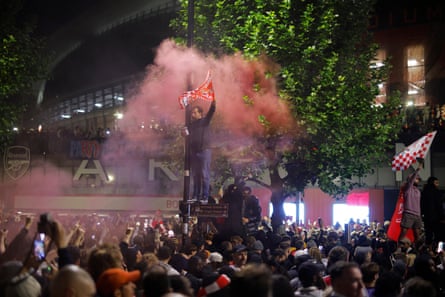
At times over the past few decades, it has felt increasingly hard to call this city one’s own. Tainted money sloshes through the gutters and sewers, luxury apartment blocks go up for nobody to live in, areas divide ever more starkly along lines of affluence, cherished cafes and businesses go under, longstanding residents get priced or Brexited out. Every state primary school in the borough of Islington is operating under capacity, according to the most recent available figures. Two were forced to close last summer.
Of course to a large extent this is the case in many places, a simple parable of Austerity Britain. But perhaps no other region (Liverpool, maybe) labours under a similar level of glassy-eyed condescension from the rest of the country. For a certain dimly unimaginative brand of right-wing provocateur, Islington has become a kind of slur, a shorthand for arrogance and elitism: the idea that this place with a 43% rate of child poverty and 40% of its residents in social housing is somehow ersatz, degenerate, fatally detached from authentic working-class sensibilities. Boris Johnson loved to throw “Islington” around as a taunt at Keir Starmer. Fun fact: Johnson lived in Islington for almost a decade.
So it is with Arsenal, who ever since the Chapman era have seemed to draw their strength in direct proportion to the level of vindictiveness they inspire. A lot of this is simply the back-and-forth nature of footballing tribalism. But some of it clearly goes a bit deeper, and often taps into a wider resentment of metropolitanism itself. They’re soft and lack character, but they’re also too physical and their coach is too assertive. They’re staid and boring, but also overly melodramatic. They celebrate too much. They’re too online. They insist on themselves.
For much of the past 22 years to be an Arsenal fan or even a player has been essentially to exist at a unique locus of ridicule, distrust, dislocation and cultural antipathy. Fearful of the future, getting eternally spanked by Manchester City and Bayern Munich in the present, and thus more inclined than most to take solace in the past. It’s incredible how many 1990s-era shirts you see on young Arsenal fans these days: a tribute to an era they do not remember, branded with the logo of JVC, an electronics company defunct since 2008.
Or take the pre-match anthem The Angel (North London Forever) by Louis Dunford, hand-picked by Arteta to play at home games since 2022. Beyond its stirring chorus, North London Forever is really a tale of ingrained decline, with its lyrics about “guvnors” and “geezers” and childhood homes being torn down and skyscrapers going up: a longing paean to an imagined past, a nostalgia trip for lads in their 20s.
How does this play out in footballing terms? Perhaps, in a world desperate to see you bottle and break, where the walls are caving in on all sides, you fight for your turf. You cling a little tighter to home. This will be your place of safety and sanctuary, your vigilant rest defence. One-nil, Gabriel from a set piece. Declan Rice plugging all the gaps. Control of the ball and control of the situation. You protect what you have at all costs. Does this mean you can’t innovate and express yourself, blow close to £1bn on players? Of course not. This is London, you can do both. And perhaps this too feels pleasingly nostalgic, a throwback to an era you do not remember, when Arsenal were mean and hungry and hated.
This is not guaranteed to work. It will not protect you against fate, ridicule, springtime Guardiola, Emi Buendía smashing one in the last minute. It will not protect you against the crying laughing emojis piling up in your WhatsApp groups. It will not protect you against the doubts that gnaw away in your darkest moments: that you are not special, that this club is at heart like all the others, a capitalistic enterprise built to sell sportswear. That this is the club of Visit Rwanda and Thomas Partey. That City will find a way again.
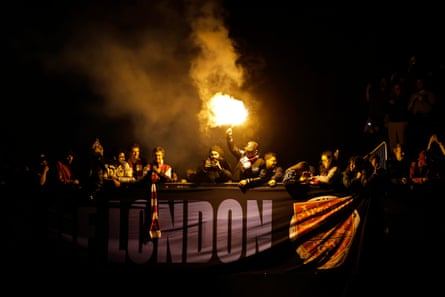
So do you retreat from the space or fight for it? Fight for the sense of belonging and community it provides? Fight for these players who you love, for a club that is not the most successful and not the least successful, but above all a way of being, a ritual and tradition, a form of expression, a home for the homeless?
The city can be a cruel and alienating place, full of the furious and lonely and disconnected. But here, for a fleeting few hours, all the nodes are connected again. It doesn’t matter whether you flew in from a different continent or trudged down the street in your pyjamas. What else, other than football, can do this to people? Then once more there is a cheer and a song and the fireworks splatter across the night sky, a roof over everyone’s heads.