


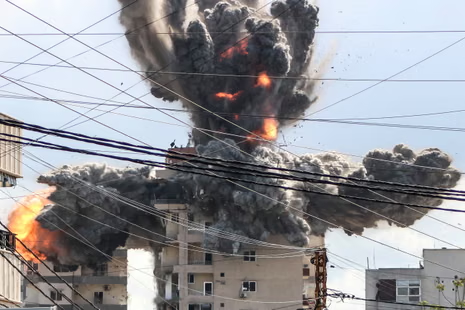
Shortly after 2pm on 8 April, it seemed that Beirut was hit by an earthquake. Within 10 minutes, multiple apartment buildings were obliterated, leaving in their wake mounds of rubble and shattered glass, pulverized concrete and twisted metal – and hundreds of dead and wounded bodies.
In those minutes, Israel had carried out one of the worst mass killings in Lebanon’s history. Dozens of Israeli warplanes dropped bombs and missiles on 100 targets across a country roughly the size of Connecticut, striking Beirut, the Bekaa valley and southern Lebanon. By the time rescue crews finished digging out mangled remains from the rubble two days later, the Lebanese health ministry’s toll stood at 357 dead and more than 1,200 injured. But even that is not a final accounting of the day’s casualties because health officials were still struggling to identify remains and conduct DNA tests.
The Israeli military said it had targeted Hezbollah “command centers” and other military infrastructure, eventually claiming to have killed more than 250 Hezbollah “operatives and commanders” without offering evidence. The attacks hit some of Beirut’s busiest commercial streets and residential neighborhoods, including a building that houses one of the city’s best known nut roasteries. The Israeli military named its bombing campaign Operation Eternal Darkness. The Lebanese called it Black Wednesday.
The 10 minutes of destruction and terror that enveloped Beirut and other parts of Lebanon came hours after a ceasefire took effect in the joint US-Israel war on Iran – a truce that was finally extended to Lebanon last week (though the bombing continues at a lower pace). Despite the ceasefire, the Israeli military is occupying more than 50 towns in southern Lebanon and has been razing entire villages to render them uninhabitable.
Is this what war looks like now? Our world has changed over the past two and half years. In the weeks after the Hamas attacks of 7 October 2023, Israel set in motion a machinery of genocide – largely enabled by unwavering US support and powered by impunity and denial – against Gaza, unleashing one of the most destructive military campaigns targeting civilians in modern times. Israel has repeated the Gaza playbook in its war on Lebanon: intense aerial bombardment and illegal mass evacuation orders that lead to the large-scale displacement of civilians; the destruction of civilian infrastructure and border towns to make way for so-called “buffer zones” occupied by Israeli troops; the targeting of hospitals and healthcare workers; and the killing of journalists. And, as it did with Gaza, the west largely looks on with indifference.
Gaza represents a new pinnacle for this type of wholesale destruction as a military strategy, of using overwhelming and disproportionate force against civilians and infrastructure. But the seed of this strategy was planted two decades ago – in a previous Israeli war on Lebanon. That war resulted in Israel’s Dahiyeh doctrine, which calls for the deliberate targeting of civilians and infrastructure as a means of collective punishment that seeks to turn local populations against armed militias. That doctrine played out in full force in Lebanon – and also has made multiple rhetorical appearances in Donald Trump’s threats to destroy societies and civilizations on a large scale.
As long as this impunity continues, this playbook will repeat itself, constituting a new normal where the eradication of infrastructure, agriculture, cities and towns fit for habitation and entire cultures, is acceptable to much of the world as a method of war. The west’s dehumanization of Palestinians – and Lebanese, Iranians and others – has also made it possible for the aggressors to keep committing more abhorrent acts of violence.
The day before Israel unleashed its fury on Lebanon, the US president famously wrote on social media that “a whole civilization will die tonight, never to be brought back again”. Trump’s apocalyptic warning that he would obliterate Iran was the culmination of a series of threats he had made against the Iranian regime in his efforts to get it to reopen the strait of Hormuz. Even after agreeing to a ceasefire and sending US officials to meet with Iranian leaders in Pakistan, Trump continued threatening to blow up Iran’s bridges, power plants and other civilian infrastructure.
Trump’s threat on 7 April to commit genocide – or at least large-scale war crimes against a country of 90 million people – shocked the world, but it too was a logical extension of a new global order that the US and other western powers enabled by allowing Israel to carry out its genocide in Gaza. There may be little hope in the near term that Washington will respect international law and change course on providing Israel with political cover and billions of dollars a year in US weapons that enable it to commit new atrocities. But recent history in the Middle East makes clear that war crimes will only get more horrific if the world doesn’t act to rein in the perpetrators and enablers.
When I first heard news of the attacks on 8 April, I made a round of WhatsApp and phone calls to check on family and friends across Beirut, as I’ve done countless times over the past two years. I reached my sister, who had been hopeful about a ceasefire the previous night. She was deeply rattled. She had gone out to meet her son for lunch, and had walked past the Rifai roastery on Corniche al-Mazraa about an hour before it was bombed. She was wondering where she should spend the night. “No place in Beirut feels safe right now,” she said.
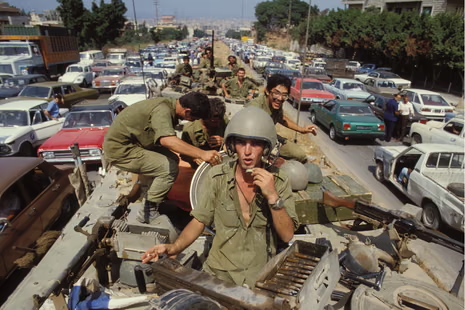
I sensed in her voice the fear and anxiety I’ve heard many times over the years, bookends to decades of Lebanon’s suffering and relentless political upheaval: the 1982 Israeli invasion; the 15-year civil war, which ended in 1990; the 2005 assassination of Lebanon’s former prime minister, Rafik Hariri, in a bombing in downtown Beirut; the Israel-Hezbollah war of 2006; the Beirut port explosion in the summer of 2020; and Israel’s last war against Lebanon in the fall of 2024.
I spoke to one of my cousins, Hussein, who had been displaced from his apartment in Dahiyeh, the southern suburbs of Beirut that are predominately made up of Shia Muslims, the group from which Hezbollah draws its base of support. The Dahiyeh is often described in western media as a “Hezbollah stronghold”, a euphemism (and lazy journalistic shorthand) that Israel uses to justify bombing and displacing densely packed neighborhoods with hundreds of thousands of residents, many of whom have no connection to Hezbollah. He was out buying bread in Hamra, one of the city’s busiest neighborhoods, when the Israeli attacks unfolded. The streets shook from two loud explosions, bombs that hit adjacent areas. “People started screaming and running in different directions,” he told me.
Hussein grabbed his bread and rushed to the small apartment where he had been staying with his family. As we talked, I could hear ambulance sirens in the background. Hussein told me dozens of ambulances had passed by that afternoon on their way to two nearby hospitals. Not surprisingly, considering the scale and intensity of attacks that unfolded over 10 minutes, Beirut’s hospitals were overwhelmed with hundreds of casualties and they put out calls for blood donations on social media.
“Now that Israel isn’t sending its warplanes to bomb Iran, they have a lot of extra time to bomb us,” Hussein said. He also wondered why the Israeli military had not issued evacuation warnings to the targeted buildings and neighborhoods in central Beirut, as it had done before.
We both agreed that, as much devastation as Israel had produced within minutes, the attack was also intended to spread fear and panic – and to make Lebanese think that everywhere is a potential target – just as Israel had done on a far larger scale in Gaza for more than two years.
Inevitably, our conversation turned to US support for Israel. The 50 or so warplanes that rained destruction across Lebanon that day were dispatched by the Israeli prime minister, Benjamin Netanyahu, but they couldn’t have taken off without decades of military assistance from successive American administrations, led by both Democrats and Republicans. These were US-made fighter jets that dropped largely US-made bombs. Israel would not be able to keep up its attacks on Gaza, Lebanon, Iran (or the three other countries it bombed last year) without tens of billions of dollars in US weapons and jet fuel – virtually unlimited aid that accelerated under Joe Biden and continued under Trump.
My cousin asked if Americans realized what was happening in Lebanon, and whether I thought Trump would force Netanyahu to abide by the US-Iran ceasefire. I didn’t know what to say.
After Israel launched a full-scale invasion of Lebanon in 1982, Hezbollah emerged as a militia to fight the subsequent Israeli occupation of the south. Iran’s Revolutionary Guards helped create Hezbollah – and since then it has received enormous military and financial support from Iran, with some US officials estimating that Iran sent $1bn to the group last year.
When Hezbollah’s guerrilla war put pressure on Israel to withdraw from southern Lebanon in 2000, the group accomplished what no Arab military had done: it had forced Israel to give up occupied land without a peace agreement. With a weak Lebanese government, Hezbollah quickly moved into the vacuum in the south, opening schools and hospitals, setting up charities and winning municipal elections.
In July 2006, Hezbollah carried out a cross-border attack and abducted two Israeli soldiers, hoping to exchange them for Lebanese prisoners held by Israel. That instigated a 34-day war in which Israel destroyed large parts of southern Lebanon and Beirut’s southern suburbs, collectively called the Dahiyeh. The Israeli military crippled Lebanon’s infrastructure, bombing bridges, power plants, sewage treatment plants, hospitals, ports and Beirut’s airport. Israel also imposed an air and sea blockade on Lebanon – all with support from George W Bush and his administration. The US administration helped prolong the war for weeks and blocked several ceasefire resolutions at the UN security council, arguing it would be premature for Israel to end its assault on Lebanon before inflicting more damage on Hezbollah. At one point, Bush’s secretary of state, Condoleezza Rice, described the war as “birth pangs of a new Middle East”.
That war 20 years ago – with its full-throated American backing and methods of total destruction – paved the way for Israel’s subsequent wars on Gaza (in 2008, 2012, 2014 and 2021), and eventually the total siege, mass starvation and genocide that Israel unleashed after 2023.
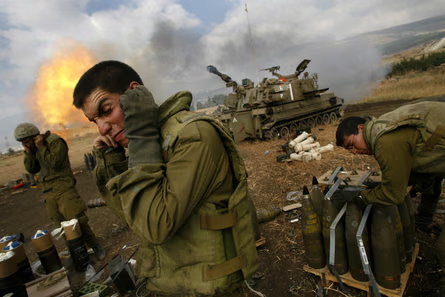
The Dahiyeh doctrine was articulated in that war on Hezbollah. The strategy calls for the deliberate targeting of civilian infrastructure and civilians – and the use of disproportionate force in Israel’s military campaigns. Gadi Eisenkot, head of the army’s northern command during the 2006 war, explained the doctrine in chilling terms two years later. “What happened in the Dahiyeh quarter of Beirut in 2006 will happen in every village from which Israel is fired on,” he told the newspaper Yedioth Ahronoth, describing Israeli strategy during any future war with Hezbollah. “We will apply disproportionate force on it and cause great damage and destruction there. From our standpoint, these are not civilian villages, they are military bases.” And in case anyone doubted that this was Israel’s official policy, Eisenkot added: “This is not a recommendation. This is a plan. And it has been approved.”
In other words, Israel built its military doctrine on the use of disproportionate force, collective punishment and destroying civilian infrastructure – all acts that constitute war crimes prohibited by international humanitarian law.
Israel’s thinktanks and other parts of its security establishment set to work on creating justifications for its illegal and immoral policy. In October 2008, Gabi Siboni, a director at the Institute for National Security Studies at Tel Aviv University and a former military officer, wrote a paper arguing that Israel must use overwhelming force and target infrastructure so that Lebanon and Israel’s other enemies get bogged down for years rebuilding their shattered countries. “Such a response aims at inflicting damage and meting out punishment to an extent that will demand long and expensive reconstruction processes,” he wrote, justifying the strategy as a way to ensure Israel’s “long term deterrence”. Siboni also argued that Israel should apply the same doctrine in Gaza.
Of course, history is full of examples of dominant military powers deploying overwhelming force to quell insurgencies – from Algeria to Vietnam to Iraq – only to fail in suppressing long-term threats. But the Dahiyeh doctrine took hold in Israel, and its proponents gained prominence and power. Eisenkot went on to serve as chief of staff of the Israeli military until he retired in 2019, and was appointed by Netanyahu to Israel’s emergency war cabinet after the 2023 Hamas attack.
The kind of erasure invoked by Trump’s threat to obliterate Iran is hard to comprehend, even amid war. But there is a through-line from the Dahiyeh, via Gaza.
In 2006, I lived in Beirut and worked for a US newspaper. About two weeks into the war, I got a call from a Lebanese journalist friend, telling me that Hezbollah was planning to take local and foreign journalists on a tour of Haret Hreik, one of the hardest-hit neighborhoods in the Dahiyeh.
It was hard to absorb the scope of devastation. Dozens of buildings had been reduced to chunks of concrete rubble. Many others had their sides sheared off, exposing their insides. Streets were piled with giant pieces of concrete, broken glass and wooden beams. Electrical wires were hanging everywhere, and everything was coated with a chalky gray dust. Stray cats picked through the ruins.
We walked through streets that I had visited many times, but I hardly recognized them because most of the storefronts, buildings and street life that situate us into a familiar place – and give it texture and meaning – had been erased.
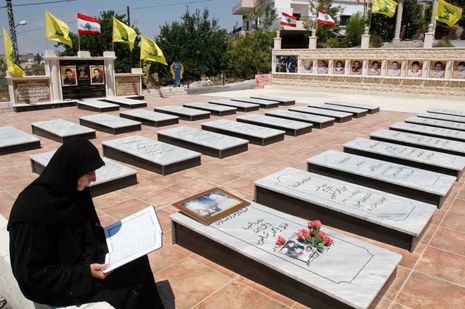
After the 2006 war, Israel and Hezbollah had occasional cross-border skirmishes but a detente largely held until October 2023, when Hamas attacked Israel. The next day, Hezbollah began firing rockets and drones into northern Israel. It was perhaps the biggest miscalculation by the group’s longtime leader, Hassan Nasrallah, who portrayed it as the opening of a “support front” that would divert Israeli military resources from Gaza. Israel escalated quickly, carrying out heavy airstrikes and shelling across southern Lebanon and the Bekaa valley. It also killed dozens of Hezbollah members and commanders throughout Lebanon.
Israel argued that it could not live with the threat of sustained Hezbollah rocket fire against it, which had displaced about 60,000 residents of northern Israel. Netanyahu’s government eventually expanded its war objectives to include the return of Israelis to their homes in the north and the destruction of Hezbollah.
Nasrallah was the de facto leader of the Iran-backed “axis of resistance”, a network of regional militias that includes Hamas, Hezbollah, the Houthis in Yemen and several Shia factions in Iraq and Syria. He had entered the conflict hesitantly, but insisted Hezbollah would end its attacks only when Israel stopped its war on Gaza. Yet Nasrallah misjudged the new world order that was emerging out of the genocide in Gaza, and how far an emboldened Israel would be willing to go. The Hezbollah leader was perhaps lulled into a false sense that Biden would restrain Israel from violating one of the few supposed “red lines” imposed by the US administration: keeping the war contained in Gaza and preventing it from spreading to Lebanon and other parts of the Middle East.
But Netanyahu had paid no price for his obstinance in prolonging the Gaza war and he wanted to unleash a more destructive regional conflict. He saw his opportunity in Lebanon, with a particularly insidious attack that spread a kind of terror that Lebanese had never experienced before.
On 17 September 2024, thousands of small bombs started going off across Lebanon. They detonated in grocery stores, cafes, banks, barber shops and hospitals. Over two days, Israel remotely blew up thousands of rigged pagers and walkie-talkies used by Hezbollah, killing dozens and wounding more than 3,000 people. For weeks afterward, Lebanon’s hospitals were overwhelmed with thousands of victims. “Some of the patients, we had to remove both eyes. It kills me,” Dr Elias Warrak, an ophthalmologist who was working at a Beirut hospital told the BBC. In his 25 years of practice, Warrak said he had “never removed as many eyes” in a single day.
But aside from fleeting coverage of the horror inflected on an already traumatized Lebanese society, many western media outlets and experts marveled at Israel’s ingenuity and technological prowess – comparing the attack to a plot pulled out of a James Bond thriller or a dystopian movie.
What if Russia had carried out such an attack in Ukraine, targeting the radios of Ukrainian soldiers but also killing and maiming bystanders, including children? Or if Hezbollah had managed to execute a similarly sophisticated attack inside Israel? How quickly would US and western politicians and media denounce these bombings for what they are: acts of terrorism? (While Russia, for example, has employed similar methods of total destruction to parts of eastern Ukraine, western condemnation is plentiful.)
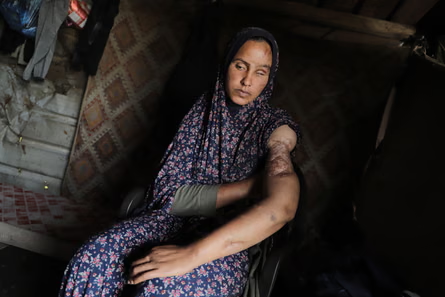
Israel also likely committed a war crime: international law forbids the use of booby traps, especially of objects that are used by civilians. By not knowing who was handling the devices and detonating them all at once, Israel could not distinguish whether they were being used at the time by Hezbollah combatants or civilians. The group later said that it had issued pagers not only to its fighters but to civilian workers. Like other factions in Lebanon, Hezbollah runs a broad social-service network, much of it focused on the Shia community, including hospitals, schools and supermarkets.
On the day of the first explosions, I called my cousin Hussein who had not yet been displaced at that point. He and his family lived in Haret Hreik, where many of the explosions took place. He too reached for a Hollywood-esque reference to try to make sense of it all, but a different one from the western analysts and media outlets that were celebrating the Mossad’s cunning. “It’s like watching a horror movie. Your mind can’t absorb this kind of fear and terror,” he told me.
When I called him the next day, after the walkie-talkie attacks, he had disconnected the batteries connected to the rooftop solar panels that powered his apartment. He was sitting in the dark with his family, after hearing rumors that solar-powered batteries had also exploded. Any device connected to the internet, or that could receive a radio signal, had become a potential instrument of death. “What can we do?” asked my cousin, who has an engineering degree. “We don’t know what to believe anymore.”
The pager attacks turned out to be the opening salvo of a large-scale war on Lebanon. On 23 September 2024, Israel bombed nearly 1,600 targets across Lebanon, killing more than 550 people. It was an aerial bombardment with little precedent in the 21st century – and that single day’s casualty count was nearly half of the entire Lebanese death toll during the month-long war in 2006.
Over two months, Israel deployed a combination of its Dahiyeh and Gaza playbooks: it displaced more than 1 million people, destroyed infrastructure and housing, and caused $11bn in economic damage to Lebanon. Israel also assassinated Nasrallah and most of Hezbollah’s top leaders. The Biden administration, which continued its flow of weapons to Israel throughout the war, eventually persuaded Netanyahu to accept a ceasefire in late November 2024. But Israel continued near-daily attacks especially in southern Lebanon, arguing that the Lebanese army had failed to disarm Hezbollah.
On 2 March of this year, two days after the US and Israel launched their war against Iran and assassinated its supreme leader, Hezbollah fired a volley of rockets at northern Israel. That reignited the war, with Israel carrying out massive airstrikes and forcibly displacing more than 1.1 million Lebanese from their homes. Israel also launched another invasion of southern Lebanon, pledging to clear frontline villages of their inhabitants and establish a new “security zone” that would be devoid of people and occupied by Israeli troops.
In this latest invasion, Israeli leaders no longer threatened to punish Lebanon with the Dahiyeh doctrine. They started invoking a worse fate: Gaza. The defense minister, Israel Katz, recently said his forces would destroy “all houses” in Lebanese border villages “in accordance with the model used in Rafah and Beit Hanoun”.
With no one to stop Israel from systemically destroying housing in Gaza’s largest towns and cities, rendering many of them uninhabitable, what’s to prevent it from doing the same in southern Lebanon?
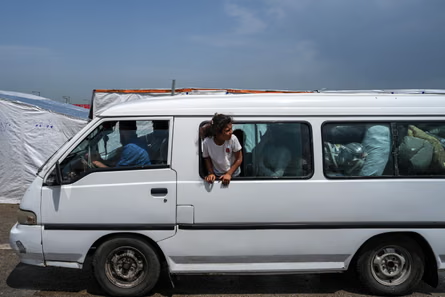
Late last week, as the shaky ceasefire took hold, Israeli leaders continued to insist that they will hold territory up to six miles deep they’ve occupied in southern Lebanon over the past few weeks. Katz said Israeli forces would create a new zone that “has been cleared of terrorists and weaponry and is empty of residents”. After the ceasefire took effect, the Israeli military continued its systematic demolition of homes, schools and other public buildings in Lebanese villages – reportedly using private contractors who are being paid based on the number of structures they destroy.
This, too, has precedent. Six months after a ceasefire in Gaza, Israel continues to occupy more than half of the territory as a “buffer zone” – one that has also been cleared of its inhabitants and where most housing has been demolished.
The world has largely moved on from Gaza. While US and western public opinion on Israel has dramatically shifted against it, there’s been no meaningful accountability, leaving the path wide open for the lawless new order that Trump and Israel are pursuing.
-
Mohamad Bazzi is director of the Hagop Kevorkian Center for Near Eastern Studies and a journalism professor at New York University. He is the former Middle East bureau chief at Newsday