


They can already carry the shopping, cook and clean. Now they can run and win half marathons.
In perhaps the most unusual spectacle ever seen at the end of the 13.1-mile (21.1km) race, robots flew over the finish line ahead of the humans for the first time in Beijing on Sunday. And there wasn’t a bead of sweat in sight.
While the living, breathing humans collapsed in a familiar heap on the ground, red-faced, clad in silver foil blankets and fantasising about a long lunch, the humanoids stood tall and unscathed. Some even seemed slightly bored, exchanging looks as if to say: “Shall we go again?”
The machine that won the race in Beijing also eclipsed the human world record, set last month.
Lightning, made by Honor, a Chinese smartphone maker, completed the half marathon in 50min 26sec, according to a WeChat post by the Beijing Economic-Technological Development Area, also known as E-Town, where the race kicked off.
That was several minutes faster than the human world record-holder, Uganda’s Jacob Kiplimo, who finished the same distance in 57min 20sec in March in Lisbon.
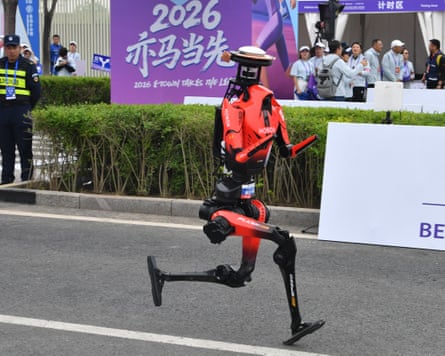
The performance by the robot marked a significant improvement from last year’s inaugural race, during which the winning humanoid finished in 2hr 40min 42sec, more than double the time of the human winner of the conventional race. Most robots were unable to finish.
This year, several robots were faster than the professional athletes. And nearly half of them navigated the race autonomously instead of being directed by remote control. The humanoids and the 12,000 human men and women ran in parallel tracks to avoid collisions.
Robots from Honor, a Huawei spin-off, took the three podium spots, all self-navigated and posting world record-beating times.
Du Xiaodi, an engineer on the winning team, said Lightning had been in development for a year. The robot was fitted with legs 90 to 95cm (35 to 37 inches) long to mimic the world’s top human runners, and used liquid cooling technology adapted from its smartphones.
Du said the sector remained in an early phase, but he was confident humanoids would eventually reshape many industries, including manufacturing. “Running faster may not seem meaningful at first, but it enables technology transfer, for example, into structural reliability and cooling, and eventually industrial applications,” he said.
It will take time to achieve widespread use of robots, but spectators were impressed. Sun Zhigang, who was in the audience last year, watched Sunday’s race with his son.
“I feel enormous changes this year,” Sun told the Associated Press. “It’s the first time robots have surpassed humans, and that’s something I never imagined.”
Wang Wen, who came with his family, said robots appeared to have stolen much of the spotlight from human runners in the event. “The robots’ speed far exceeds that of humans,” he said. “This may signal the arrival of sort of a new era.”
Indeed, humans who have spent months pounding the pavements preparing for next Sunday’s London Marathon would be forgiven for feeling disheartened by the sudden emergence of robot rivals.
There may be a slight crumb of comfort in the fact that the robots’ success in Beijing wasn’t entirely without hiccups – one of them fell flat at the start line and another bumped into a barrier.
此内容由惯性聚合(RSS阅读器)自动聚合整理,仅供阅读参考。 原文来自 — 版权归原作者所有。