







The United Arab Emirates’ ruling royal family is benefiting from tens of millions in EU subsidies to grow crops destined for the Gulf, it can be revealed.
A cross-border investigation by DeSmog and shared with the Guardian found subsidiaries controlled by the Al Nahyans collected more than €71m (£61m) in six years for farmland it controls in Romania, Italy and Spain.
The Al Nahyan family is the second richest in the world, with an estimated wealth of more than $320bn (£235bn), mostly derived from the Emirates’ vast oil reserves.
Subsidies under the common agricultural policy (Cap) make up a third of the EU’s entire budget, paying out about €54bn each year to farmers and rural areas across the bloc.
But an unknown proportion of this ends up in the hands of foreign investors – including those controlled by autocratic states.
DeSmog, in partnership with Spain’s El Diario and Romanian news outlet G4Media, reviewed data for thousands of Cap beneficiaries between 2019 and 2024, tracing 110 European subsidy payments to a network of companies and subsidiaries controlled by the UAE’s Al Nahyan family and one of its sovereign wealth funds, ADQ.
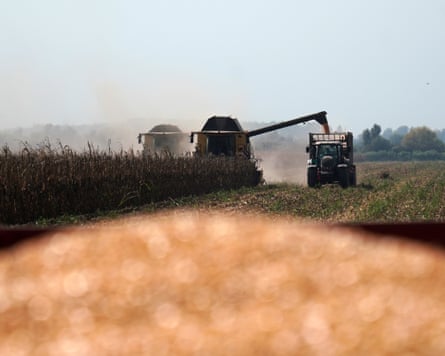
The largest of these payments came through the Romanian agricultural company Agricost, which owns the EU’s single largest farm, measuring 57,000 hectares (141,000 acres), five times the size of Paris.
EU farm subsidies disproportionately benefit large landowners – a 2024 Guardian investigation found that just 17 billionaires received more than €3bn between 2018 and 2021. In 2024 alone, Agricost received €10.5m in direct payments – more than 1,600 times the amount collected by the average EU farm.
Campaigners have expressed alarm that the UAE, which has been widely condemned for jailing activists, criminalising homosexuality and multiple allegations of torture – repeatedly denied by the UAE – benefits from regular EU farm payouts.
The Al Nahyans and companies named in this article did not respond to several requests for comment. ADQ declined to comment.
The findings come as policymakers debate the future of the subsidy scheme. In July 2025, the European Commission published a proposal for the next round of Cap payments for 2028 to 2034, which could cap land-based payments to €100,000 per farmer each year.
A spokesperson for the European Commission said it believed income support through Cap payments “should be better targeted including by reducing and capping payments for the bigger farms”, and is calling on the European parliament and Council to support its proposed changes to the subsidy scheme.
“The Cap is not helping EU farmers; it continues to enrich the wealthiest landowners,” said Faustine Bas-Defossez, director for nature, health and environment at the advocacy group the European Environment Bureau. “And now, even worse, it is fuelling autocratic regimes.”
The Al Nahyans are the most powerful monarchy in the AE, which is made up of seven federated states, each with its own royal family. At the helm is Sheikh Mohamed bin Zayed Al Nahyan, leader of Abu Dhabi and president of the UAE.
In just over 15 years, the Emirati dynasty has established itself as a major global agricultural player, acquiring swathes of land and agribusiness companies across Africa, South America and Europe. The UAE now controls about 960,000 hectaresof farmland worldwide.
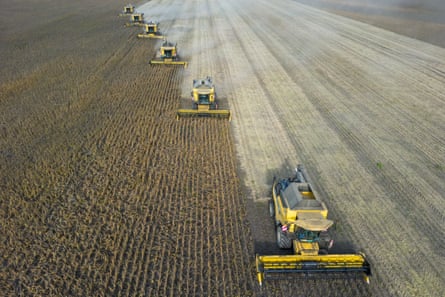
This expansion forms part of the Emirates’ wider food security strategy, aimed at securing supplies for a country where high temperatures, water scarcity and sandy soil make growing crops a challenge. The UAE currently imports up to 90% of its food.
The investigation found that in the EU, the expansion has been channelled through three main companies in Spain, Italy and Romania.
Agricost, Romania’s vast farm, was bought by the Al Nahyans in 2018 for an estimated €230m through Al Dahra, the UAE agribusiness group. Al Dahra was founded by the president’s brother, Sheikh Hamdan bin Zayed Al Nahyan, before Abu Dhabi’s sovereign wealth fund, ADQ, bought 50% of the company in 2020.
No information on Al Dahra’s current ownership structure is publicly available, but DeSmog understands it remains linked to individuals on the board, which is chaired by Sheikh Hamdan bin Zayed, and his son, Sheikh Zayed bin Hamdan Al Nahyan, who is married to the UAE president’s daughter.
Since 2012, Al Dahra has also acquired multiple farm companies in Spain, responsible for more than 8,000 hectares of land. Together, these received more than €5m in Cap subsidies between 2015 and 2024, DeSmog found.
The UAE’s Spanish and Romanian farms both cultivate alfalfa and other crops for animal feed, with the majority of produce designed for export, including to the Gulf. Al Dahra holds a long-term contract with the UAE government to supply animal feed for the country, partly used for its rapidly growing dairy sector.
In 2022, ADQ also bought Unifrutti, a fresh fruit producer with an estimated worth of $830m. According to DeSmog’s analysis, Unifrutti’s Italian farms received at least €186,000 in Cap subsidies in the three years after the sale.
The size of payouts to the UAE reflects significant issues with the way Cap subsidies are calculated, which are largely based on the area of land farmed. The European Commission’s proposal to cap direct payments would impact only a fraction (0.5%) of the EU’s top landowners, who now capture 16% of the entire Cap budget.
The UAE’s receipt of EU subsidies is “a scandal hiding in plain sight”, said Thomas Waitz, an Austrian Green party MEP and party coordinator for the agriculture committee.
“Ninety-nine percent of real European farmers receive less than €100,000 in subsidies. That money was never meant for fossil fuel dynasties, it’s meant to strengthen real European farmers.”
The subsidised farms make up just one strand of Al Dahra and ADQ’s agricultural push in Europe – an expansion which includes grain mills in Greece and Bulgaria, as well as massive dairy farms in Serbia.
Despite technically being state-owned, ADQ is closely controlled by the UAE’s ruling royal family, experts say.
“There is no clear boundary between the state and family coffers,” Marc Valeri, associate professor in political economy of the Middle East at Exeter University, said. “This is a very authoritarian and repressive regime, so the difference between state budgets and family budgets is completely blurred.”
The UAE has some of the largest sovereign assets in the world – as of 2025 its seven wealth funds hold almost $2.5tn.
These assets are largely managed by close relatives of the president. Between 2023 and January 2026, ADQ was chaired by Sheikh Tahnoon bin Zayed Al Nahyan, the president’s brother and the country’s national security adviser.
Since January, ADQ has become part of Abu Dhabi’s newest sovereign wealth fund, L’imad Holding, chaired by the crown prince, Sheikh Khaled bin Mohamed bin Zayed Al Nahyan, the president’s eldest son and likely successor.
The subsidies traced by DeSmog may provide just a snapshot of the total EU payments benefiting Gulf royals, due to patchy official data and a lack of transparency by UAE corporations.
All EU countries are required to publish information on the farms and farm owners receiving Cap subsidies.
However, the entries only name the direct recipient, making it difficult or sometimes impossible to identify the ultimate owners and investors benefiting from the funds.
Unifrutti, for example, owns farms in Sicily and the Almeria region of Spain, but no information about the subsidies received by these companies could be found.
Additional reporting by Pol Pareja and Alina Mihai