











The world is threatened by a “suicidal” model of capitalism that is leading to war, fascism and the potential extinction of humanity, Colombia’s president has said, as he convened 57 governments to address the climate crisis.
Gustavo Petro blamed fossil fuel interests for taking ever more desperate measures to prevent a transition to green energy. “There is inertia in the power and the economy of this archaic form of energy – fossil fuels – that lead to death. Undoubtedly, that form of capital can commit suicide, taking with it humanity and [other] life,” he said. “The question that needs to be asked is whether capitalism can truly adapt to a non-fossil energy model.”
Colombians will head to the polls next month to elect a new leader, with Petro, who was elected the country’s first leftist president in 2022, barred by the constitution from seeking a second consecutive term. The former economist and guerrilla member said the world was in a perilous position: “We are heading towards barbarism. And barbarism is the prelude to, or the very essence of, fascism.”
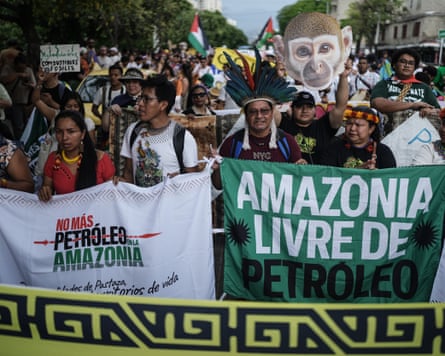
In the coastal city of Santa Marta, Colombia is hosting the world’s first conference on transitioning away from fossil fuels. Two days of talks among government ministers and high-level officials began on Tuesday, preceded by four days of civil society discussions and academic workshops.
Some countries have already started working on roadmaps to phase out fossil fuels. Colombia published its draft plan last week and, on Tuesday, France became the first developed country to release a national roadmap to phase out fossil fuels, which included a timetable to remove coal from its national grid by 2027, end oil dependency by 2045 and fossil gas by 2050.
Benoit Faraco, the French climate envoy, said it went further than the country’s national plan under the Paris agreement. For decades, nuclear power has supplied most of France’s electricity and this will be supplemented by an increase in renewables. “This process has made us realise we want to be an electro-superpower,” said Faraco. “We want to be the electricity Saudi Arabia of Europe, selling green electrons to the UK, Ireland, Germany and other countries.”
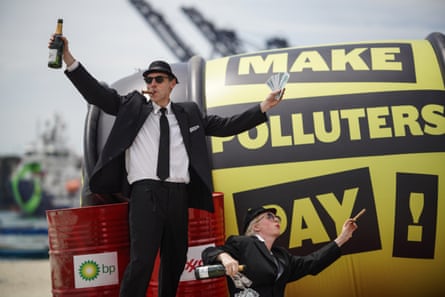
As countries got down to detailed discussions of timetables for action, and boosting low-carbon technologies, one key message emerged from developing countries and finance experts: that addressing debt must be a central plank of any global platform of climate action.
Tzeporah Berman, founder and chair of the Fossil Fuel Treaty Initiative, said: “There are many fossil-fuel producing countries in the global south that are being pushed into expanding fossil fuel production just to feed their debt.
“There is an expanding debt crisis in the global south. It is impossible for countries to even imagine a fossil fuel transition with such limited fiscal space.”
Debt in Africa alone has doubled in the last five years to more than $1tn. Rising interest rates, imposed by central banks to dampen inflation caused in part by fossil fuel crises, are adding to the burden, while soaring fuel and food prices are placing further demands on stricken economies.
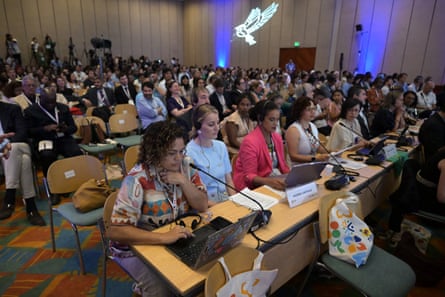
Susana Muhamad, a former environment minister of Colombia, now special envoy of the Fossil Fuel Treaty Initiative, said that countries struggling to make interest payments on their debts could not afford imports such as medicines, fertilisers and technology without the revenues from exporting fossil fuels. “It’s a problem of the economic dependency of the countries on fiscal income, but also the balance of trade, to be able to sustain their economies,” she said.
Many delegates from the global south spoke of similar problems, as high debt repayments have eaten into their foreign exchange reserves and high interest rates have made it more difficult to borrow to invest in renewables. Muhamad said: “I cannot emphasise how important it is that this has been discussed.”
Several civil society activists called for debt forgiveness. Lidy Nacpil, coordinator of the Asian Peoples’ Movement on Debt and Development, said: “We welcome the stance taken by the high-level delegates in Santa Marta, who have acknowledged that a just transition is impossible while global south nations remain shackled by predatory, unsustainable and illegitimate debts. Much of the debt our people are being forced to pay did not benefit them and have in fact caused harm to people and the planet, such as the massive debts arising from fossil fuel projects.”
This conference will not produce new promises of cash for developing countries to help them out of their debt traps and to fund a “just transition” to a low-carbon economy, but it could generate new ideas for financial reforms that would spur investment.
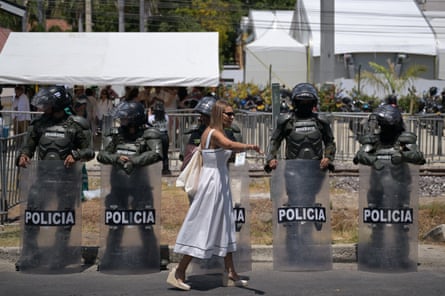
Leo Roberts, acting associate director for energy transition at the E3G thinktank, said: “Santa Marta was never going to be the place to produce a big new number on finance for the transition away from fossil fuels, but it is a space where conversations can take place about, for instance, subsidy reform to take the $1.5tn in [annual] fossil fuel subsidies and repurpose them to somewhere else.”
Nick Robins, senior director for finance and private sector at the World Resources Institute thinktank, said countries should also work to “close off the financial oxygen for fossil fuels”, for instance through reforms to banking regulations. This should include preventing the fossil fuel industry from assessing its own climate risk, he said.